Learning Games Product Guide

10 Best Trivia Games for Kids in 2026: Age-Matched Difficulty

Trivia games where the difficulty actually matches your child's age — knowing which are too hard for a 6-year-old and too simple for a 10-year-old.

10 Best Trivia Games for Kids in 2026: Age-Matched Difficulty editorial illustration

A trivia box marked 'Ages 8+' can stump a ten-year-old with its hardest cards while breezing past a younger sibling with its easiest. The age on the box is a starting point, not a promise — difficulty swings widely from one game to the next.

The more common surprise is quantity. A travel card game with 50 cards wears thin by the third family game night, while a full board game with 1,200 questions stays fresh for months but takes up table space and plays slower.

This guide sorts the field by what matters once the box is open: whether the questions match your child's reading level, how many are left before repetition sets in, and whether the format fits a plane seat or a kitchen table.

#1

Skillmatics Guess in 10 Animal Planet

Skillmatics Guess in 10 Animal Planet

Young kids

Customer rating 4.7/5
Check Price

Worth Noting

  • For an eight-year-old, the answers can become predictable after a few plays
  • The 50-card deck sits on the lean side; weekly households may want a larger question bank than this provides.
Format
Card game, travel
Portable
Yes
Age Range
6+
Questions
50 game cards
Read the full review

Each turn a player asks up to ten yes-or-no questions — habitat, diet, size — to pin down the animal on a clue card. Because the win comes from reasoning through clues rather than recalling facts, a six-year-old can succeed without naming a single species; the thinking does the work. That deductive loop carries real educational value, and the 20-minute rounds fit short attention spans.

The animal theme lands well with the target age, and the wedge-shaped card box slips into a backpack for car trips. Play works for two to six people, so a single child with a parent or a small group of cousins can all join around a table or in the back seat. Conversation drifts toward the animals themselves, turning game time into practice asking smart questions.

The sweet spot is families with kids aged six to eight, especially animal lovers, who want a first trivia game that builds thinking skills rather than testing memory. For older children chasing tougher questions, a question-heavy board game stretches further; this deck plays best as a first trivia game for the younger set.

Save the deck for travel or rotate it with other games to keep the 50 clues feeling fresh.

Bottom line: For families with kids aged six to eight who want a first trivia game that teaches thinking over memorization, this is the natural starting point — and at a budget price, it's easy to try.

#2

Hasbro Trivial Pursuit Family

Hasbro Trivial Pursuit Family

Family game night

Customer rating 4.7/5
Check Price

Worth Noting

  • Fewer cards per category than the 1,200 figure suggests, limiting variety on repeated plays
  • Question difficulty can run uneven
Format
Board game
Portable
No
Age Range
8+
Questions
1,200
Read the full review

Delivers the complete Trivial Pursuit ritual — board, wedges, die, and 1,200 questions split into dedicated kid and adult decks. Teams advance around the printed track rather than just drawing cards, which keeps mixed-age families engaged for a full game night. That structure is what separates it from the compact card-only options here.

Best for families with kids 8–12 who want a structured, sit-down game night rather than quick rounds. Teen and parent teams take the adult deck; younger children should pair with an adult, since some kid-deck questions run hard while adult ones run easy.

Pair each younger player with an adult teammate to keep question levels fair.

Bottom line: Choose this when the night's goal is a seated, team-based board game for kids 8 and up — not quick rounds between errands.

#3

Skillmatics Guess in 10 States

Skillmatics Guess in 10 States

Geography learners

Customer rating 4.6/5
Check Price

Worth Noting

  • When the deduction runs dry, some clue cards offer only thin direction, leaving a solver without a path.
Format
Card game, travel
Portable
Yes
Age Range
8+
Questions
50 game cards
Read the full review

Each of the 50 state clue cards turns US geography into a deductive guessing game: players ask yes-or-no questions, narrow the possibilities, and close on the right state with help from six clue cards. The structure rewards reasoned elimination more than raw recall, which is why it settles at age 8 and up rather than six like the animal-themed opener in this set.

Geography enthusiasts and puzzle-minded 8-to-11s get the most from this edition, and the card-only format travels well for road trips. Because it is an educational product, buyers should keep in mind that a small number of cards have been noted to carry an inaccurate state fact.

Team an 8- or 9-year-old with an adult for the opening rounds — the geography bar runs higher than the box age hints.

Bottom line: Best for geography-loving kids 8 to 11 and families wanting a sharper reasoning challenge over a gentle first trivia game.

#4

Mount Cleverest True or False

Mount Cleverest True or False

Mixed-age groups

Customer rating 4.6/5
Check Price

Worth Noting

  • In compact sizing, card print runs small and slows reading for some eyes.
  • The 300 answers get memorized after several plays, capping long-term replay value.
Format
Card game
Portable
Yes
Age Range
6+
Questions
300
Read the full review

A true/false format gives every player an even shot, so the fast recall of older kids stops being an unfair advantage and teams of adults and children genuinely compete. That inclusive structure suits mixed-age gatherings, travel, and quick family nights where a full board game would drag. The tradeoff sits in replay depth: once the 300 answers get memorized after a few plays, the game loses its surprise. For players who read small print slowly, the compact card size can slow the pace – an adult reading cards aloud keeps everything moving.

Read each card aloud – teams with younger readers stay involved without squinting at the small print.

Bottom line: For big mixed-age groups wanting an inclusive round everyone can join quickly, this earns its spot; expect a few dozen plays rather than an endless bank of questions.

#5

Hasbro Harry Potter Trivia

Hasbro Harry Potter Trivia

Potter fans

Customer rating 4.6/5
Check Price

Worth Noting

  • Compact format ships without a board or scorepad
  • Some questions are demanding enough that casual fans find them near-impossible.
Format
Compact card game
Portable
Yes
Age Range
8+
Questions
600
Read the full review

The 600 questions spanning six Harry Potter categories arrive in a compact wedge case that slips into a bag, giving this set clear travel appeal. It's a card-only design built for quick rounds on the go rather than a spread-out game night.

Best for dedicated Harry Potter fans aged 10 and up who already know the lore. The card-only format carries no board or scorepad, and casual fans can hit questions that feel near-impossible — so this suits lore-lovers wanting a travel-ready set, not young children or newcomers.

Bottom line: The right fit is a dedicated Harry Potter fan who wants portable trivia — the wedge case travels well and the fandom depth rewards those who know it. For a full board-game night, the larger set in this lineup fits better.

#6

Sounds Fishy Party Game

Sounds Fishy Party Game

Older kids

Customer rating 4.7/5
Check Price

Worth Noting

  • Round scoring can get muddled, and groups often simplify or improvise the rules.
  • Demands an inventive bluffing mindset, so it won't satisfy buyers after pure factual trivia.
Format
Party game
Portable
Yes
Age Range
10+
Questions
—
Read the full review

Players invent fake answers to wild trivia questions, then vote on which sounds most real — a contest of creative bluffing rather than pure recall, and a clear turn from the clue-based approach of the top pick. Rounds take about 15 minutes and comfortably host up to 10 players, making each night feel like a group performance.

That creative bent suits older kids and teens who enjoy quick thinking and humor; the scoring rules can get muddled in the moment, so most groups simplify or improvise them as they play. Families expecting straightforward factual trivia will find this hinges on inventiveness instead of knowledge.

Groups get the most fun by simplifying the scoring — treat the points as flexible and let the laughter lead.

Bottom line: Best for older kids and teens who enjoy inventing answers — not a substitute for straightforward facts trivia, but a lively centerpiece for groups that like to bluff.

#7

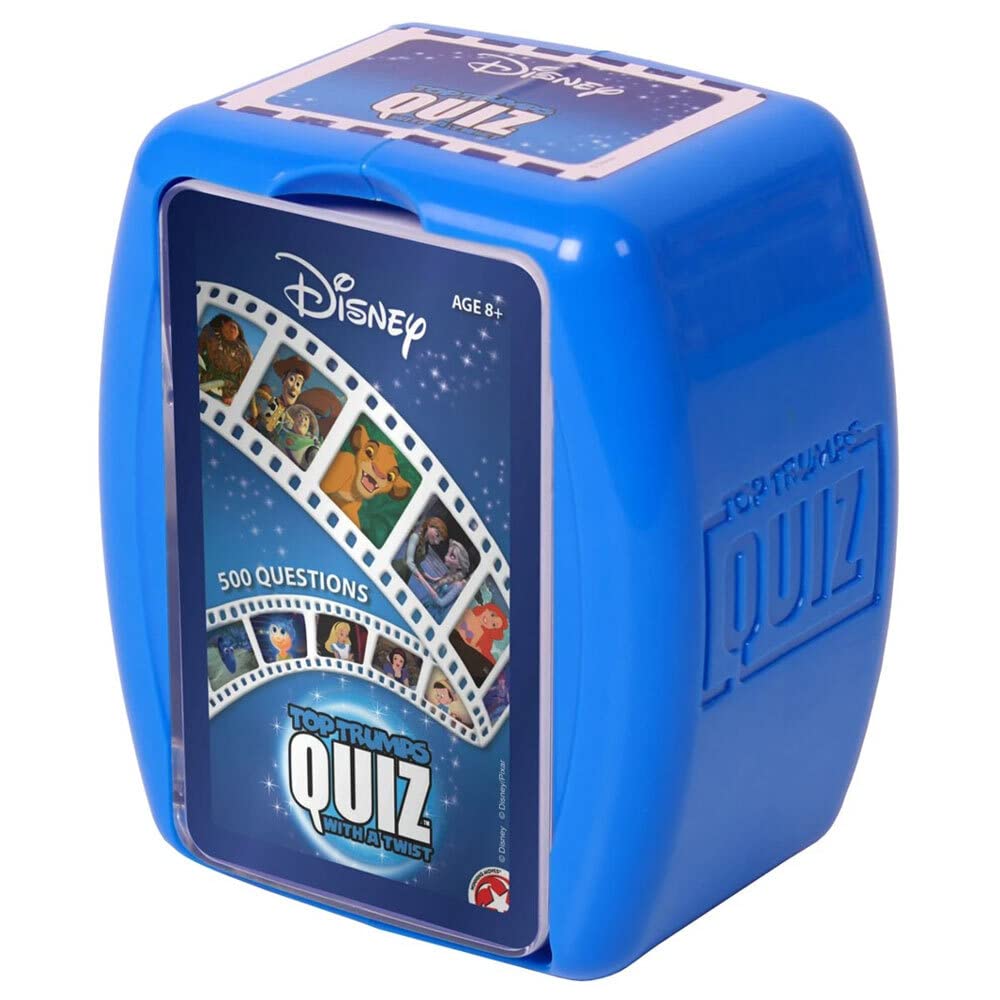
Top Trumps Disney Quiz

Top Trumps Disney Quiz

Disney fans

Customer rating 4.6/5
Check Price

Worth Noting

  • Long-term quality is less certain without verified user feedback
Format
Card game
Portable
Yes
Age Range
6+
Questions
500
Read the full review

For Disney trivia night, this card game delivers 500 questions spanning films like Frozen, Bambi, and Encanto, and its compact format slips into a travel bag or classroom drawer. The catch: without verified user feedback, long-term quality is less certain — a real consideration for families who play weekly.

Bottom line: A themed choice for Disney-fan families or classroom breaks, provided you accept that its long-term performance isn't backed by user reports.

#8

NatGeo Rock Bingo

NatGeo Rock Bingo

Geology buffs

Customer rating 4.6/5
Check Price

Worth Noting

  • Question-based trivia takes a back seat to the broader science-kit format.
Format
Science kit
Portable
No
Age Range
—
Questions
52 trivia cards
Read the full review

Curious kids get hands-on geology with real gemstones, bingo boards, and 52 trivia cards built for bingo, memory, tic-tac-toe, and trivia in one premium-priced box. The toolkit design makes this more science activity kit than pure trivia game, a fit for young rock enthusiasts over families wanting question-based play.

Bottom line: Buy it for a young rock enthusiast who would rather touch and sort minerals than answer questions; pure trivia fans should pick a different game.

#9

All of Us Family Trivia

All of Us Family Trivia

Teens and adults

Customer rating 4.5/5
Check Price

Worth Noting

  • Rated 12+ with questions that can be too hard for kids in the 5–12 range.
Format
Card game
Portable
Yes
Age Range
12+
Questions
480
Read the full review

Spans four generations with 480 questions in a timer-and-scoreboard format, covering kids through grandparents in one box. However, the 12+ rating and some difficult questions place it outside the 5–12 group this search targets, so it works best when teens and adults carry the session.

Bottom line: Best for teen-and-adult family nights where older players carry the difficulty, not for a kids-only trivia session.

#10

Quokka What Would You Choose

Quokka What Would You Choose

Silly laughs

Customer rating 4.6/5
Check Price

Worth Noting

  • Some copies arrive without an instruction sheet, which can stall the first family game night.
Format
Card game
Portable
Yes
Age Range
5–12
Questions
500+
Read the full review

The 500+ dilemma prompts turn family game nights into lively conversation, and the sturdy cards survive repeated road-trip shuffling. But this is a preference game, not a knowledge-based trivia game — buyers expecting fact-recall questions will find quirky scenarios instead, which suits laughter-focused families better than quiz-focused ones.

Bottom line: Reach for this when the family wants to chat and laugh through a journey — a good match for road trips and casual game nights.

How to Choose

Match the Age to the Player

The stated age range is a floor, not a calibration. A game labeled 6+ still assumes basic reading fluency and general knowledge, so a five-year-old leans on a parent for most cards while an eight-year-old finds the same questions too easy. Two siblings two years apart can experience the identical box completely differently.

Question Count Matters

Enough cards keep answers from becoming predictable. A set with 50 cards cycles through every question within two or three game nights, and by the fourth the correct responses are memorized. Games with 500 or more questions keep the same box interesting for months, which separates a one-weekend novelty from a regular rotation item.

Pick the Right Format

Format decides how the game actually gets played. A full board game brings physical pieces, a scoring track, and a set ritual that anchors a traditional game night, but it needs table space and a longer time commitment. A compact card game trades those trappings for instant setup and portability.

The hidden trade-off: many travel card games omit boards and scoring pieces entirely, which surprises buyers expecting the full board game experience. Decide up front whether you want the ceremony or the convenience.

Look at the Subject Focus

The subject determines what your child actually learns. An animal-themed guessing game builds reasoning and deduction, a geography version teaches state facts, and a general-knowledge game spreads bits across science and history. Treat 'educational' as a marketing word — factual errors do slip into otherwise strong titles, so scan recent reviews for accuracy complaints.

Portability Weighs In

A truly portable game fits in a backpack and survives a car ride without losing pieces. Card games in tins or wedge cases travel well; board games with tokens and boards do not. If the game is meant for restaurants, planes, or road trips, the lighter the better — for home game night, weight is irrelevant.

Frequently Asked Questions