Learning Games Product Guide

10 Best Phonics Games for Kindergarten 2026: That Teach Blending

Which kindergarten phonics games teach real letter-sound blending and CVC word building, versus ones that only drill recognition.

10 Best Phonics Games for Kindergarten 2026: That Teach Blending editorial illustration

Walk down the phonics aisle and you'll find plenty of boxes stamped 'phonics' that actually teach something narrower: sight-word recognition or plain letter names. For a kindergartner, the skill that matters is blending — pulling letter sounds together into words. That distinction shapes every pick here.

The games that get blending right usually build it on top of letter-sound basics, with a second difficulty level that stretches the same set from ABC recognition into CVC words. That two-stage structure is what makes one purchase last from pre-K through first grade, rather than a single-skill toy your child boxes up within weeks.

Component durability decides whether the game survives. Thin cardstock buckles under enthusiastic four-year-olds, while thick board or wooden tiles hold up across years of reuse — and most games in this range cost enough that you want them to last.

#1

Alphabet & Phonics Bingo

Alphabet & Phonics Bingo

Whole-class phonics

Customer rating 4.8/5
Check Price

Worth Noting

  • Thin cardstock markers can show wear under very heavy daily classroom use by rough handlers.
Player Count
2 to 24
Phonics Scope
Letters to CVC blends
Difficulty Levels
2 levels, ABC to CVC
Component Durability
Thin cardstock
Read the full review

Two built-in difficulty levels and a 2–24 player range stretch this bingo set from pre-K letter recognition through first-grade CVC blending — a single purchase that grows with a child instead of being outgrown. Matching 26 alphabet cards and 26 phonics cards against 192 words and images, one game covers the full progression from letter-sound relationships to word building that kindergarteners actually need, where a CVC-only tile game would stop early. Because it's bingo, every player stays active matching and flipping markers rather than waiting for a turn.

This is the pick for kindergarten classrooms and large groups up to 24 children, where the two difficulty levels let one teacher run the same game for kids at different reading stages. It delivers the letter-sound, blending, and word-building practice ages 4–6 need from a single box, so families skip a separate letter game and a separate CVC game. The genuine tradeoff sits with the thin cardstock markers: they hold up under regular classroom pacing, but very rough daily handling by small hands can accelerate wear.

Laminate the cardstock markers before heavy daily use to protect them from small-hand wear.

Bottom line: For a parent or teacher who wants one game to carry a child from letter sounds through CVC blending, this is the purchase that grows with the reader.

#2

Alphabet Bingo

Alphabet Bingo

Letter name basics

Customer rating 4.8/5
Check Price

Worth Noting

  • Skill growth stops at letter recognition
Player Count
2 to 6
Phonics Scope
Letter recognition
Difficulty Levels
Single level
Component Durability
Thick boards
Read the full review

Cooperative play modes set this bingo apart — pairs, small groups, and solo play all reinforce letter names and sounds without competitive pressure, while the thick double-sided boards hold up to repeated small-hand use across family-heavy evenings.

Fits pre-K and early-kindergarten learners making their first contact with letters — a gentle, low-stakes family activity. Its focus stays at letter recognition with no blending or CVC coverage, so it works as the pre-reading foundation before the full-arc top pick takes over.

Bottom line: A calm, cooperative first board game for letter-name beginners — pair it with the top pick's blending arc when kids are ready.

#3

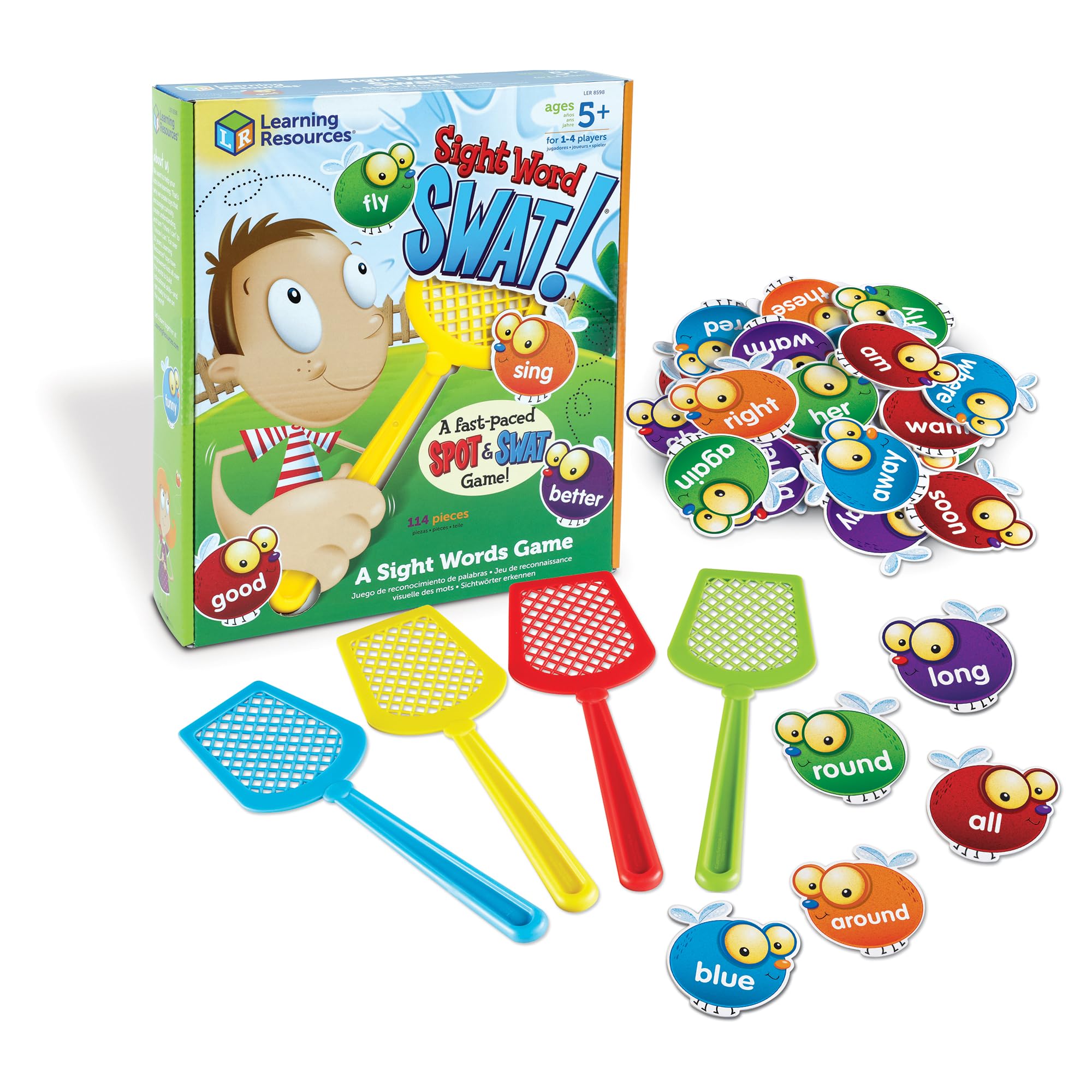
Sight Word Swat

Sight Word Swat

Active word practice

Customer rating 4.8/5
Check Price

Worth Noting

  • Color-coded level labels can feel arbitrary when a child's true skill doesn't match the tier
Player Count
Up to 4
Phonics Scope
Sight-word recognition
Difficulty Levels
5 color-coded levels
Component Durability
Sturdy wands
Read the full review

Two hundred twenty Dolch sight words across five color-coded levels fuel a fast-swatting race that builds word-recognition fluency for up to four players — no batteries, durable wands, and budget-friendly pricing for a 220-word library.

This is a recognition tool, not a blending or phonics game, so it suits readers already comfortable with letter sounds who need automatic sight-word recall; teachers running small-group drills get the most value, while families wanting CVC decoding should look to the phonics arc game instead. Color levels progress from pre-primer to second grade, though the mapping between color and a child's true skill can feel arbitrary to some caregivers.

Preview a few flies at each color level first — a child's true skill may not match the labeled tier.

Bottom line: Best for teachers running small-group drills who want children to build automatic sight-word recall — active, budget-friendly, and best paired with a separate phonics program.

#4

Zingo Word Builder

Zingo Word Builder

Premium CVC building

Customer rating 4.7/5
Check Price

Worth Noting

  • At a premium price, the core mechanics mirror cheaper CVC sets, so budget shoppers can find equivalent practice for less.
Player Count
2 to 6
Phonics Scope
CVC word building
Difficulty Levels
2 levels
Component Durability
Plastic tiles
Read the full review

Two difficulty levels let the same game serve first-word beginners (ages 5) and readers ready for spelling patterns, while the Zinger's spring-loaded dispenser shoots out a double-sided letter tile kids race to match on their card. The payoff is stealth learning — building CVC words and spelling patterns through pure game instinct. Component quality stands out, with thick cards and a chunky dispenser that survive repeated rounds.

Best for families who want a polished, award-winning literacy toy that siblings and adults join in on, and for gift-givers trading up on components. At a premium price, the core CVC mechanics echo cheaper puzzle sets, so budget shoppers can get equivalent practice for less elsewhere.

If the Zinger sticks mid-round, a gentle tap on the dispenser clears the tiles — play resumes within seconds.

Bottom line: A durable, polished CVC builder that rewards families who value components and replay; budget buyers should look at simpler puzzle sets first.

#5

Snap It Up Phonics

Snap It Up Phonics

Word-family speed

Customer rating 4.7/5
Check Price

Worth Noting

  • Thin instructions can need adult interpretation on the first play
Player Count
Up to 6
Phonics Scope
Word families, CVC
Difficulty Levels
Single level
Component Durability
Standard cards
Read the full review

Snap It Up Phonics turns decoding into quick-fire rounds: players race to spot word-family and CVC blends in their hands and snap up the matching card. Unlike the same brand's Sight Word Swat, which leans on physical movement and sight-word recall, this sits at the table and drills the vowel and word-family patterns that build real decoding speed.

This is the right pick for kindergartners and first-graders who already know their letter sounds and want to blend word families fast — small-group classroom centers are its natural home. It is not for absolute beginners who haven't mastered letter recognition, and the 6+ rating edges it toward first-grade territory. The rules are thin enough that an adult will likely interpret them on the first play, and the budget price and six-player cap make it easy to slot into a rotation.

Bottom line: For a reader past letter basics, this is the budget, six-player way to build word-family speed — plan to walk through the rules once before turning kids loose.

#6

Coogam CVC Spelling

Coogam CVC Spelling

Tactile CVC practice

Customer rating 4.7/5
Check Price

Worth Noting

  • Cardstock flashcards crease more easily than the wooden tiles under rough handling
Player Count
Solo or small group
Phonics Scope
CVC word building
Difficulty Levels
Single level
Component Durability
Wooden blocks
Read the full review

Fifty-eight smooth linden-wood letter blocks and fifty CVC cards make reading a hands-on, screen-free activity. Kids sort and spell words on five wooden trays, and each card self-checks by revealing the correct answer only after a word is built. The tactile feedback holds attention where flashcard drills lose it.

This suits tactile and kinesthetic learners in homeschool setups or small-group classroom phonics centers who need physical manipulation to lock in letter-sound pairings. It is a solo or small-group activity rather than a group competitive game, so families after a game-night option should look to the bingo-style picks instead.

Bottom line: Tactile learners in small-group settings get a durable, self-verified CVC builder here; families wanting a group game should pick the bingo-style option instead.

#7

Match It! Letters

Match It! Letters

Independent word building

Customer rating 4.8/5
Check Price

Worth Noting

  • For a child just starting to blend, some words like 'ice' and 'pie' run past their vocabulary.
Player Count
Solo play
Phonics Scope
CVC spelling
Difficulty Levels
Single level
Component Durability
Durable cardboard
Read the full review

This budget set of 20 CVC word puzzles uses self-correcting pieces so a child confirms the answer before an adult checks, reinforcing sounding out without supervision. It targets solo practice rather than group rounds, making it a fit for independent learners and quiet centers.

Bottom line: A low-cost pick for quiet independent practice at home or classroom centers, where self-correction matters most.

#8

Gojmzo CVC Spelling

Gojmzo CVC Spelling

Wooden CVC alternative

Customer rating 4.7/5
Check Price

Worth Noting

  • A missing 'y' tile leaves 'boy' or 'yes' unbuildable when a child reaches for them
Player Count
—
Phonics Scope
CVC word building
Difficulty Levels
Single level
Component Durability
Wooden tiles
Read the full review

Wooden letter tiles and thick laminated CVC cards hold up to small-group center rotations, giving tactile learners a hands-on spelling kit. Word coverage can vary per set, since some units arrive short a 'y' or 'q'. That inconsistency keeps it behind the more consistent wooden set, though the play itself stays sturdy.

Bottom line: Best for a literacy center that keeps several spelling kits in rotation, once the letter contents are verified before first use.

#9

Word Pop

Word Pop

Multi-sensory fidget

Customer rating 4.6/5
Check Price

Worth Noting

  • Engagement dips once the core CVC set is mastered, limiting replay value for quicker readers.
Player Count
Up to 4
Phonics Scope
CVC blending
Difficulty Levels
Single level
Component Durability
Plastic pop-its
Read the full review

The pop-it boards layer sight, sound, and touch onto CVC blending, keeping fidget-prone kindergarteners engaged while matching Science-of-Reading methods. It performs well as a small-group center activity, but font mismatches between boards and cards can trip up early readers still learning letter shapes.

Bottom line: Best for fidget-prone learners who need tactile engagement to stick with CVC practice — less suited once a child has moved past basic blending.

#10

Sentence Building Game

Sentence Building Game

Sentence-level literacy

Customer rating 4.7/5
Check Price

Worth Noting

  • Card pieces run small enough to frustrate little hands and kids with motor delays
Player Count
—
Phonics Scope
Sentence building
Difficulty Levels
Single level
Component Durability
Small cards
Read the full review

Interlocking puzzle pieces turn known words into full sentences, teaching capitals and punctuation playfully — a genuine next step for readers past letter sounds. It is not a blending or CVC tool, though, so it belongs as a follow-on purchase, and the card pieces run small for little hands.

Bottom line: Best as a follow-on purchase once a child has letter sounds down — ideal for homeschool or classroom early-writing work, not for beginners.

How to Choose

Phonics Scope

The word 'phonics' gets applied loosely. A game that has kids match letters to pictures builds alphabet recognition; the skill that unlocks reading is blending — sounding out individual letters and merging them into a word. If a box promises CVC (consonant-vowel-consonant) words, you're getting real decoding practice; if it pushes sight words, you're drilling memorized recognition instead.

Ask what the child actually does during play. Swatting a printed word teaches recognition. Dragging wooden letters to form 'cat' forces the brain to blend 'k' plus 'a' plus 't'. Match the mechanic to the skill your kindergartner needs next.

Player Count

Player count determines whether the game fits your table. A 2–4 player set works for one child plus a parent, but it stalls when a classroom of 20 needs a single instruction. Games that scale to 20-plus players let a teacher run one warm-up and have every child working at the same time — a genuine time-saver that justifies the higher price.

Difficulty Levels

Single-level games teach one skill and get boxed once that skill clicks. A two-stage design that moves from ABC recognition into CVC blending keeps the same set relevant across pre-K, kindergarten, and even first grade — effectively three purchases' worth of practice in one box. The trade-off is complexity: more stages mean more rules to explain to a young child.

Component Durability

Four- and five-year-olds drop, bend, and occasionally stomp on game pieces. Thin cardstock buckles within weeks; thick board, plastic tiles, or wooden blocks survive years of daily reuse. The price difference between a flimsy budget set and a sturdy mid-range one is smaller than the cost of replacing the flimsy set twice.

Self-Correcting Feature

Self-correcting pieces — where a letter only fits the correct slot — give a child instant feedback without an adult hovering. That independence builds confidence, but it also means the game is best for solo or quiet-time practice. For group play, a matching mechanic or a judge keeps more kids engaged at once.

Frequently Asked Questions