Learning Games Product Guide

10 Best Geography Games for Kids of 2026: Right Age, Right Scope

Which geography games actually match your kid's age and learning focus — and which skip key countries or break after months of play.

10 Best Geography Games for Kids of 2026: Right Age, Right Scope editorial illustration

Geography game shelves lean toward either US-focused titles that cover states well but stop at the border, or world maps that quietly drop smaller countries to fit the board. The interactive globes in between look impressive, but they rely on hardware and companion apps that can stop working a few months in.

Board, card, and puzzle formats sidestep those electronics, and the strongest ones adjust difficulty so the same game stays useful as kids grow. Matching the game to your kid's age and to a US or world focus is what turns a geography game into something a family actually returns to instead of a one-time novelty.

A 7-year-old needs chunkier, hands-on geography; a 12-year-old can handle strategy and rulebooks. Picking for the wrong end of that range is the most common reason a geography game ends up in the closet.

#1

Race Across USA

Race Across USA

Elementary school kids

Customer rating 4.7/5
Check Price

Worth Noting

  • Occasional misprinted cards can surface in a fresh box.
  • Easy-deck questions can feel too simple for older players.
Age Range
8+
Game Type
Board game
Geographic Scope
US
Educational Focus
State facts, locations
Read the full review

Two difficulty levels let a single board game engage an 8-year-old and a 12-year-old at the same table, and the 20-minute playtime keeps family game night from dragging. State facts, capitals, and locations surface through light competition, pairing each round with real geography recall rather than rote drill. The straightforward rules keep the learning goal front and center even in casual play, and repeated rounds show the geography sinking in without feeling like homework.

This is the natural pick for elementary-age kids, family game nights, and classroom use. The easy deck skews toward younger players, so a 12-year-old will lean on the harder deck for a stronger challenge — that tradeoff is the reason one box serves such a wide age band. Families wanting deeper strategy in a longer session will find it in the national-park-themed board game in this set, which asks for older players and a bigger time commitment. Race Across USA instead covers the widest age range among the geography board games here at a mid-range price.

Let older kids run the harder deck from the start — the easy questions are aimed at younger players.

Bottom line: The two-deck design gives one box the widest age appeal among the board games here, making it the natural centerpiece for mixed-age family nights.
#2

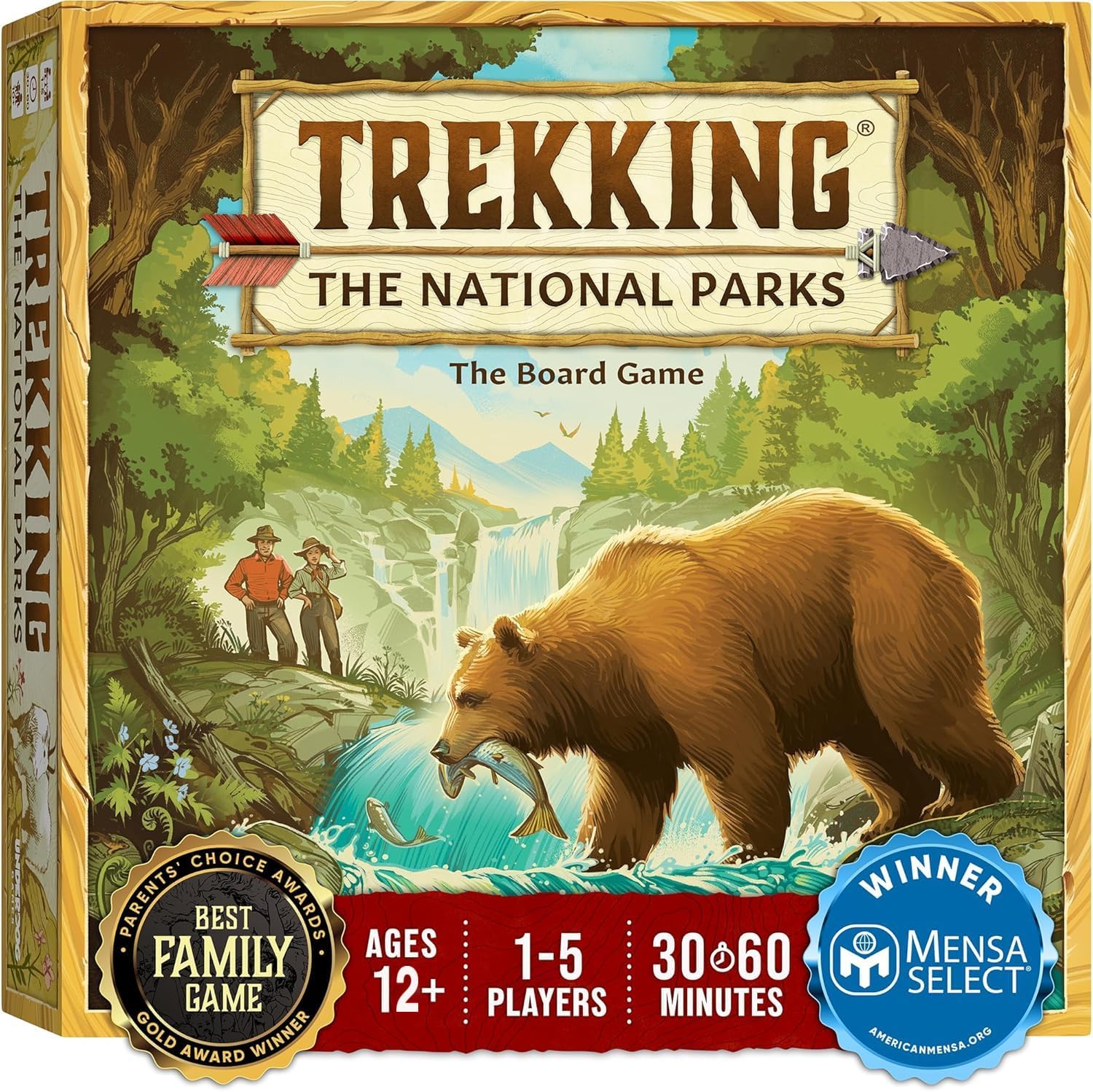
Trekking Nat. Parks

Trekking Nat. Parks

National park fans

Customer rating 4.7/5
Check Price

Worth Noting

  • A full session runs about 45 minutes, longer than quick rounds.
  • In mixed-age households, the 12+ rating keeps younger kids out.
Age Range
12+
Game Type
Strategy board game
Geographic Scope
US parks
Educational Focus
Park facts, geography
Read the full review

Trekking The National Parks trades the light pacing of the family geography game for real strategic weight — route-building, scarce park cards, and multiple paths to victory reward planning over trivia recall. The 45-minute sessions and 12+ rating suit teens and adults who enjoy decisions with consequences, plus national parks enthusiasts who will savor the destination cards.

This one fits game-night households with older kids and up, where a 45-minute session is the point of the evening. The rulebook can trip up first-time players and the 12+ floor leaves younger siblings on the sidelines — boundaries to weigh, though the layered play rewards the setup.

Walk through the rulebook once before game night — the scoring clicks after a turn or two, and the game flows smoothly.

Bottom line: For game-night families with older kids who want strategy over trivia, the national parks theme and route-building depth make the longer session worthwhile.

#3

World Game Card Game

World Game Card Game

World geography learners

Customer rating 4.6/5
Check Price

Worth Noting

  • In a group, the compact cards can be hard to read at a glance.
  • Occasional fact cards carry arbitrary or incorrect details
Age Range
8+
Game Type
Card game
Geographic Scope
World
Educational Focus
Flags, capitals, locations
Read the full review

Covering all 194 countries across flags, capitals, and locations, this is the only option in the lineup that treats world geography as complete — the budget foam puzzle skips the smaller nations entirely. Difficulty scales with a toggle, so a beginner and a seasoned traveler can share one game.

Built for classroom use, travel, and anyone chasing complete world coverage, the 2-5 player count and 8+ floor sit comfortably on family tables. This suits learners who want the full map over trivia purists hunting verified facts — the flexible difficulty is the real draw here.

The compact deck fits a coat pocket, so it travels easily between car and table.

Bottom line: Best for the classroom or travel bag where full world coverage matters more than a US focus — the complete-map play is its whole reason to exist.

#4

Magnetic US Map Puzzle

Magnetic US Map Puzzle

Preschool & kindergarten

Customer rating 4.6/5
Check Price

Worth Noting

  • Pieces can slide on vertical fridge surfaces
  • The top layer may peel at the edges with rough handling.
Age Range
4+
Game Type
Magnetic puzzle
Geographic Scope
US
Educational Focus
State names, landmarks
Read the full review

43 magnetic pieces that mount on fridge or whiteboard bring US geography to a preschooler's daily line of sight. No reading is needed — little hands match state shapes by sight, building the map while an adult cooks nearby.

This is the map for toddlers and early-elementary kids, and for homes where learning lives on the wall rather than the table. A 4-year-old can sort states by shape and assemble the whole map independently. Best results come from a smooth whiteboard over a vertical fridge door.

Press each piece flush onto a smooth whiteboard so the magnets engage fully.

Bottom line: A toddler's first US map — keep it on a flat whiteboard where the magnets hold and states stay in daily sight.

#5

Guess in 10 US States

Guess in 10 US States

Family road trips

Customer rating 4.6/5
Check Price

Worth Noting

  • For a 6-8 year old, question difficulty can outpace the age label
  • Occasional cards carry factual errors, so answers are best verified against a map.
Age Range
8+
Game Type
Card game
Geographic Scope
US
Educational Focus
State facts
Read the full review

50 quick guessing cards in a compact box play a full round in 20 minutes, making this the most travel-friendly option in the set — small enough for a plane tray or a car seat. The clue-based mechanic teaches state facts through recognition, not spatial map learning. It fits families who want a light, portable game for road trips, game nights, and classroom ice-breakers rather than serious geography study. For a 6-8 year old, question difficulty can run ahead of the age label, so it suits older kids or mixed-age teams where an adult lends a hand, and occasional fact errors are worth double-checking against the complete-world pick's coverage.

Bottom line: For a family that wants a fast, packable state-trivia option between road stops, this is the pick — just keep a map handy to double-check the occasional card.

#6

Mapology USA Puzzle

Mapology USA Puzzle

Tactile learners

Customer rating 4.5/5
Check Price

Worth Noting

  • In hands used to interlocking cardboard, the foam pieces feel lighter and less premium
  • Capital flags can leave kids guessing which state each one marks
Age Range
5+
Game Type
Foam puzzle
Geographic Scope
US
Educational Focus
States, capitals, facts
Read the full review

Fifty state-shaped foam pieces build a full US map by hand, with capital flags placed where kids think they belong — a self-paced alternative to the board-game timing of the top pick. The map fills in spatially as pieces go down, which is how hands-on learners lock in state capitals for elementary and homeschool study. The mid-range price fits classrooms drilling recitation. Foam feels lighter than interlocking cardboard, so premium-puzzle users notice the difference, and the flags reward kids who reason through where each capital sits rather than guess-checking an answer key.

Encourage kids to reason through where each capital flag sits — the guesswork becomes the lesson.

Bottom line: For tactile learners and homeschoolers, building the map by hand locks in state capitals — the lighter foam feel is the only real concession to get there.

#7

DIGOBAY World Puzzle

DIGOBAY World Puzzle

Visual learners

Customer rating 4.7/5
Check Price

Worth Noting

  • Teaches visual country placement only
Age Range
4-8
Game Type
Floor puzzle
Geographic Scope
World
Educational Focus
Continents, countries
Read the full review

Thick, sturdy cardboard pieces assemble into a 22.8-inch round world map that young visual learners enjoy piecing together. The challenge fits ages 4-8 well. Unlike the card and board games in this set, it builds place recognition rather than facts — no flags, capitals, or trivia — so fact-hungry families will want a game alongside it.

Bottom line: Best as a hands-on floor puzzle for visual learners ages 4-8 who prefer building to question-and-answer play.

#8

Momo & Nashi US Puzzle

Momo & Nashi US Puzzle

Budget-minded families

Customer rating 4.5/5
Check Price

Worth Noting

  • Under regular play, some chipboard pieces can warp or peel along the edges.
Age Range
4-8
Game Type
Floor puzzle
Geographic Scope
US
Educational Focus
States, capitals
Read the full review

At a budget price, this floor puzzle brings 70 large, colorful chipboard pieces teaching states and capitals, with bright colors supporting recognition and recall for young kids. The limitation: pieces do not interlock firmly, so a finished map can shift with movement — suited to calm seated play rather than kids who like to pick the completed puzzle up.

Bottom line: Best for budget-minded families with young kids who stay seated while playing — the loose fit only becomes an issue once the finished map is moved around.

#9

100 PICS Flags

100 PICS Flags

Flag fans

Customer rating 4.6/5
Check Price

Worth Noting

  • Slider mechanism can wear down with rough handling, making cards harder to advance.
Age Range
6+
Game Type
Flash card game
Geographic Scope
World
Educational Focus
World flags
Read the full review

100 PICS Flags fits 100 world flags into a slide-reveal case that slips into a pocket, making flag recognition a quick pick-up-and-play habit. Its scope stops at flags — no locations or capitals — and the photo cards run business-card size.

Bottom line: For flag-memory drills, stocking stuffers, or road trips, this is a budget fit — provided kids treat the slide case gently.

#10

Mapology World Puzzle

Mapology World Puzzle

Country-shape learners

Customer rating 4.5/5
Check Price

Worth Noting

  • Smaller countries aren't included, so the puzzle leaves visible gaps in world coverage.
Age Range
5+
Game Type
Foam puzzle
Geographic Scope
World
Educational Focus
Flags, capitals, shapes
Read the full review

75 country-shaped foam pieces with 65 flag stickers give young kids a hands-on way to learn where nations sit, at a mid-range price that suits budget-minded families. The foam holds up to small hands, though it feels less premium than cardboard. Small countries are omitted, so this works best as a starter puzzle.

Bottom line: Works best as an introduction to country shapes for the 5-7 crowd; skip it if you need a complete world map.

How to Choose

Match the Age Range

Age ratings track reading level and attention span more than geography knowledge. Card and board games rated 8+ expect fluent reading of state and country names, while strategy titles marked 12+ ask players to hold multiple win conditions across a 45-minute session.

A 6- or 7-year-old recognizes shapes before reading names, so a magnetic or floor puzzle fits better than a trivia deck. For kids 10 and up, a trivia-capped game feels shallow within a few plays.

Choose the Game Type

Electronic and AR formats pack the most content, but every quiz runs through a stylus, touch sensor, or companion app. When one of those fails, the whole product goes quiet, and there is no repair path for a consumer toy.

Board, card, and puzzle formats have no firmware to crash and no app to abandon. A card deck missing a card still plays; a puzzle with a chipped piece still teaches.

US or World Scope

World-scope games advertise completeness, but a fixed puzzle frame or 50-card deck cannot render every small nation at legible size. Most 'world' products quietly drop countries like Ukraine or much of Central America.

Check the included regions if global awareness is the goal. If the goal is solid US state knowledge, a US-focused game covers all 50 states honestly and is often the better fit for elementary-age kids.

Players and Playtime

Playtime sets whether a game actually gets played. A 20-minute card game suits a road trip but ends too fast for a family game night, and a 2-6 player limit leaves larger families fighting over turns.

A 45-minute strategy game demands longer attention, so it only works when the youngest player can sit through it. Match session length to the kids at the table.

What It Actually Teaches

Not all geography games teach the same skill. Flag quizzes and trivia cards train recognition — a child can name all flags yet still not place those countries on a map.

Puzzles with country- or state-shaped pieces build spatial reasoning and relative location, which is the core of map sense. Pick the skill you want first: recall for quiz day, or a mental map that lasts.

Frequently Asked Questions