Learning Games Product Guide

10 Best Emotion Regulation Games for Kids of 2026: Real Age Fit

Emotion regulation games that actually match your child's developmental stage — and hold up through repeat play, not just the first round.

10 Best Emotion Regulation Games for Kids of 2026: Real Age Fit editorial illustration

Emotion regulation games promise to teach big feelings through play, but the category has a two-sided problem. Many listings advertise a wide 'kids and teens' range while actually suiting a narrow slice, and several of the most-praised games pair thoughtful questions with boards or blocks that don't survive regular use.

The fix is to judge curriculum and components separately, and to trust detailed age specs over the headline. This guide sorts the strongest options by the child's actual stage — first emotional words for toddlers and preschoolers, structured CBT conversation for elementary kids, and deeper clinical tools for teens.

Whatever the format, the best games earn their keep by getting played again next week, not just on the first night. The picks here balance question quality, build durability, and replay depth so you know what you are actually buying.

#1

PlayTherapySupply CBT 123

PlayTherapySupply CBT 123

Kids 7-15

Customer rating 4.5/5
Check Price

Worth Noting

  • After several sessions the prompts begin to repeat, so dedicated players will want an expansion pack
Age Range
7-15 years
Component Count
—
Format & Players
Card, 2-4 players
Therapy Approach
CBT
Read the full review

A 7-15 age span with 15-20 minute rounds gives this deck the broadest reach in the set, fitting a counseling session, a classroom SEL block, and an after-dinner family round equally well. The updated v2.0 edition ships 80% more cards than the original, and kids who resist talking about feelings keep returning to the deck on their own. Gameplay makes the link between thoughts, feelings, and actions visible in each round, turning an abstract concept into something players see and react to.

The deck functions as an icebreaker in small groups, where children who struggle with verbal expression engage more easily with cards than with direct questioning. That practical edge carries into classrooms and youth groups, not just one-on-one sessions, which is where the game's broadest value shows up.

School counselors, therapists, and parents of kids 7-15 are the natural audience — anyone who wants an established CBT tool that plays more like a game than a lesson. Repeat players will outpace the deck's prompts after several sessions and want an expansion pack to keep the material fresh.

Bottom line: For kids 7-15 who need a CBT conversation tool that actually draws them in, this deck is the set's strongest fit across home, classroom, and therapy.

#2

LR Feelings Puzzle Cards

LR Feelings Puzzle Cards

Toddlers, preschool

Customer rating 4.7/5
Check Price

Worth Noting

  • Not for kids past six who want multi-round board or card gameplay
Age Range
3-6 years
Component Count
48 pieces
Format & Players
Puzzle cards, solo
Therapy Approach
General SEL
Read the full review

Self-correcting puzzle shapes and real-life photos make emotion-to-face matching a durable, independent activity for kids as young as three. Where the classroom board game in this set redraws its surface for group turn-taking, this matching format lets one child work through all 24 double-sided puzzles solo.

This one suits toddlers and preschoolers meeting emotion words for the first time, plus preschool classrooms and Montessori learning corners. It's a matching activity rather than a multi-round game, so children much past six should graduate to a facilitated conversation set.

Bottom line: For toddlers and preschoolers ready to name what a face feels, this self-correcting set supplies the foundation no card game can.

#3

CBTiger Therapy Game

CBTiger Therapy Game

Group therapy

Customer rating 4.5/5
Check Price

Worth Noting

  • Counselor-style prompts mean casual family nights can feel more clinical than playful.
Age Range
6-12 years
Component Count
—
Format & Players
Go-Fish, 2-4 players
Therapy Approach
CBT, ABCD model
Read the full review

High-grade cards and adorable animal art make CBTiger play like a game rather than a lesson, with a clear 14-emotion ABCD curriculum that keeps kids requesting rounds. Next to the wider-age pick in this set, it gives up some age range for child-appealing components.

The right fit is a therapist or counselor running group sessions with kids 6-12, where prompts carry psychoeducation and rapport-building. The prompt style is tuned for counselor-led play rather than casual family nights, so home buyers should reach for the top pick instead.

Bottom line: For a professional or parent running guided CBT-style play, CBTiger pairs eye-catching cards with a curriculum kids genuinely enjoy.

#4

hand2mind Memory Match

hand2mind Memory Match

Budget quick use

Customer rating 4.7/5
Check Price

Worth Noting

  • Memory-match format offers little scenario depth beyond the recognition prompt.
Age Range
5-12 years
Component Count
80 tiles
Format & Players
Memory match
Therapy Approach
SEL, empathy
Read the full review

The 80 full-color tiles deliver a double payoff: they show that one emotion can look different on different faces while giving young players a satisfying matching goal. Twenty color-coded feelings keep rounds brisk, and the Getting Started guide gets a therapist up and running within minutes — a budget-friendly, reusable activity built for counseling sessions rather than weekly game night.

Social workers, counselors, and preschool-elementary teachers can run it as a session warm-up or wrap-up, and it pairs naturally with children on the autism spectrum. Buyers wanting guided back-and-forth discussion will find the recognition prompt too light.

Bottom line: The right buy for counselors and teachers who need a quick, reusable recognition activity — skip it if guided family conversation is the goal.

#5

Don't Go Bananas

Don't Go Bananas

Family cooperative

Customer rating 4.3/5
Check Price

Worth Noting

  • Rules take a learning curve to parse on the first read, often requiring a simplify-before-play pass.
  • A few prompt cards phrase feedback in a way that can read as judgmental to sensitive kids.
Age Range
6-12 years
Component Count
—
Format & Players
Card + board, 2-4
Therapy Approach
CBT, 5 emotions
Read the full review

Where the set's other games have players compete to be first, Don't Go Bananas makes the whole table work together — kids coach each other through anger, worry, fear, sadness, and jealousy using the CBT ABCD model, so social skills and coping strategies grow side by side.

Best for a family with two to four elementary kids, or a counselor running an SEL session, it keeps younger 6- to 8-year-olds engaged without feeling like a lesson. The tradeoff: rules aren't obvious on the first read-through, and a few prompt cards phrase feedback in ways that can land as judgmental — worth checking the wording before you play with sensitive groups.

Bottom line: Right for families and counselors who want collaborative, game-like emotional practice and don't mind a quick rule look-up before the first round.

#6

Emotional Rollercoaster

Emotional Rollercoaster

Anger focus

Customer rating 4.5/5
Check Price

Worth Noting

  • Flimsy board may tear along its fold during first setup
Age Range
4-12 years
Component Count
—
Format & Players
Board, 2-6 players
Therapy Approach
Anger, mindfulness
Read the full review

Purpose-built for families and classrooms targeting anger, Emotional Rollercoaster pairs I-statement practice with breathing exercises no other pick in this set teaches. The curriculum is the strongest anger-specific offering here, though the small pieces need supervision and a board tear may appear while setting up — a harder pill to swallow at this price.

Bottom line: Choose it when anger-specific coping is the goal and play stays supervised — not for families needing a hard-wearing board.

#7

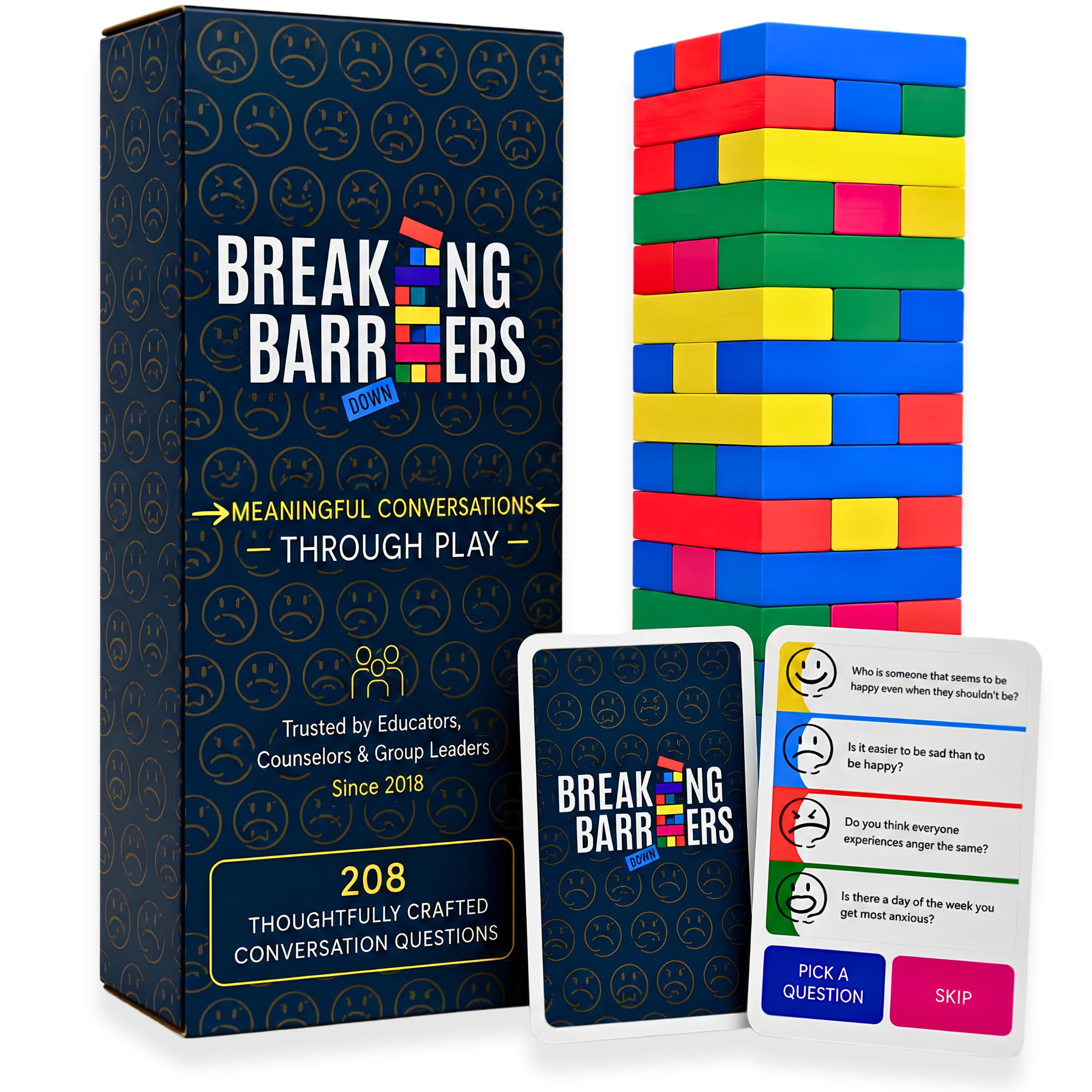
Therapy U Breaking Barriers

Therapy U Breaking Barriers

Deep discussion

Customer rating 4.6/5
Check Price

Worth Noting

  • Paint chipping and uneven block edges vary between units, affecting the game's feel and longevity.
Age Range
4+ years
Component Count
208 prompts
Format & Players
Jenga-style, up to 6
Therapy Approach
Emotion, social skills
Read the full review

The deepest question set in this lineup for conversation-rich play: 208 prompts across six players consistently draw out genuine sharing and perspective-taking in therapy and family settings alike. The wooden blocks are the tradeoff — uneven and slick, so the tower leans and falls during play; substituting a standard Jenga set is a possible workaround to keep the prompts.

Bottom line: Best for therapists and conversation-focused families who prize dialogue depth and accept swapping the wooden blocks for a sturdier tower.

#8

Who's Feeling What?

Who's Feeling What?

Preschool groups

Customer rating 4.5/5
Check Price

Worth Noting

  • A single board accommodates just two players, so a full classroom needs several sets for simultaneous group play.
Age Range
3-5 years
Component Count
24 cards
Format & Players
Board, 2 players
Therapy Approach
SEL, recognition
Read the full review

Twelve double-sided caller cards redraw the board each round — a genuine group turn-taking SEL format for ages 3-5, not flashcard matching. Emotion recognition drives the play. Classroom performance in long-term use isn't yet confirmed by a deep field-verification base, a boundary for buyers who need established validation before purchasing.

Bottom line: Pick this for a preschool classroom or 1-on-1 toddler emotion play, where the fresh board each round keeps young attention engaged.

#9

Talking, Feeling & Doing

Talking, Feeling & Doing

Professional use

Customer rating 4.7/5
Check Price

Worth Noting

  • For casual family game night, the premium price and clinical focus overshoot the need
Age Range
4+ years
Component Count
—
Format & Players
Classic board game
Therapy Approach
Child psychotherapy
Read the full review

This psychotherapy classic draws on a decades-long clinical history to surface diagnostically meaningful insight into a child's inner world — depth no other pick here matches. The premium-priced, professional framing targets therapists and training clinicians; casual family play is the wrong use case.

Bottom line: Buy this for a clinical toolkit where insight into a child's conflicts matters more than casual play — therapists and training clinicians get the most from it.

#10

Mindfulness Therapy Game

Mindfulness Therapy Game

Teens, self-care

Customer rating 4.5/5
Check Price

Worth Noting

  • In daily group use, card stock may show wear sooner than the price suggests, depending on the deck.
Age Range
8+ years
Component Count
50 cards
Format & Players
Card, up to 5
Therapy Approach
Mindfulness, self-care
Read the full review

This 50-card deck splits across five categories — true/false, mindfulness practices, visualizations, social skills, and self-care — with simple instructions a counselor can run as a group icebreaker without prep. Prompts stay followable for ages 8 and up, covering a genuine range of regulation techniques. Play stays light and unstructured, better suited to icebreaking than competitive sessions.

Bottom line: A grab-and-go deck for counselors who want an instant icebreaker with teens and adults, provided card quality isn't the deciding factor.

How to Choose

Age Range Matters Most

Age labels in this category run generous — a game marked 'kids and teens' usually serves one end well. A 4-year-old needs to connect a facial expression to a feeling name; a 10-year-old needs to trace an upsetting thought to a behavior and try another.

Match the range to where the child is now. Too easy loses its challenge fast; too abstract gets abandoned after one round.

Pick a Therapy Framework

The framework decides how the game changes behavior. CBT games walk kids through the thoughts-feelings-actions chain, giving structure kids can verbalize once reading and reflection arrive. General SEL games build vocabulary and recognition without that structure, suiting younger children. Mindfulness decks train calm and awareness, best for older kids who can sit with internal experience.

The trade-off: cognitive frameworks fall flat before age 6, so concrete matching and recognition games are the on-ramp.

Weigh Card Count for Replay

Prompt quantity drives replay. A small question bank exhausts its freshness after a few sessions, and kids stop engaging when every prompt feels repeatable. Unique topics matter more than total cards, since some games recycle.

For sustained use, plan to rotate between two decks or buy an expansion. Otherwise expect the game to ask the same thing by week three.

Choose a Format That Fits

Format sets the friction. Matching and puzzle games run solo or in pairs with near-zero setup — natural for calm-down corners. Board games reward turn-taking but need table space and time. Card games sit in between: portable, flexible for 2-4, and easy to pull out on demand.

Player count shapes who gets along. Semi-cooperative games shine with siblings because the goal is helping, not beating. A two-player board feels thin with three or four kids present.

Check Component Durability

Here question quality and build quality most often diverge. Thoughtful prompts land on boards that rip at the folds and blocks that lean and fall during play.

A premium price does not guarantee premium parts. Weigh materials as carefully as the curriculum, and read for piece size — smaller components frustrate young hands.

Frequently Asked Questions