Screen Time and Learning for Preschoolers: Judge the Episode, Then Test Transfer
A five-context media audit that evaluates the child, content, activity, co-use and what each screen episode displaces—then checks off-screen learning.
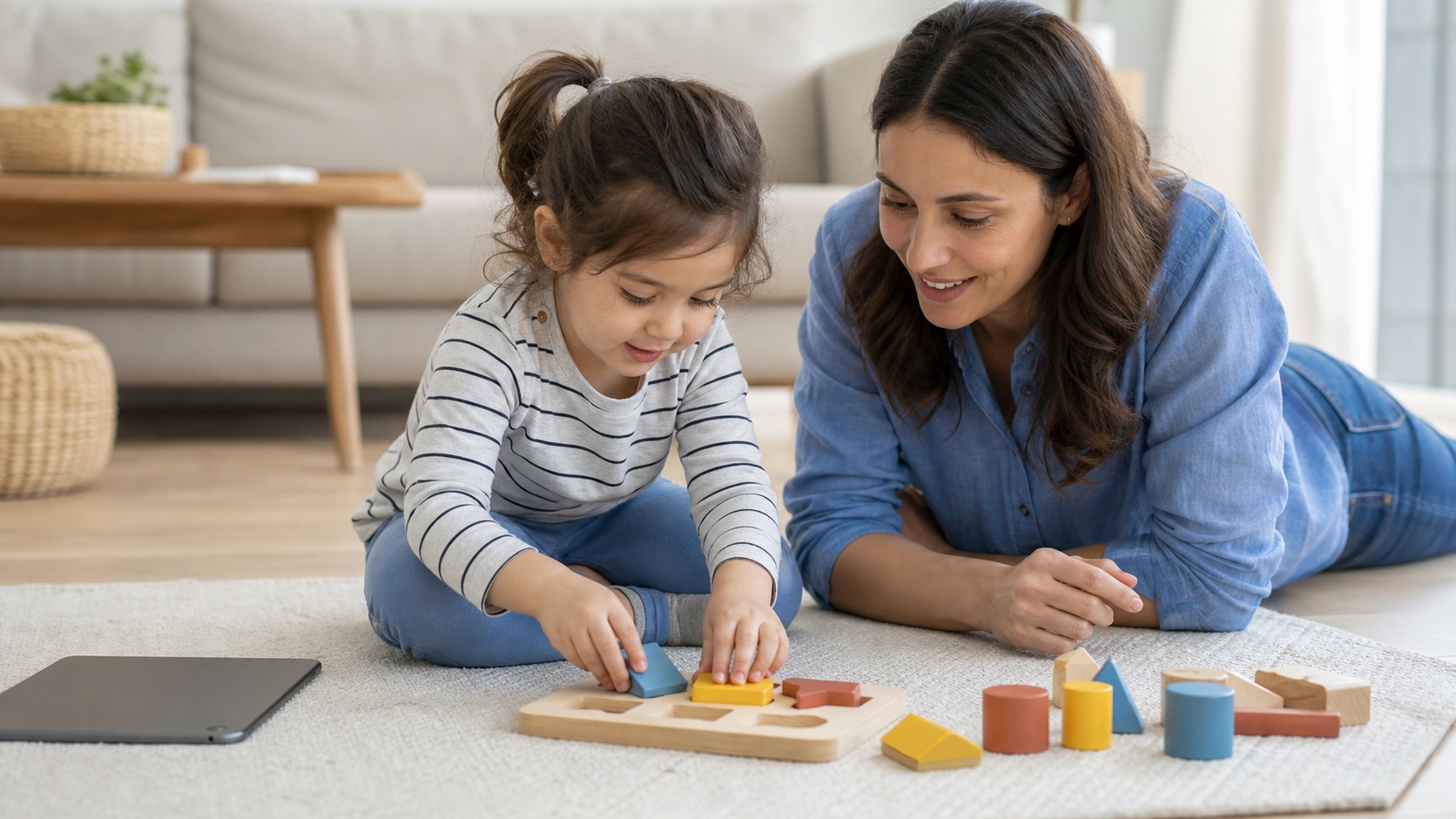
Minutes matter, but the same number of minutes can contain very different developmental experiences. A video call with a grandparent, a co-viewed story, a solitary autoplay feed and a shape activity followed by block play should not be treated as interchangeable.
Audit each recurring screen episode by child, content, context, co-use and crowd-out. Then test whether anything learned appears in conversation, play or the real world after the device closes.
Move Beyond One Number Without Ignoring Time
The American Academy of Pediatrics' 2026 policy describes media as a digital ecosystem shaped by the child, caregiver, product design and wider systems. It warns that engagement-based design can encourage prolonged use and displace sleep, movement and relationships.
This broader frame does not make duration irrelevant. Longer exposure creates more opportunity for displacement and persuasive design. The World Health Organization's under-five guidance integrates sedentary screen time with physical activity and sleep across the whole day.
Use a time boundary as a guardrail, then investigate what happens inside and around the episode.
Use the Five-Context Screen Audit
Child
Age, language, temperament, developmental needs, current regulation and ability to stop affect what the episode becomes.
Content
Pacing, narrative, learning target, accuracy, advertising and representation matter more than an “educational” label.
Context
Time, place, purpose and device setup shape attention, sleep and whether screen use becomes the default response to boredom or distress.
Co-use
A responsive adult can connect symbols to the child's experience, answer signals and extend learning into action.
Crowd-out
The episode displaces something: waiting, chores, conversation, sleep, movement, pretend play, books or observation.
Evaluate the recurring pattern, not a single exceptional day. Families need workable systems, not retrospective guilt.
Account for the Transfer Problem
Young children often have difficulty applying information from a two-dimensional representation to a three-dimensional situation. The AAP's 2026 review notes that infants under 18 months particularly struggle with screen-to-world transfer because of immature cognitive processing.
Interactivity does not automatically solve this “video deficit.” Tapping a pictured cup after an animation may not mean the child recognizes or uses the concept with a real cup. Social contingency, repetition, adult language and direct practice can help bridge the representation.
Therefore, “watched attentively” and “completed the activity” are not learning outcomes. Test the idea away from the display.
Run a Three-Step Transfer Check
Before, during and after
- Before: name one target and sample it briefly off-screen. Can the child already identify, explain or perform it?
- During: observe whether the child predicts and responds or mainly follows cues. Note adult help and automatic prompts.
- After: close the device and use the idea with an object, picture book, conversation, movement or pretend problem.
Repeat with a changed example the next day. If the child succeeds only when the same animation or answer choices appear, describe it as screen-supported performance rather than generalized learning.
Choose Content That Leaves Room for Thought
Prefer content with a clear developmental target, comprehensible language, moderate pacing, meaningful repetition and pauses for response. Avoid unrelated sounds, visual rewards and scene changes that compete with the idea.
For stories, ask whether events are coherent and whether the child has time to predict. For math, look for quantities and relationships rather than number recitation alone. For science, connect claims to observation. For social-emotional content, practice the behavior with a real person afterward.
Disable autoplay and algorithmic recommendations when possible. A deliberately selected episode has a different risk profile from an endless feed optimized to retain attention.
Co-Use Through Serve and Return
Co-viewing is not merely an adult sitting nearby. Follow the child's attention, name what they notice, respond to gestures or questions, pause for an answer and connect the screen event to shared experience.
Harvard's Center on the Developing Child describes serve and return as responsive back-and-forth interaction foundational to early development. Media can provide a topic, but the human exchange supplies contingent meaning and relationship.
Do not narrate every second or turn leisure into a quiz. One prediction, one connection and one off-screen action may be enough.
Plan the Bridge Into Play
Shape episode
Find, rotate and combine real shapes to make a picture or structure.
Animal story
Retell the problem with toys and invent a different solution.
Counting activity
Make requested snack sets, compare them and change each by one.
Music video
Repeat the rhythm with movement, household instruments or turn-taking.
Nature clip
Observe outdoors, draw evidence and distinguish what is directly seen from what the video claimed.
Video call
Continue the relationship through a drawing, shared object or later conversation about the person.
If an episode never inspires language, action or play and is difficult to stop, its educational branding deserves skepticism.
Audit What the Screen Displaces
Track one week in broad categories: sleep and bedtime transition, active play, outdoor time, meals, shared conversation, books, independent play and caregiver recovery. The question is not whether every screen minute is harmful; it is whether the pattern repeatedly removes a high-value developmental experience.
The AAP reports associations between heavier noneducational or solo media use and less optimal language, cognitive, social-emotional and sleep outcomes, while noting that much evidence is observational. Direction and context can be complex.
Replace strategically. A calm cooking video followed by making food differs from a feed used at every meal. A necessary caregiver break is a real family need; choose bounded, predictable content rather than pretending the need does not exist.
Treat AI and Interactive Assistants as a Separate Risk Tier
Generative systems can produce unlimited stories and conversation, ask personal questions and simulate social responsiveness. A child may not understand that confident language can be invented or that the system does not know, care or keep secrets like a person.
For preschoolers, adults should operate the account, keep interactions shared, avoid personal data, constrain the topic and inspect output. Do not use a chatbot as a private companion, emotional regulator or unsupervised teacher.
If AI is used for a story or learning activity, follow the same transfer rule: the child should contribute ideas and continue the language, play or concept after the tool closes.
Build a Family Pattern That Can Survive Real Life
Choose a few defaults: selected content rather than feeds, predictable start and stop cues, device-free sleep routines and meals, co-use when learning is the goal, and an off-screen bridge. Keep devices out of reach when they are not in use.
Discuss persistent sleep disruption, extreme transition distress, loss of play or language concerns with a pediatrician or appropriate developmental professional. Screen observations cannot diagnose a condition, and removing a device may expose rather than cause an underlying difficulty.
A useful preschool media plan is not the one with the most impressive educational labels. It is the one in which the child still sleeps, moves, talks, plays, relates—and carries something meaningful from the screen into the world.
Frequently Asked Questions
-
Use current pediatric and local health guidance as a guardrail, then consider content, context, co-use and crowd-out. The same duration can produce very different experiences, but longer use increases displacement risk.
-
Yes, under some conditions, especially with developmentally appropriate content and adult support. Young children may struggle to transfer screen information, so check learning with real objects, conversation and play.
-
It remains media use, but responsive co-use can change its developmental quality by adding language, relationship and real-world connections. It does not eliminate the need for time boundaries or offline activity.
-
Video calls can provide contingent social interaction with a real person, making them meaningfully different from passive video. Adult support may still help young children sustain and understand the exchange.
-
It should target a clear idea, leave room for child response, avoid distracting design and lead to knowledge the child can use away from the screen. Marketing language alone is not evidence.