AI Homework Rules for Parents: Govern the Hand-Off, Not the Screen Time
A family agreement that adapts to different assignments, teachers and ages—without banning AI or monitoring every prompt.
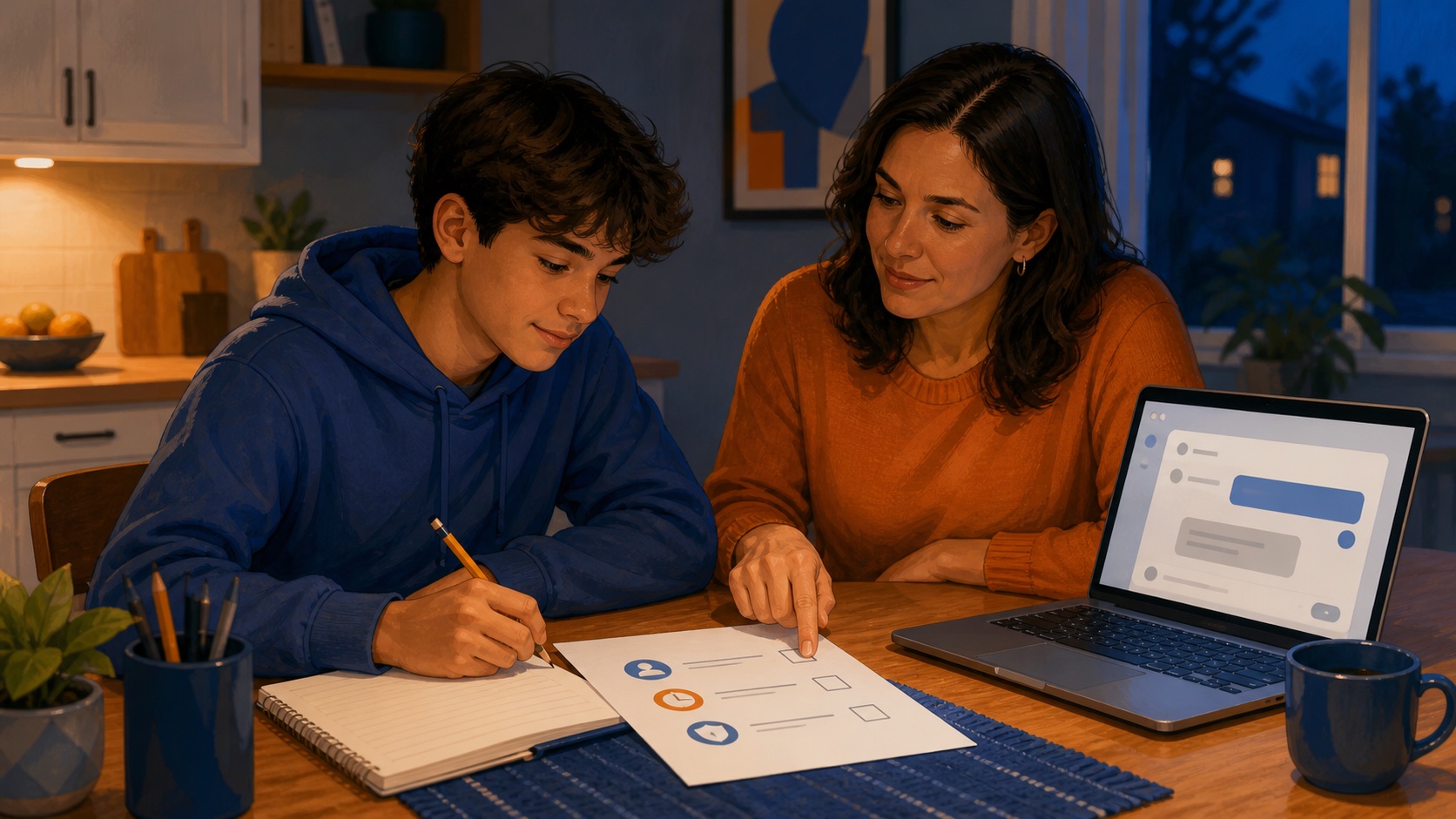
Good AI homework rules govern what a student hands over, not how many minutes a chatbot stays open. Before a child uses AI, a family needs five answers: Who has authority over this assignment? Which skill must remain the student’s? What information must stay private? How will the student prove and disclose ownership? When must the conversation move to a human?
This is more useful than either “never use AI” or “use it responsibly.” A 2026 Common Sense Media survey illustrates the disagreement inside many homes: 52% of parents characterized AI use for school assignments as unethical and deserving consequences, while 52% of surveyed 12- to 17-year-olds characterized it as innovative and worth encouraging. That attitude split does not tell us which side is right. It shows why a workable family policy must define actions rather than trade moral labels.
Why a Time Limit Is the Wrong Main Rule
Minutes measure exposure, not learning. A student can replace the point of an assignment in five minutes by requesting a finished response. Another student might spend 30 minutes asking for practice questions, answering each one before seeing feedback and then studying the missed concepts. The second session is longer but leaves more of the thinking with the learner.
A family rule also cannot grant permission that the teacher did not give. The same teacher may allow AI to brainstorm a project topic but prohibit it when students create the assessed outline. A school may approve one protected tool while disallowing consumer accounts. “AI is allowed in our house” therefore cannot mean “AI is allowed on this assignment.”
The family needs a default for moments when instructions are clear and a way to stop when they are not. Our guide to when AI helps students learn explains the underlying boundary: assistance is useful when the student still performs the mental work the task is designed to build. The agreement below turns that idea into household practice.
Use the One-Minute Assignment Check
Do not negotiate the entire future of AI at the start of every homework session. Answer these five questions for the assignment in front of you:
- AuthorityWhat did this teacher permit for this task? If the answer is “I’m not sure,” AI waits.
- TargetWhat should the student be more able to do alone afterward?
- JobWhat is the least help needed: clarification, one hint, practice questions or feedback on an attempt?
- DataCan the request be made without entering sensitive information or material the school has not approved for this tool?
- ProofWhat will the student explain, revise or complete without AI before submission?
A “no” or “unclear” answer does not always mean AI is forbidden forever. It means the child cannot make that decision alone yet. Ask the teacher, choose a school-approved alternative or complete this assignment without AI.
The Family AI Homework Agreement
This agreement is deliberately short enough to use. Complete it with the child, keep it near the homework space and review it after four weeks rather than treating it as a permanent contract.
Our goal is to use AI in ways that leave the student more capable, honest and safe.
- School rule first.The teacher’s instructions for a specific assignment override our household default. When the rule is unclear, we ask before using AI on assessed work.
- Student attempt first.The student identifies the learning target and makes a visible attempt before requesting help, unless AI is an approved access support or the teacher directs otherwise.
- Least help needed.AI may clarify, hint, quiz or comment on the student’s work only as far as the assignment permits. It does not create the performance being assessed.
- Private information stays out.We do not enter personal, classmate, school-record, health, account or other sensitive information into an unapproved tool.
- Verify, own and disclose.The student checks important claims, completes an unaided ownership check and describes AI assistance as the teacher requires.
- A human takes over when needed.The student stops when a rule is unclear, a topic is high stakes, an output is disturbing or manipulative, or repeated AI help is not producing independent progress.
Tools we may use: ____________________
Uses that require an adult: ____________________
Review date: ____________________
“Visible attempt” does not have to mean pages of struggle. It could be a diagram, two possible claims, the first line of a solution or a note identifying exactly where the student became stuck. The point is to give the tool something the student has thought about—not to manufacture frustration before help is allowed.
Match Independence to Readiness, Not Just Age
Grade level is a useful clue, but it is not a readiness test. Two eighth-graders can differ sharply in whether they remember assignment rules, protect private information, challenge a fluent answer and stop when a conversation becomes uncomfortable. Tool-specific minimum ages and parental-consent terms still apply.
Co-use
Use when: The child cannot yet apply the five-question check reliably or does not meet the service’s conditions for independent use.
Boundary: An adult conducts or directly shares the interaction, or the child uses only a school-approved experience under school directions.
Limited independence
Use when: The child can identify the rule and target but still needs reminders to verify, disclose or protect information.
Boundary: Name the permitted AI jobs in advance and review the learning result afterward, with occasional agreed-upon chat review.
Self-managed use
Use when: The student consistently follows teacher rules, protects data, questions outputs and can perform a nearby task unaided.
Boundary: The student records or discloses assistance and participates in periodic review; independence can narrow after a specific breach.
These levels are an editorial framework, not validated developmental cutoffs. A child may be self-managed for generating science practice questions and need co-use for a high-stakes application essay. Independence belongs to the decision, not permanently to the child.
Make the Privacy Rule Concrete
“Don’t share personal information” is too abstract for a rushed homework session. As a family default, do not paste names tied to contact details, account credentials, precise location, private photos or voice recordings, health information, discipline records, IEP or 504 material, a classmate’s work, or nonpublic teacher and school records into a consumer AI service. Use school-approved tools and school procedures when student information is genuinely required.
For children under 13, the Children’s Online Privacy Protection Act gives parents protections around covered services’ collection of personal information. That does not make every compliant product instructionally appropriate or safe for every child. Service rules also vary. For example, ChatGPT’s current age guidance says it is not intended for children under 13 and requires parental consent for ages 13 to 18; under-13 educational interactions must be conducted by an adult. Check the current terms of the actual product rather than transferring one company’s rule to every tool.
UNESCO’s guidance on generative AI in education similarly emphasizes data privacy, age limits for independent conversations and age-appropriate human oversight. The practical family rule is simple: if you would hesitate to email the information to an unknown company, do not paste it into a chatbot merely because the homework is due.
When a Rule Is Broken, Repair the Type of Breach
A consequence should restore what was lost. Removing a device may create a pause, but it does not by itself rebuild learning, honesty or privacy. First classify what happened:
Learning breach
Example: AI solved the target problem before an attempt.
Repair: Redo the key portion without AI, explain the reasoning and complete one similar transfer task.
Honesty breach
Example: AI-written material was submitted without permission or disclosure.
Repair: The student tells the teacher with parental support, follows the teacher’s remedy and resubmits only if invited.
Privacy breach
Example: The child pasted a record, credential or another person’s information.
Repair: Stop sharing, secure any exposed account, use available deletion controls and inform the school or affected adult when their information is involved.
Safety breach
Example: A chatbot produces disturbing content, pressures secrecy or becomes a substitute for appropriate human help.
Repair: End the interaction, show a trusted adult and move the question to a qualified person or emergency support when necessary.
Do not make an AI detector the family court. Even the provider of ChatGPT cautions educators that detection approaches are unreliable and can unfairly affect some students. Ask for process evidence instead: the first attempt, sources, revision choices, an explanation and a short unaided transfer task.
Introduce the Agreement Without Starting a Surveillance Contest
Begin with curiosity: “Show me one way AI has genuinely helped you learn and one way it has made it tempting to skip the work.” Then test the one-minute assignment check on a real task. A parent can say:
“I’m not trying to catch you using AI. We need a shared way to decide which help is permitted, which thinking must remain yours and when either of us should ask the teacher.”
Complete the six clauses together. The parent should add a reciprocal promise: do not secretly use AI to impersonate the child, manufacture messages in the child’s voice or interrogate every conversation without a previously discussed reason. Younger children and specific safety concerns require more direct oversight, but constant hidden monitoring can turn disclosure into concealment.
The American Academy of Pediatrics recommends that families discuss technology rules with children, apply a plan to adults as well and revise it as children mature. The American Psychological Association’s parent guidance likewise emphasizes talking about privacy, using AI together and co-creating boundaries. Neither source validates this particular homework agreement; both support the broader practice of explicit, shared and revisable rules.
At the review date, do not ask only, “Did you obey?” Ask: Can the student explain the work? Is independent performance improving? Were teacher rules followed? Was sensitive information protected? Did the child bring uncertainty to a human? Tighten one boundary that failed and loosen one that the student has shown readiness to manage.
What This Agreement Can—and Cannot—Do
No controlled study has established that these six clauses, these readiness levels or a four-week review period improve grades or prevent misuse. They are editorial recommendations synthesized from learning science, current child-technology guidance, privacy rules and the practical authority structure of schoolwork. Families should adapt them to disability accommodations, school-approved supports and individual safety needs.
The agreement also cannot repair vague school policy on its own. In a 2024 survey, 83% of parents of teens said their child’s school had not communicated with them about generative AI, and 60% were unsure whether the school had rules. Those figures describe one survey period, not every school today. If the assignment is unclear, send a narrow question: “May students use AI to brainstorm, receive feedback or edit language on this task, and how should that help be disclosed?”
Current U.S. Department of Education guidance says education technology should have a clear instructional purpose, transparent data practices and evidence of learning value. Its five questions—what problem the tool solves, when, for whom, for how long and with what evidence—are also a useful test at home. A signed agreement is not the outcome. A child who can make those decisions with decreasing adult help is.
Frequently Asked Questions
-
A ban is appropriate when the teacher prohibits AI, the child cannot use a tool within its age and consent rules, sensitive information cannot be protected, or a foundational skill needs independent practice. Outside those situations, a purpose-based agreement can teach judgment more effectively than assuming every use is equivalent.
-
There is no universal age that establishes readiness. Start with the product’s current minimum-age and parental-consent terms, then look for observable skills: following teacher rules, protecting private information, questioning outputs, disclosing help and stopping when human guidance is needed. If those skills are not reliable, use AI together or choose a school-approved alternative.
-
Direct supervision is appropriate for younger children, co-use and specific safety concerns. For a ready teenager, an agreed purpose, visible first attempt, ownership check and periodic review may preserve more trust than secret continuous monitoring. State in advance what will be reviewed and what events trigger closer oversight.
-
Separate learning from honesty. Have the child explain what happened, contact the teacher with parental support, follow the teacher’s remedy, and redo the target skill without AI if permitted. Then narrow the relevant boundary temporarily. Do not rely on an AI detector as proof.
-
Do not interpret silence as permission. Ask whether AI may be used for specific actions such as brainstorming, hints, feedback or editing, and how assistance should be disclosed. If an answer is not available before the deadline, complete the assessed work without AI or use only the non-AI supports already permitted.