STEM Toys Product Guide

10 Best STEM Kits for Middle School 2026: Reliable Picks That Teach

STEM kits for middle school matched to age and interest — reliable electronics, hands-on chemistry, and builds that actually teach.

10 Best STEM Kits for Middle School 2026: Reliable Picks That Teach editorial illustration

Middle school is when STEM kits either click or get pushed to the back of a closet. Many kits advertise an impressive number of projects, yet the ones that actually hold an 11-14 year old's attention are those that teach a real skill instead of delivering a one-time reaction. A box full of cheap parts is a fast path to boredom.

The market splits between budget solar kits that need direct sun and careful assembly, and electronics kits that perform consistently. Kids this age notice when a project fizzles; a kit that works builds confidence, while a flimsy one feeds frustration. Matching the kit to the child's patience and interest determines whether it gets used at all.

Most families face a trade-off between a long-term electronics curriculum and a broader chemistry set. Both teach, but they serve different interests. Choosing the discipline a child is already curious about beats chasing the box's project count.

#1

Snap Circuits Extreme SC-750R

Snap Circuits Extreme SC-750R

Serious young engineers

Customer rating 4.8/5
Check Price

Worth Noting

  • Structured progression rewards sustained study over quick, one-time builds
  • Premium pricing places it above typical STEM kits
Projects
750+ projects
Durability
Snap-fit, durable
STEM Focus
Electronics
Instructions
Clear, printed guide
Read the full review

The SC-750R packs 750+ electronics projects into a snap-together system, and the included student study guide carries a beginner from basic circuits through electromagnet, solar-cell, and power-amplifier builds. Each project builds on the last, so a young engineer finishes with genuine working knowledge instead of a one-time gadget. The well-documented manual keeps every step easy to follow, and the sheer project count holds a curious builder's attention across many sittings. As an educational tool it goes beyond most gadget kits: the climb from simple switches to a working amplifier gives a real feel for how circuits behave.

This is for serious young engineers and homeschoolers aiming at a genuine electronics education, and the premium price fits a gift-giver with a generous budget. Some projects run on batteries you supply, so keeping cells on hand smooths the experience from the start. The structured study guide suits a learner who enjoys working through a progression, and the depth carries comfortably from age 8 well into the early teen years.

Bottom line: A rare kit that genuinely teaches electronics rather than just entertaining — worth the premium when the goal is a working foundation, not a single afternoon.

#2

Nat Geo Chemistry Set

Nat Geo Chemistry Set

Hands-on chemists

Customer rating 4.7/5
Check Price

Worth Noting

  • Some reactions come out more muted than the box art suggests, so expectations need setting.
Projects
45 experiments
Durability
—
STEM Focus
Chemistry
Instructions
Sometimes sparse
Read the full review

Forty-five experiments deliver genuine chemical reactions — a bubbling volcano, a geyser, a rocket — that middle-schoolers can watch, measure, and question. That lab-style doing sets it apart from the snap-together circuit kits in this category, placing chemistry, not electronics, at the center.

This suits hands-on science learners, homeschooling families, and birthday-gift buyers seeking real lab-style experimenting — less so kids drawn to physics or robotics. Some projects need household items beyond the box, so it best rewards families comfortable with a quick pantry run.

Keep the instruction booklet close — a few experiments proceed more smoothly with an adult walking through the steps.

Bottom line: This is the chemistry set for the kid who'd rather pour and mix than snap circuits — a mid-range buy that turns screen time into lab time.

#3

Nat Geo Circuit Kit 120

Nat Geo Circuit Kit 120

Circuitry beginners

Customer rating 4.7/5
Check Price

Worth Noting

  • No programming or advanced control options
Projects
120 projects
Durability
Snap-on, tool-free
STEM Focus
Circuits
Instructions
Clear directions
Read the full review

National Geographic's Circuit Kit delivers 120 snap-on projects with zero tools, so a middle-schooler can light a bulb or spin a motor within minutes of opening the box. The click-together build rewards each step with instant feedback, keeping a curious beginner moving without loose wires or a soldering station.

Best for a tween newly curious about how electricity works, and parents who want a safer way in than soldering and loose components. The honest boundary is scope: this is a first kit that teaches foundational circuit logic, not the deep curriculum a more experienced builder will eventually need.

Bottom line: A confident first electronics set for a tween curious about electricity — fast, satisfying builds that introduce the basics with zero friction.

#4

Smartivity Hydraulic Launcher

Smartivity Hydraulic Launcher

Mechanics builders

Customer rating 4.6/5
Check Price

Worth Noting

  • Wooden arms can snap during assembly or excited play
Projects
2-in-1 launcher
Durability
Thin wood parts
STEM Focus
Hydraulics, mechanics
Instructions
Clear diagrams
Read the full review

The 2-in-1 hydraulic launcher turns liquid pressure into motion, teaching core physics through a build that actually fires darts and planes. Where the bridge-building kit in this round emphasizes static load and tension, this one rewards the same curiosity with immediate, playful payoff as hydraulics, force, and energy transfer come together piece by piece.

This suits curious builders ages six to fourteen who prefer constructing to a ready-made toy, and it works well as a parent-child or classroom activity. Wooden parts reward careful handling, so it is a build-and-display piece for patient hands rather than a rough-and-tumble toy.

Have an adult manage the tight-fitting joins during assembly and store the launcher flat when not in use.

Bottom line: Right for curious builders who enjoy constructing their own toys, ideally with a parent or teacher joining in — handle the wooden parts gently.

#5

T&K Structural Engineering

T&K Structural Engineering

Future civil engineers

Customer rating 4.6/5
Check Price

Worth Noting

  • The supplied yellow pin tool can be ineffective at seating stubborn connectors.
  • Stubborn connections can slow assembly and test a younger builder's patience.
Projects
20 models
Durability
Tight, brittle parts
STEM Focus
Structural engineering
Instructions
Some steps unclear
Read the full review

Twenty bridge and skyscraper models place core civil-engineering ideas — force, load, compression, and tension — in front of middle schoolers through scale builds teachers can use as live demonstrations. Each structure changes how load distributes, giving students a tangible feel for why trusses and columns behave as they do.

The right owner is the STEM-focused student who genuinely enjoys constructing, or a teacher building a structural lesson around the 20 models. Assembly can frustrate — pieces fit tightly — so this suits patient builders who treat the challenge as part of the process, not kids after instant results.

Plan for an adult to help across a few sessions — the tight fits go together more smoothly with two people holding the frame.

Bottom line: Best for the patient, STEM-focused builder who wants hands-on understanding of how real structures stand — the mechanical depth is the draw, and the tight assembly is the price of entry.

#6

SCAEMO 4-in-1 Solar Kit

SCAEMO 4-in-1 Solar Kit

Budget families

Customer rating 4.6/5
Check Price

Worth Noting

  • Thin wooden parts may crack after assembly, so finished models suit display rather than rough daily play.
Projects
4 builds
Durability
Thin wood
STEM Focus
Solar, wind energy
Instructions
Clear, simple
Read the full review

Four wooden builds — a solar car, solar plane, wind car, and electric fan — deliver clear lessons on circuits and renewable energy, with assembly guided by easy-to-follow printed instructions. As the budget entry in this set, it gives quick visual results where the top-pick electronics kit goes deeper into curriculum; it also carries verified quality where the more popular 12-in-1 solar robot's reliability stays hard to confirm.

This fits younger middle schoolers, science fair demos, and budget-conscious families after a fast finished project. Completed models reward careful handling over rough play, so expect display-grade builds rather than a lasting toy.

Run the solar builds in direct sunlight — indoor lighting won't generate enough power.

Bottom line: The right pick for budget-conscious families wanting a quick, visual introduction to renewable energy — choose the top-pick kit instead when curriculum depth matters more.

#7

Poraxy 5-in-1 STEM Kit

Poraxy 5-in-1 STEM Kit

Classroom projects

Customer rating 4.6/5
Check Price

Worth Noting

  • In a classroom where builds get handled repeatedly, thin wood can crack, limiting these to a single project session.
Projects
5 model cars
Durability
Thin wood parts
STEM Focus
Mechanics, craft
Instructions
—
Read the full review

Kids 8-13 get five wood models to build, paint, and personalize — activity that holds attention during class or a rainy afternoon. The thin wood can crack under firm pressure and motors may not run as expected, so this suits one-time classroom projects rather than durable everyday toys.

Bottom line: Pick this when you need several cheap, paintable projects for a classroom or a quick gift; expect it to be a single-session activity, not a lasting toy.

#8

Sillbird Solar Robot 12-in-1

Sillbird Solar Robot 12-in-1

Model variety

Customer rating 4.3/5
Check Price

Worth Noting

  • Solar-only operation leaves robots stalled indoors or beneath cloud cover, limiting play to bright, sunny days.
Projects
12 robots
Durability
—
STEM Focus
Solar, robotics
Instructions
—
Read the full review

Twelve distinct robot builds — cars, planes, and windmills — offer real variety at an entry-level price, giving owners plenty of projects for the money. Long-term durability is difficult to verify before purchase, so treat this kit as a low-stakes experiment rather than a lasting commitment.

Bottom line: Best as a low-stakes first robotics gift for a curious 8-14 year old; not the pick when you need certainty before spending.

#9

Henoda Programmable Robot

Henoda Programmable Robot

Tech-savvy kids

Customer rating 4.5/5
Check Price

Worth Noting

  • App-based voice and programming features can be inconsistent.
Projects
468-piece robot
Durability
Weak joints
STEM Focus
Robotics, coding
Instructions
Hard-to-fit pieces
Read the full review

This 468-piece robot delivers the widest control options in this set — remote, app, voice, and path programming — and keeps kids genuinely occupied. Assembly demands patience as pieces fit tightly, which suits older children who enjoy a challenge. For a tech-savvy teen willing to work through a build, this remains an engaging gift.

Bottom line: Suits a patient, tech-savvy child who wants a challenging build over a plug-and-play toy — just be ready for some app troubleshooting.

#10

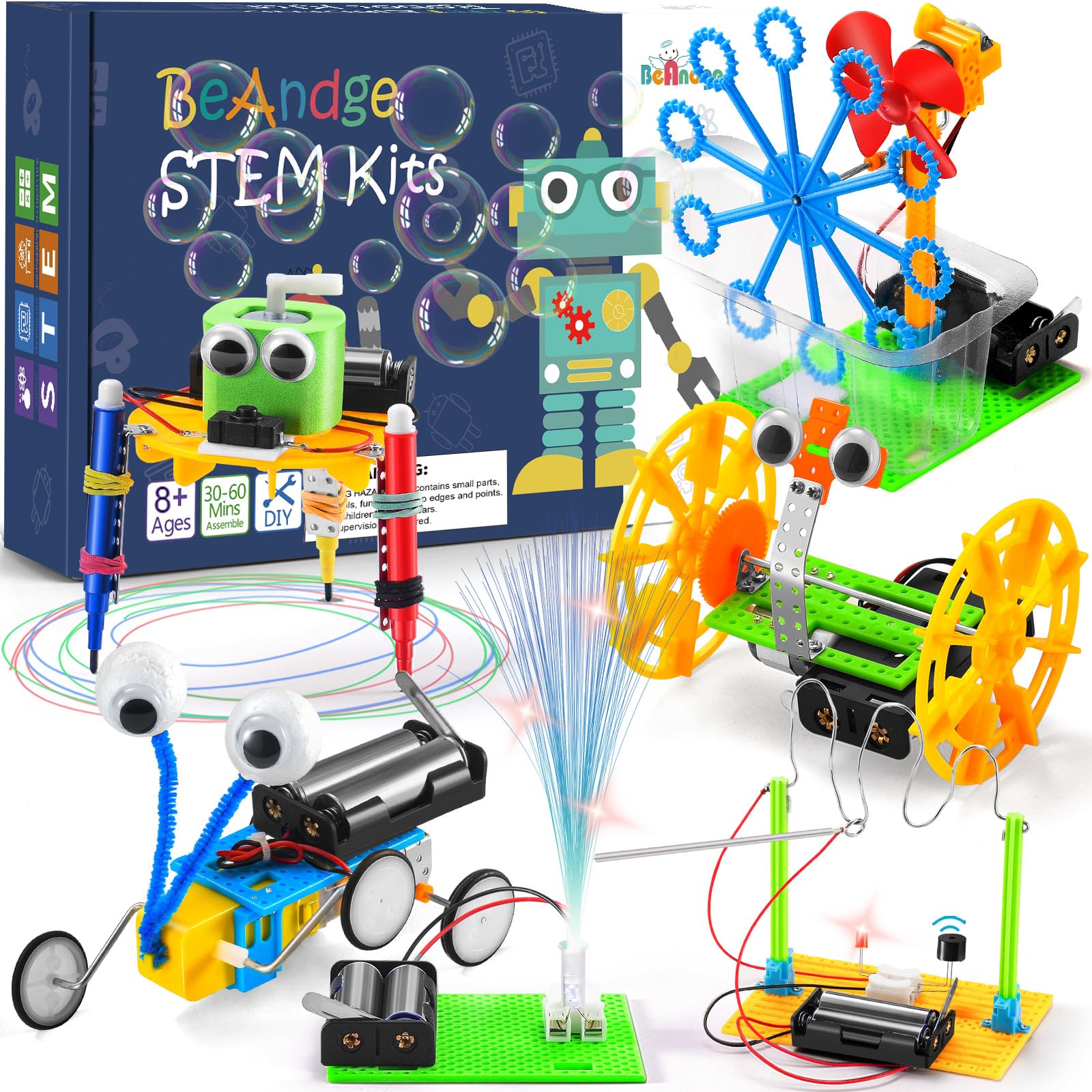
BeAndge 6-in-1 Robotics

BeAndge 6-in-1 Robotics

Patient builders

Customer rating 4.5/5
Check Price

Worth Noting

  • Tiny screws make assembly a two-person job, and some components have been noted not to light.
Projects
6 builds
Durability
—
STEM Focus
Robotics, crafts
Instructions
Tiny screws
Read the full review

Six different projects — robot, balance car, and bubble machine — offer real variety at a budget price while building creative problem-solving skills. Tiny screws make assembly a two-person job, and a component like the fiber lamp has been noted not to light. This fits patient builders with adult help, not younger kids chasing independent success.

Bottom line: Best for families who treat assembly as a shared project — patient kids with an adult on hand get real value at a budget price.

How to Choose

Age Range and Complexity

A kit labeled '8+' spans a huge range of fine-motor skill and reading level, so the age mark alone is a weak guide. Kits aimed at younger kids use large, forgiving pieces and short assembly, which a 13-year-old finishes in minutes and never revisits.

Kits pitched at older teens demand smaller parts, longer builds, and sustained focus. Match the complexity to the child's patience and frustration tolerance, not just their birthday.

Project Count and Variety

Manufacturers advertise 100+ experiments to look generous, but many of those are one-time reactions, bonus internet links, or recycled activities. A kit with 45 focused experiments can teach more per hour than a sprawling set, because each build reinforces the last.

Look for projects that build on one another rather than a long list of disconnected tricks.

Durability and Build Quality

Thin laser-cut wood snaps under the grip of kids who haven't yet learned to judge force, which is exactly the 11-14 range. Snap-fit plastic and metal components survive repeated assembly and enthusiastic play.

Solar-powered kits only perform in direct sunlight, so they disappoint on cloudy days or indoors under ordinary lamps. Consider how many times the kit will be rebuilt before you decide whether a wood or solar build is a problem for your house.

Instruction Clarity

Diagrams that skip steps or assume prior knowledge force kids to interrupt an adult mid-build, which drains the appeal of an independent project. Numbered steps with photo-real illustrations let a middle schooler work alone, building the confidence the category promises.

If any reviewers mention confusing steps, expect a parent to finish the build instead.

STEM Focus

Electronics kits build circuit intuition that transfers directly to high school physics and coding, while chemistry delivers immediate visible payoff for its effort. A child drawn to how machines work will lose interest in mixing solutions, and vice versa.

Pick the discipline the kid is already curious about rather than the one that looks best in a product photo.

Frequently Asked Questions