Music Learning Product Guide

11 Best Sheet Music Stands of 2026: Steady at Full Extension

Which sheet music stands hold their height with heavy books and stay stable for students, teachers, and gigging musicians.

11 Best Sheet Music Stands of 2026: Steady at Full Extension editorial illustration

Most folding stands at the low end of the price range share a stubborn flaw: the taller you extend them, the more they sway. A stack of method books or a three-ring binder can turn a steady-looking desk into a teetering platform, and that is the last distraction a student needs during practice.

Sturdiness is not about weight alone. A narrow tripod base and a shallow tray cause most real-world wobble, so it pays to look past marketing phrases and focus on usable height range, tray capacity, and base footprint.

This guide separates stands that hold their line at standing height from those that are only comfortable at desk level, and it maps each one to a specific role. For a school fleet the priority is decade-long survival; for an individual student it is easy setup and a tray that holds real books.

#1

Manhasset 48 Symphony
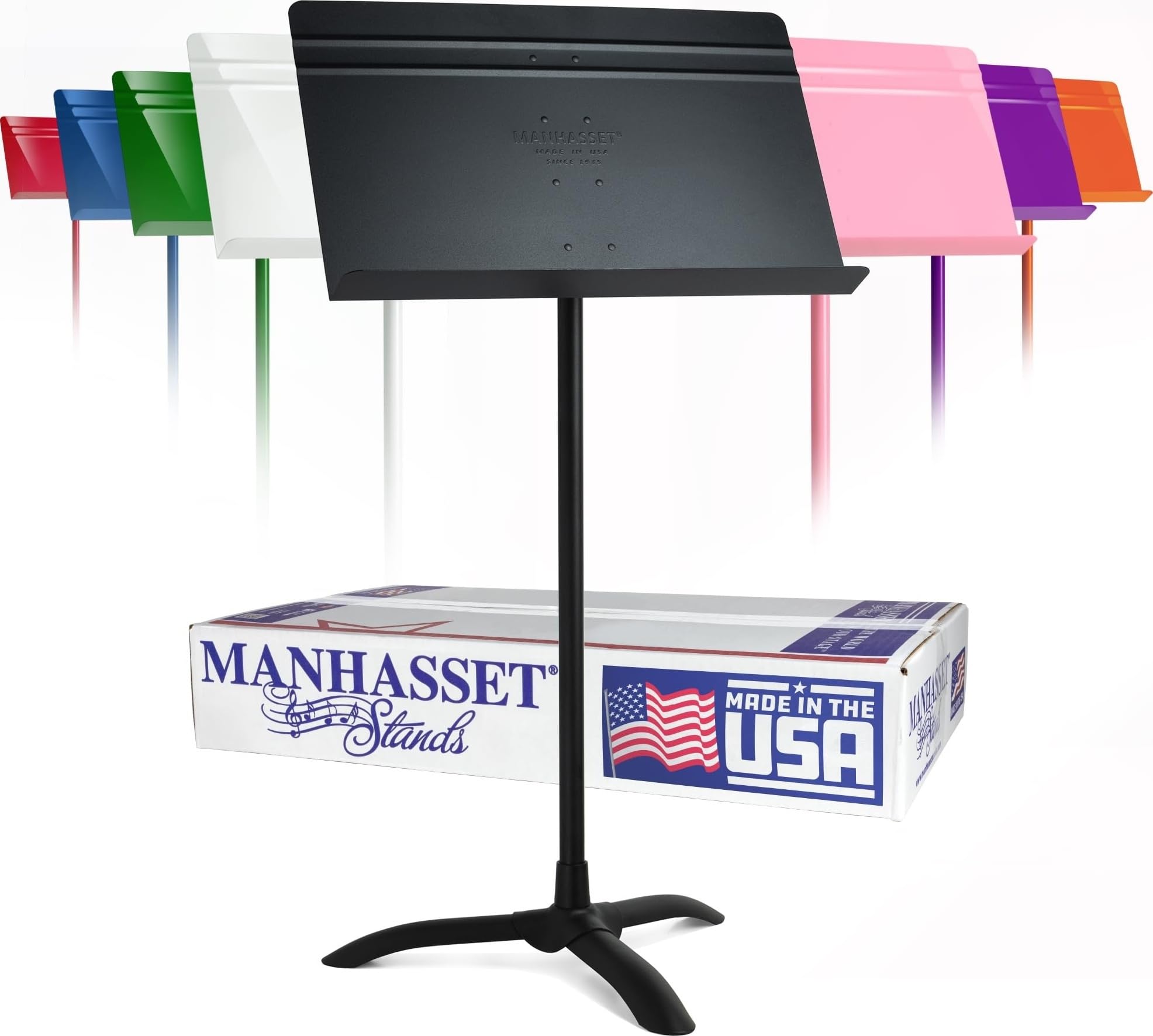
Manhasset 48 Symphony

Institutional durability

Customer rating 4.8/5
Check Price

Worth Noting

  • Doesn't fold; the base comes apart for moves, demanding more trunk space than a portable
Weight
7 lbs
Stability
Steel base, non-folding
Tray Size
19-in wide desk
Tilt Angle
Adjustable
Read the full review

The 19-inch steel bookplate and rigid desk keep thick method books and full orchestra scores from swaying, even fully extended to 48 inches. The one-handed clutch drops the height lock and re-engages it in a single motion, so the desk settles into position on a rehearsal floor and holds there all session. The aluminum desk over a steel base is the same construction that has anchored school band rooms for decades.

Institutional buyers see the payoff over time. The desk, base, and clutch carry the weight of daily use without the wobble that shows up in welded budget stands, which is why a fleet of these outlives several generations of cheaper folding desks. Maintenance stays minimal — a periodic clutch adjustment is the extent of it, and the Made-in-USA build keeps replacement parts available.

The boundary is portability. The base comes apart for moves, and the 7-lb total asks for more trunk space than a folding model. That's immaterial when the stand lives in a single classroom, studio, or orchestra pit. For teachers hauling gear between sites, the folding tripod that anchors the portable category is the better match for that schedule.

Keep the base assembled in its permanent spot — the one-handed clutch handles height changes between musicians without breaking the stand down.

Bottom line: This is the stand that outlives the rooms it equips — the buy for anyone who sets up in one place and wants flat, stable pages for decades.

#2

Peak SMS-40

Peak SMS-40

Portable gigging

Customer rating 4.8/5
Check Price

Worth Noting

  • Folded bundle runs a bit longer than ultra-compact straps, so backpack carry is cramped.
Weight
3.7 lbs
Stability
Aluminum tripod, wide base
Tray Size
20 x 13.5-in desk
Tilt Angle
Adjustable
Read the full review

The 3.7-lb aluminum tripod with quick-clamp levers sets up in seconds and spreads wide enough to hold a heavy method book in a breeze. That combination of portability and firmness sets it apart from the fixed-base institutional standard — professional stability without a permanent home footprint.

Best suited to teachers shuttling between classrooms and gigging players who need durability in a carry bag. The folded bundle is a touch clunkier than ultra-compact budget stands, but the stability payoff at full extension makes that tradeoff easy to accept on stage.

Cinch the legs and slide it into the carry bag; folded length suits a trunk or gear cart better than a tight backpack.

Bottom line: For gigging players and teachers who move gear regularly, this is the portable stand that holds firm — the slightly wider folded footprint is the only real cost.

#3

GLEAM 5-in-1

GLEAM 5-in-1

Budget practice

Customer rating 4.7/5
Check Price

Worth Noting

  • Narrow phone-holder clip that skips larger Pro Max devices.
Weight
5.3 lbs
Stability
Alloy steel tripod
Tray Size
2-in deep tray
Tilt Angle
Adjustable
Read the full review

Alloy steel legs and a 2-inch deep tray anchor this stand where budget folding stands wobble, holding thick method books at a price near the low end of the market. Tool-free assembly folds it flat into the included carrying case in under a minute, while the height range spans seated practice through standing play.

This fits students and classroom budgets that need a stable everyday stand more than the portable pick's featherweight fold. The phone-holder clip runs narrow and won't grip recent Pro Max sizes, a detail to check if you sight-read from a device.

Leaving the desk a notch below full extension keeps play steady at normal heights.

Bottom line: For budget-conscious students and classrooms, this pairs a deep tray with alloy stability the cheap folding stands skip.

#4

On-Stage SM7211B

On-Stage SM7211B

Wide orchestral scores

Customer rating 4.7/5
Check Price

Worth Noting

  • At 13.2 lbs, it's heavier and bulkier than compact mini-stands, so carrying it any distance gets tiring.
  • Plastic rivets on the leg braces can come loose under hard use, so heavy-handed folding is the part to watch.
Weight
—
Stability
Wide tripod base
Tray Size
19-in wide steel desk
Tilt Angle
Adjustable
Read the full review

The 19-inch steel bookplate and wide tripod base hold full orchestral scores and heavy binders without tipping, and a 3-year warranty backs the build. Unlike the non-folding institutional standard, this desk folds flat for transport, so it suits players splitting time between a studio and an orchestra pit.

It fits orchestral musicians reading wide scores, schools stocking a durable fleet, and gigging players hauling heavy binders. Plastic rivets on the leg braces have been noted to come loose under hard, extended use — a durability boundary worth checking for anyone who folds this stand daily.

Bottom line: Institutional build, a 19-inch bookplate for orchestral scores, and a folding base for the commute — the professional stand for players who won't commit to a fixed floor position.

#5

CAHAYA Dual-Use

CAHAYA Dual-Use

Desk and floor

Customer rating 4.7/5
Check Price

Worth Noting

  • Bracket alignment varies between units, so the tray may need a gentle bend in some cases to seat evenly
Weight
6.7 lbs
Stability
Wide tripod base
Tray Size
2-in deep tray
Tilt Angle
Adjustable
Read the full review

The CAHAYA Dual-Use converts between floor and desktop setups with no tools, spanning 31 to 57 inches to cover seated woodwind play and standing work alike. Its wide tripod base and 2-inch tray hold a 12-pound stack of music confidently at normal heights, and assembly and breakdown take minutes for players who set up and pack down each day.

This suits saxophonists and woodwind players who move between a band-room stand and a home desk, while the full accessory kit included keeps the budget price worthwhile for students. Tall players at the upper end of the height range should note stability softens above the halfway point — keeping the desk lower delivers steady, wobble-free play.

Bottom line: For musicians who shift between a standing sheet stand and a flat desk, this single unit covers both positions without extra gear or cost.

#6

Vekkia Perforated

Vekkia Perforated

Humid climates

Customer rating 4.7/5
Check Price

Worth Noting

  • Screws can strip while tightening, leaving the stand unusable until replaced.
Weight
6.7 lbs
Stability
Wide metal base
Tray Size
—
Tilt Angle
180°
Read the full review

The Vekkia's anti-rust coating and 180-degree tilt desk hold tablets and books firmly — a fitting pick for humid coastal practice rooms. It runs heavier than the compact option in this set, better suited to a fixed home spot than daily backpack trips. Screws can strip during tightening, so a quick check of the joints on arrival is worthwhile.

Bottom line: Best for home players in humid coastal regions who leave the stand at one height.

#7

Donner DMS-1

Donner DMS-1

Low-light practice

Customer rating 4.6/5
Check Price

Worth Noting

  • A thin bookplate bows under heavy method books, so practice materials need to stay light.
  • Set screws on some units strip within a couple months of daily folding, affecting the desk's grip.
Weight
3.5 lbs
Stability
22.9-in base
Tray Size
Standard-size desk
Tilt Angle
Adjustable
Read the full review

The built-in LED light and 3.5-lb weight suit beginners practicing in dim bedrooms, and the carry bag eases transport. Light sheet music sits fine, but heavier method books bow the bookplate, and on some units set screws strip within a couple months of daily folding — boundaries for anyone wanting a years-long stand.

Bottom line: Best for a young student who needs a lit, portable stand for nightly practice and will upgrade once heavy scores enter the rotation.

#8

Vekkia Portable Pro

Vekkia Portable Pro

Compact travel

Customer rating 4.7/5
Check Price

Worth Noting

  • Desk runs narrower than standard
Weight
6.8 lbs
Stability
Wide base
Tray Size
Narrow magnetic-back desk
Tilt Angle
Adjustable
Read the full review

The magnetic back keeps clips and accessories firmly attached to the desk, and the whole stand folds into a slim bundle with its carrying bag, while height adjusts easily. The desk runs narrower than a standard stand, so wide two-page spreads hang past the edges — a comfortable fit for single-page songbooks and lead sheets rather than orchestral scores.

Bottom line: Right for traveling musicians who read from single-page songbooks and want accessories clipped on; wide two-page repertoire belongs on a full-width stand.

#9

Amazon Basics

Amazon Basics

Set-and-forget home

Customer rating 4.6/5
Check Price

Worth Noting

  • Under a heavy binder the pressure-fitted platform can detach from the shaft
Weight
5.9 lbs
Stability
Steel tube base
Tray Size
Aluminum desk plate
Tilt Angle
—
Read the full review

The aluminum plate proves sturdy — a 13-inch laptop or thick music book sits flat with no bend, and four-step assembly takes minutes. The friction-slide height lock is genuinely stiff, so repositioning mid-session is a chore; a player who sets the height once and leaves it never notices. Height changes are best done at setup, not during play.

Bottom line: For home players who set the height once and leave it, the sturdy plate holds its own; anyone who adjusts between sets should pick a lighter tripod instead.

#10

Ramzi

Ramzi

Budget with light

Customer rating 4.7/5
Check Price

Worth Noting

  • For heavy daily use, construction quality can vary between units
Weight
—
Stability
Tripod base
Tray Size
1.6-in deep tray
Tilt Angle
Adjustable
Read the full review

Exceptional budget value: the clip-on light is bright, height and angle adjust smoothly, and the included book stand and case complete the kit. At a home practice desk it holds music steady at a good reading angle. This budget pick suits a student's dim practice corner, kept to light at-home sessions rather than daily heavy use.

Bottom line: For a student's at-home practice desk in a dim room, the bundled light and case make this a natural budget choice.

#11

Mdvora

Mdvora

Classroom multi-pack

Customer rating 4.6/5
Check Price

Worth Noting

  • Wobbles at standing height and tips with heavier binders, so keep it to light sheet music
Weight
3.5 lbs
Stability
Alloy steel tripod
Tray Size
16.1 x 11.2-in tray
Tilt Angle
Adjustable
Read the full review

The multi-pack pricing gives budget-conscious schools an affordable way to equip a classroom, and the alloy legs fold and assemble quickly for young students learning to carry their own gear. As a standing-height stand with thick method books it wobbles, so this works best for light sheet music in supervised practice rooms rather than heavy binders or outdoor use.

Bottom line: Best for a teacher outfitting a music room with stands for young students practicing light sheet music — keep the desk below full extension and off outdoor stages.

How to Choose

Height Range

The printed height range is a maximum, not a stable range. Inside any telescoping column, the overlapping tube section is what keeps the desk level; at full extension that overlap shrinks to a few inches, so a sideways push from a turning page turns into lever force that overcomes the friction lock.

Find where the stand stops wobbling with your music loaded, then treat that as your usable range. A 57-inch stand that sways at 50 inches is effectively a 50-inch stand for a standing player.

Tray Depth and Width

Tray depth separates a stand that carries sheet music from one that carries method books. A shallow tray leaves a thick binder's center of gravity in front of the desk lip, so the weight pulls the whole head forward. A 2-inch tray with spring arms pushes that rearward and holds the book in place.

Width matters the moment you open a two-page score. A 19-inch desk keeps both pages flat and supported; a narrower tray makes the outer edges droop and demands constant page management.

Stability and Footprint

Base width is where stability is actually won. A tripod with a wide footprint puts more counter-leverage low to the ground, so the force from a heavy book has to lift a longer lever arm before the stand tips. Narrow bases look compact but transfer that force straight to the hinge.

For classroom and institutional use, choose the widest base that fits the room; for gigs where you're carrying the stand daily, you trade some footprint for folded length.

Weight and Portability

A stand's weight tells you less than how that weight is distributed and how it folds. A 7-pound non-folding base stays in two long pieces and demands trunk space, while a 3.7-pound tripod folds into a bundle you can sling over a shoulder. The folded profile, not just the poundage, is what determines whether it rides on the bus or stays at home.

Tilt Adjustability

Tilt locks are the first thing to wear out on budget stands. A wing screw against a plastic bushing can't hold full downward pressure from a heavy book, so the desk slowly droops during a piece. Look for a metal-on-metal clutch or a positive detent that stays put when you lean into the tray.

Frequently Asked Questions