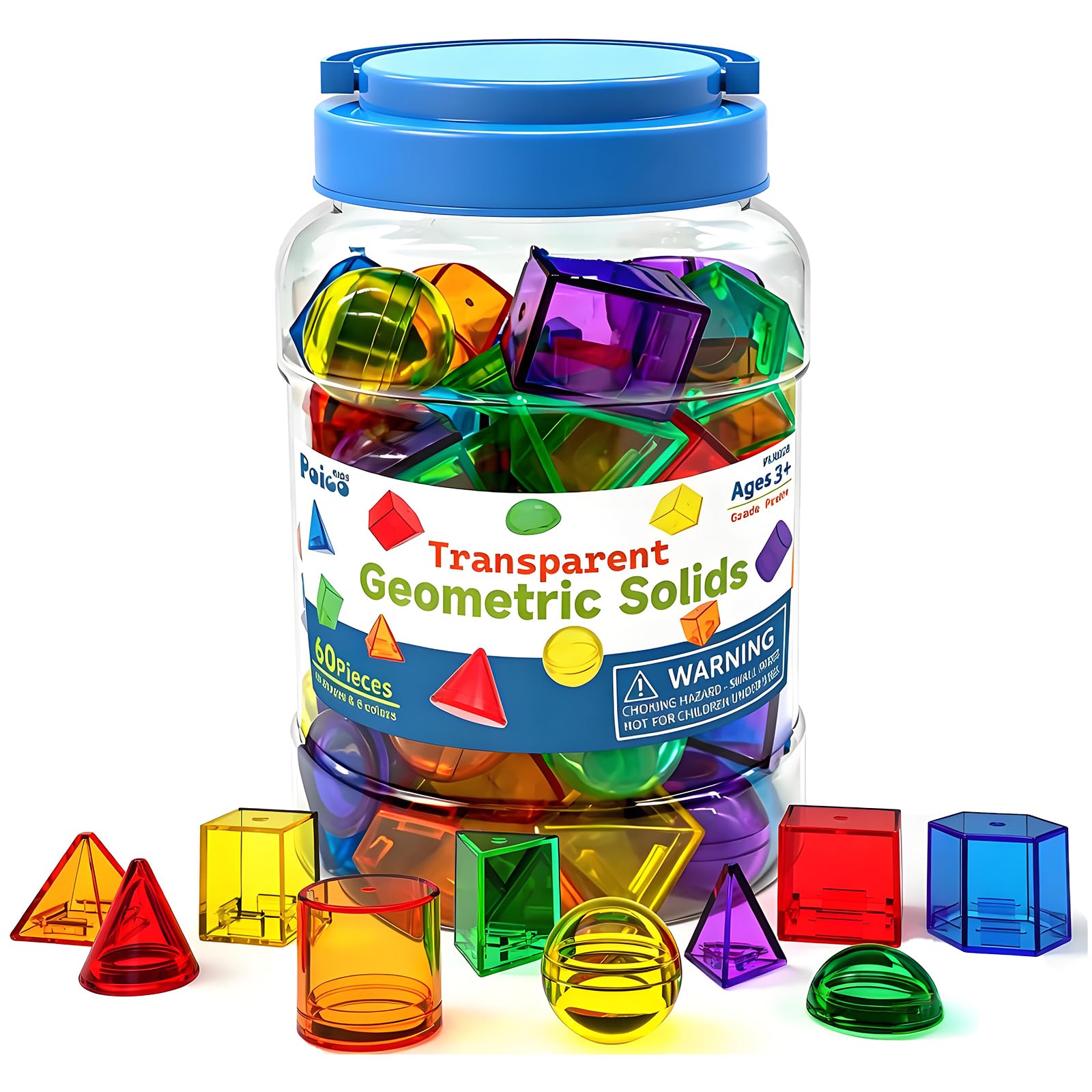
Math Learning Product Guide

8 Best Geometric Solids Set of 2026: Match Material to Lesson

Choose a geometric solids set by teaching goal — transparent for volume, foam for young kids, wood for long-term use.

8 Best Geometric Solids Set of 2026: Match Material to Lesson editorial illustration

Geometric solids sets photograph well. Bright, transparent shapes promise to make 3D concepts click for any student. In real classrooms, durability and size are where many sets disappoint — thin plastic cracks on a first drop, and shapes come out smaller than the listing suggests.

The answer is not a single set that does everything. It's choosing the material to fit the lesson. Transparent solids with removable bases earn their place when you're measuring volume with water or rice. Foam sets trade clarity for safety and surviving rough handling. Wooden blocks last for years but stay opaque.

Sort sets by their teaching role and the decision becomes simple: pick transparency for measurement, foam for the youngest learners, and wood when you want one set to outlast a decade of lessons.

#1

Learning Resources View-Thru

Learning Resources View-Thru

Volume teaching

Customer rating 4.6/5
Check Price

Worth Noting

  • Shapes run 3–6 cm, smaller than they look in photos
  • Dropped on a hard surface, the thin plastic can crack
Material
Transparent plastic
Shape Size
3–6 cm
Shape Count
14 shapes
Folding Nets
No
Read the full review

Transparent walls and removable bases turn volume from a formula into a visible comparison. Students fill the rectangular prism with water or rice, pour it into the cylinder, and the equal capacity becomes something they see rather than assume. Each base pops free so the solid sits level on a desk, and the top fill hole keeps the set tidy between pours. Two shapes holding the same amount at different heights is a volume lesson you can point at instead of describe, and a half-filled solid makes capacity intuitive before any numbers appear.

The fourteen solids span cones, prisms, cylinders, and pyramids, with a cube and a rectangular prism among the familiar shapes for early geometry. The vivid see-through colors hold students' attention during group instruction, which matters when a concept like surface area needs eyes on the object. Because every solid shares the same transparent material, comparing one shape to another never requires a switch in tools, and the colored outlines make edges and faces easy to reference mid-lesson.

A single kit covers volume, surface area, and solid shape recognition, keeping one purchase useful across a full year of geometry topics. Students who start by naming the cube move on to filling it and later to calculating its surface area — a natural progression from the same pieces, one that lets a single classroom set serve several grade levels.

Set on a table or tray, the shapes suit guided lessons where a small group can watch each solid fill and empty. Water, rice, or sand all work for volume comparison, and each solid empties cleanly once the base is removed. The set fits learners age 8 and up, with the fourteen pieces nesting together compactly for storage between sessions.

The View-Thru set is a supervised demonstration tool, not a toy for free play. Teachers and homeschoolers who run guided volume, area, and shape lessons will find the design matches the job when the pieces stay on a tray or desk during use. For classrooms where volume gets poured and compared rather than memorized, the removable bases set this kit apart from other transparent solid sets.

Bottom line: For classrooms that teach volume by pouring and comparing, the removable bases deliver what diagrams can't — a lesson students can see.

#2

hand2mind Foam 12-Pc

hand2mind Foam 12-Pc

Early learners

Customer rating 4.5/5
Check Price

Worth Noting

  • Squishy foam lacks rigid flat faces, so precise dimension and calculation work isn't practical
  • At 2 to 3 inches, the blocks run smaller than listing photos suggest; group demonstrations make this noticeable
Material
Soft foam
Shape Size
2–3 in
Shape Count
12 shapes
Folding Nets
No
Read the full review

hand2mind's foam set leads with squeezable softness where the top-pick transparent solids lead on volume. The 12 pieces compress under pressure and spring back, holding up to drops and rough handling that would crack a plastic shell. Foam also sets down quietly, a small advantage in a room of young listeners.

Teachers report pulling the same set across age spans, from toddlers who grasp and pass pieces to early-elementary students naming triangular prisms and cones. The slightly grippy surface lets small fingers hold each solid firmly during identification-by-touch games, and assorted colors let teachers call out 'find the blue cylinder' to keep a table engaged. Unlike wooden blocks, the soft body won't chip paint or dent furniture when pieces land.

This set targets preschool and kindergarten classrooms plus homeschool families with young children who learn through touch. The tradeoff sits in the material: opaque foam can't show fill-and-compare volume lessons, so this is a shape-recognition tool rather than a measurement one. For buyers whose curriculum depends on seeing inside solids, the transparent set in this lineup is the right call.

Expect the 2-to-3-inch scale before unboxing; the pieces suit individual table work more than front-of-class demonstrations.

Bottom line: Right for preschool classrooms and caregivers who want a soft, durable set that small hands can grab freely for shape recognition and color sorting.

#3

Yichushisu Solids & Nets

Yichushisu Solids & Nets

Nets & surface area

Customer rating 4.5/5
Check Price

Worth Noting

  • Net tabs run lighter than the solid pieces, so folded edges can soften under repeated handling.
  • Price runs above basic shape sets, with real value only in a net-focused curriculum.
Material
Thickened plastic
Shape Size
1.96 in
Shape Count
12 solids + 12 nets
Folding Nets
12 nets
Read the full review

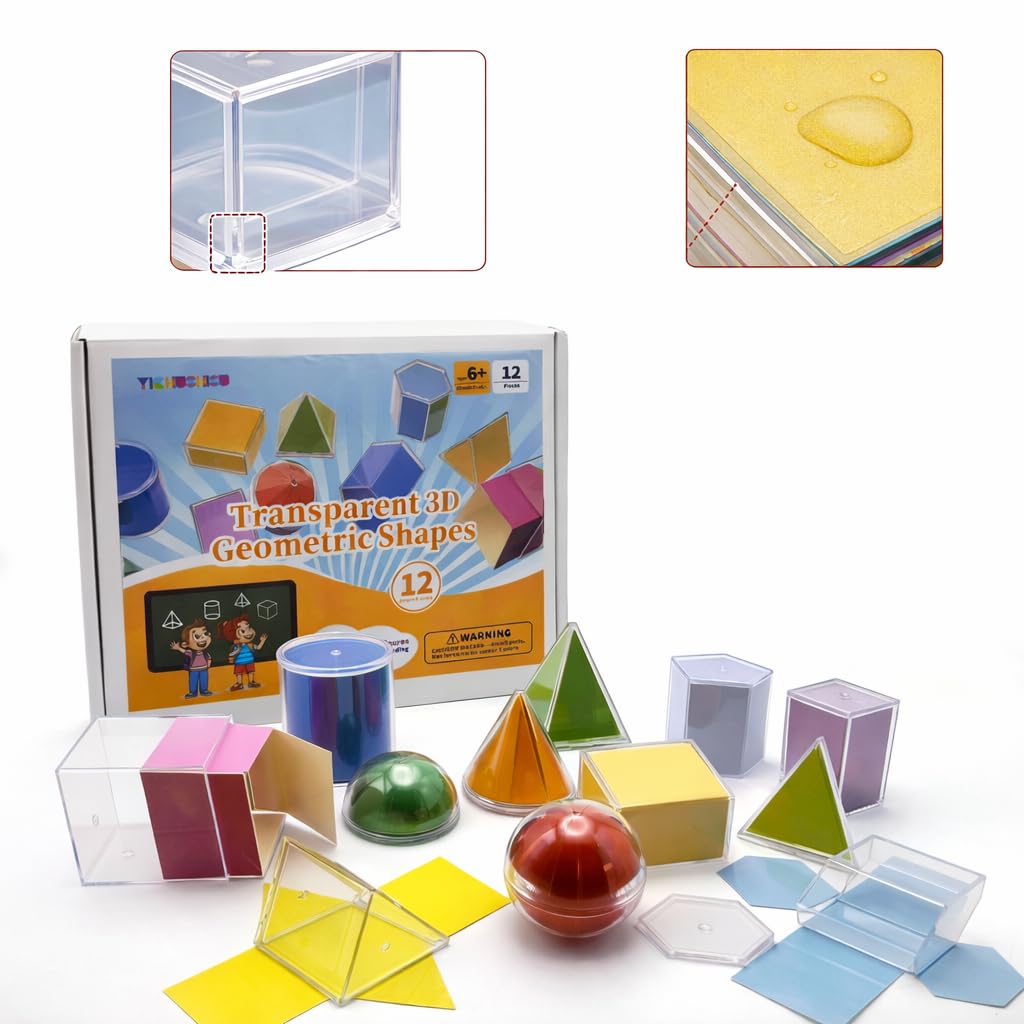
The 12 folding nets paired with 12 clear solids set this apart — no other option here lets students fold a flat pattern into the very shape it builds. Snap-lock lids hold each solid secure and support fill-and-measure volume checks, while thickened plastic keeps the pieces firm through repeated assembly cycles. Where the top pick delivers volume through removable bases, this set adds the surface-area lesson those transparent shapes can't reach on their own.

Each piece measures 1.96 inches, sized for individual students at desks rather than large-group front-of-room demonstrations. The included storage box keeps all 24 components together between class periods, which suits teachers who reset materials daily.

This set belongs in middle-school classrooms and homeschools where surface-area and net units sit on the syllabus. The price premium pays off only when the folding-net lessons are actually taught; for buyers after simple shape recognition or young-child-safe pieces, cheaper or softer options fit better.

Bottom line: Teachers and homeschoolers running surface-area units get the full value of the folded-net design; shape-recognition-only buyers should look to a cheaper set.

#4

Syhood Wooden 15-Pc Set

Syhood Wooden 15-Pc Set

Montessori learning

Customer rating 4.7/5
Check Price

Worth Noting

  • Shapes measure smaller than expected, shrinking their visual presence on a shelf
Material
Solid wood
Shape Size
—
Shape Count
15 pieces
Folding Nets
No
Read the full review

Solid burlywood wood gives the Syhood set the durability plastic shapes lack. These blocks absorb desk-height drops and a school year of daily handling without cracking, and the natural finish stays smooth in smaller hands instead of showing the scuffs transparent plastic accumulates. The 15-piece count offers a more compact, budget-friendly alternative to the larger wooden set in this lineup while keeping the same tactile appeal for shape sorting and tracing.

The set fits Montessori-style classrooms and homeschool setups where children learn by touching — running fingers along faces, edges, and vertices on smooth natural wood while naming each shape out loud. Because the material is opaque, volume measurement is off the table; keep a transparent set nearby when fill-and-compare lessons come up. The burlywood color keeps blocks visible against most table surfaces during small-group sorting, which suits supervised work with younger kids.

Shape recognition builds through repetition — spinning a cube to count its six faces sticks with young learners faster than a flat textbook drawing, and the wood's weight makes each form feel distinct. That hands-on foundation holds up for a season of classroom use before the blocks show the wear that marks cheaper plastic sets.

Keep the blocks on a tray or mat during sorting so the compact pieces stay contained.

Bottom line: A durable, natural-material set for hands-on shape recognition that keeps working long after plastic alternatives crack. Reach for the transparent volume-teaching set in this lineup if fill-and-compare lessons matter more.

#5

hand2mind Blue Power

hand2mind Blue Power

Budget volume

Customer rating 4.4/5
Check Price

Worth Noting

  • In a back-row demonstration the 2-inch shapes read small
  • A dropped shape can crack on a hard floor, so handling stays supervised
Material
Transparent plastic
Shape Size
2 in
Shape Count
12 shapes
Folding Nets
No
Read the full review

The hand2mind Blue Power brings clear plastic solids with removable lids to the lowest price tier in this guide, and that transparency is exactly what the soft foam sets trade away. Opaque foam resists drops but rules out fill-and-compare lessons; these shapes let a student pour water into a cube, transfer it to a cylinder, and watch the capacity difference appear in front of them.

The 12 pieces stand two inches tall and arrive with a storage tray, sized for tabletop work where a small group can rotate each solid and trace its faces, edges, and vertices. Live demonstrations of volume and capacity come across clearly, and handling the shapes builds spatial reasoning as students compare one solid against another. The see-through walls also expose interior structure while measuring — something the opaque alternatives cannot offer.

This set fits the budget-conscious teacher running supervised small-group lessons at a table rather than a whole-class free-for-all. The plastic is thin — a dropped shape can crack on a hard floor — so it belongs in careful hands and not a toy bin for young children. Where drops are part of the daily plan, the softer foam set is the safer choice, but it gives up the fill-and-compare lessons these clear shapes enable.

Bottom line: For a classroom on a tight budget that still needs real volume lessons, this is the transparent set to buy — just keep drops off the agenda.

#6

Deekin Wooden 18-Pc

Deekin Wooden 18-Pc

Art & tracing

Customer rating 4.6/5
Check Price

Worth Noting

  • Manufacturer labels this for ages 20 and up, so classroom use with young students runs beyond stated intent.
  • Opaque wood rules out water-fill volume lessons, narrowing the set to recognition and tracing.
Material
Solid wood
Shape Size
—
Shape Count
18 pieces
Folding Nets
No
Read the full review

18 large wooden blocks at a mid-range price give this set the best cost-per-piece among the natural-wood options, and the solid feel suits Montessori shelves and tracing exercises where plastic looks out of place. Multicolor finishes keep shapes visually distinct for sorting and matching, while flat faces trace cleanly onto paper.

Verified feedback stays thin, so long-term durability leans on a leap of faith rather than a documented record — the trade for 18 pieces at this price. The natural-wood character and large silhouettes carry the value for recognition-driven lessons.

Bottom line: Best for Montessori-style rooms and craft stations, where 18 natural-wood blocks at a mid-range price earn their keep through tracing and simple recognition work.

#7

EXBEPE 60-Pc Translucent

EXBEPE 60-Pc Translucent

Light table play

Customer rating 4.3/5
Check Price

Worth Noting

  • Translucent walls aren't rated to hold water, so fill-and-compare volume lessons need independent verification.
  • Construction quality rests on faith rather than field reports, so durability before first classroom use is an open question.
Material
Translucent plastic
Shape Size
—
Shape Count
60 pieces
Folding Nets
No
Read the full review

Sixty pieces in ten configurations give this set the largest shape count in the roundup, and on a light table the multicolor plastic glows brightly enough to anchor a full sorting or sensory station. The quantity supports whole-class color, shape, and size matching games.

The set stops at visual and tactile exploration rather than graded measurement. Its pieces aren't rated to hold water, so true volume lessons fall to the transparent sets, and construction quality has little documented field history behind it before first use.

Bottom line: Reach for this when a light table or sensory bin is the goal — the glow and piece count carry the day; pass when you need verified volume teaching or documented build quality.

#8

Sotiff 140-Pc Mini

Sotiff 140-Pc Mini

Counting & sorting

Customer rating 4.2/5
Check Price

Worth Noting

  • Blocks come in at mini scale, so they suit sorting over close inspection.
  • Small wood pieces can be a choking hazard around toddlers.
Material
Wood
Shape Size
0.71 in
Shape Count
140 pieces
Folding Nets
No
Read the full review

The Sotiff set packs 140 wood blocks into seven shapes and five colors at the lowest cost per piece of anything in this lineup — a real bargain for anyone who needs volume rather than precision. Those savings come from size: the blocks measure only 0.71 inches, too small for volume measurement or class-wide demonstrations. The trade-off suits counting, sorting, and pattern games, plus craft projects that consume many small shapes at once.

The wood construction keeps the pieces intact through drops and heavy handling, and the five colors make grouping and pattern work easy to keep organized. The mini pieces are a choking risk, so this is not a pick for early-childhood rooms; keep it with older students or supervised art sessions. As a bulk supply of many small shapes, it earns a place beside the solid-wood Montessori sets when the activity is manipulation rather than formal geometry.

Keep the blocks in a sealed bin between activities so the small pieces stay accounted for and out of reach of young children.

Bottom line: Best for classrooms or homes that need many small shapes for sorting bins, pattern games, or art projects and can keep the pieces away from toddlers; skip it for formal geometry or close shape inspection.

How to Choose

Number of Shapes and Variety

Six shapes cover the basics — sphere, cube, cylinder, cone, and two prisms — enough for early shape recognition. Once lessons move to comparing volume or surface area, variety matters. Look for a set pairing each prism with a pyramid on a matching base, so on-paper comparisons hold with the manipulatives in hand.

Material Type

Transparent plastic is the only material that lets students see inside a shape, which is what makes volume demonstrations possible. The trade-off is fragility: thin clear plastic cracks when dropped on a hard floor.

Wooden blocks survive years of handling but hide their interiors, so they teach shape recognition and feel, not measurement. Foam splits the difference for young kids — gentle on fingers, quiet on tables, and impossible to break, though opaque. Pick the material that matches the students' age and whether you need to see inside.

Fillable Design for Volume

Transparency alone doesn't enable measurement — you also need a removable base, fill hole, or snap-lock lid to pour contents in and out. A transparent shape with a fixed base is a display piece, not a measuring tool. Removable bases let students fill a cube with water or rice and pour it into a prism to compare capacity directly. Without that opening, a transparent set offers no advantage over a wooden one.

Folding Nets

Folding nets are the only way to show the 2D-to-3D connection: students fold a flat polygon into a solid and see which faces match. That makes them valuable in middle school, where surface-area problems require visualizing a prism's faces. The trade-off is that nets are flimsier than the solids, so they need careful handling. If your curriculum never covers nets, they add cost and clutter without teaching value.

Shape Size

Size is where product photos mislead buyers most. Classroom sets hover around two to three inches, fine for a close-up demonstration but easy to lose and hard to see from the back of a room. Mini sets drop to under an inch, turning small pieces into a choking hazard for young children and frustrating older students who can't read measurements at a glance. Match size to viewing distance — bigger for whole-class demos, small for individual desk work.

Frequently Asked Questions