Math Learning Product Guide

9 Best Math Manipulatives 2026: Match the Set to Your Child's Age

Find math manipulatives that fit your child's age and grip, from counting cubes to fraction towers.

9 Best Math Manipulatives 2026: Match the Set to Your Child's Age editorial illustration

Most listing photos make every linking-cube set look identical — 100 colorful plastic squares with nearly the same specs. The differences only show up in a child's hands: how firmly the cubes click together, whether small pieces survive a drop, and whether a 4-year-old can actually pull them apart.

The same basic shapes support counting, operations, and place value across K–2, so brand trust matters less than how the pieces fit a child's hands. Snap tension, piece size, and included guides separate a set a kindergartener can manage from one that needs an adult's strength to pull apart.

Beyond cubes, the right tool shifts with the grade. Fraction towers make equivalency visible for 4th and 5th graders, magnetic ten-frames cement number bonds in kindergarten, and color-coded base-ten blocks turn regrouping into a picture. Matching the tool to the skill matters as much as matching the snap to the hand.

#1

LR MathLink Cubes

LR MathLink Cubes

Counting & operations

Customer rating 4.8/5
Check Price

Worth Noting

  • Firm snap tension calls for 5-and-up grip, so young hands may need adult help to connect and separate cubes.
Age Range
5+
Activity Cards
None
Pieces & Color
100 cubes, 10 colors
Material & Build
Non-toxic plastic
Read the full review

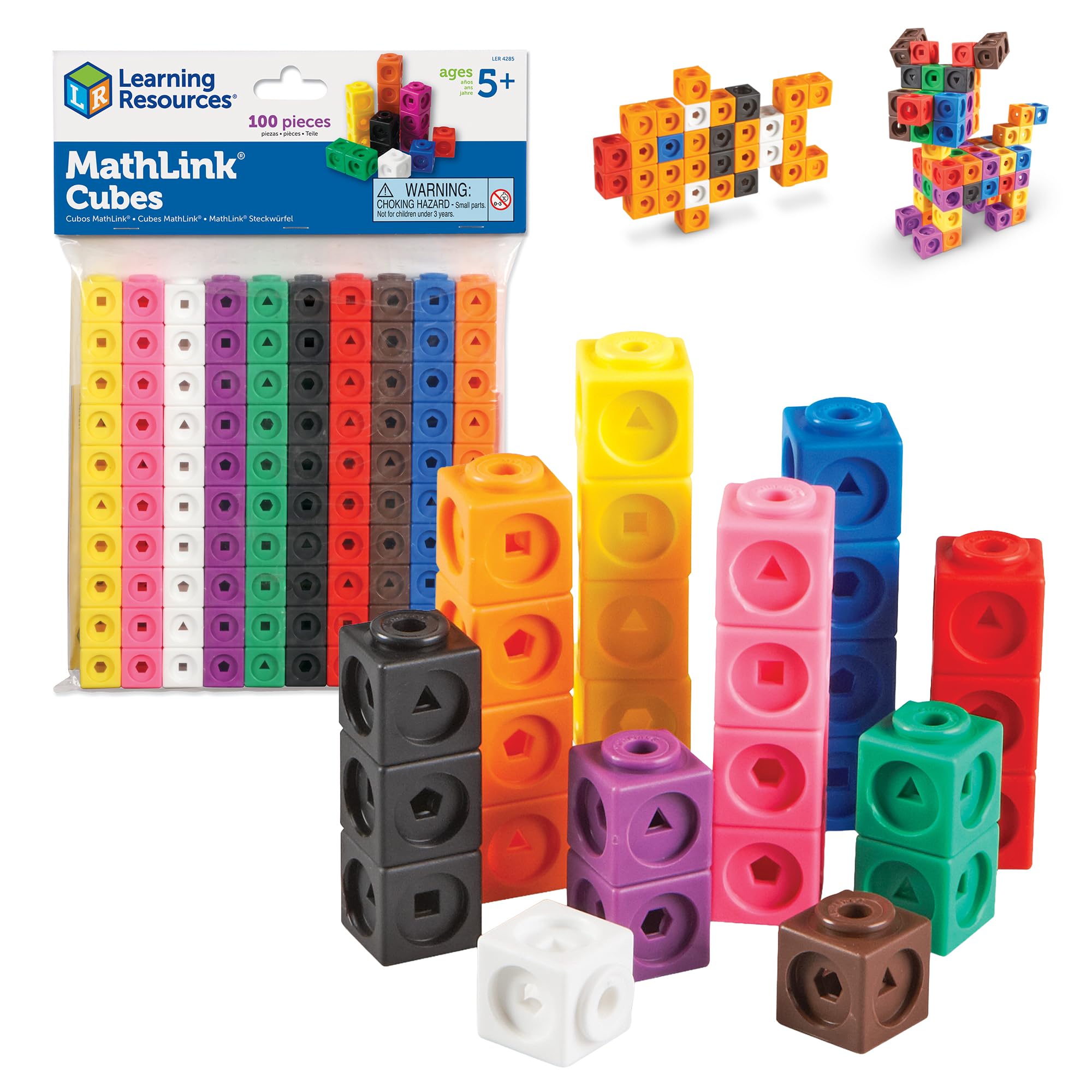
The 100 cubes snap together firmly and hold their connection through a full activity — sturdy plastic blocks that let a child stack counting towers, model addition, and pull apart cleanly between exercises. Geometric cutouts on every face allow blocks to join from any side, so tall constructions stay rigid while a child works and the connection between pieces remains predictable throughout a lesson.

A child can stack ten cubes to build a ten-frame, link three and two to show five, then remove blocks to demonstrate subtraction — each connection reinforces the math underneath rather than acting as a loose building exercise. The blocks hold position mid-activity instead of shedding pieces, and repeated classroom handling does not loosen the snap, which keeps a lesson coherent from start to finish whether a teacher runs a guided station or a child explores independently.

Homeschool families covering K-2 and classroom teachers building manipulative stations get a set that survives daily handling and spans counting, addition, and place value across a full school year. The firm snap is calibrated for 5-and-up grip, so 4-year-olds will need an adult's help to connect and separate cubes — preschool hands are better served by the easier-snapping cube set in the same lineup, while kindergarten and up take to this one on their own.

Bottom line: One set carries counting, addition, and place value from kindergarten through second grade — the foundation piece a K-2 math shelf is built around.

#2

edx Math Cubes

edx Math Cubes

Pre-K & K hands

Customer rating 4.8/5
Check Price

Worth Noting

  • A few cubes in each set fit tighter or looser than others, which can slow longer builds for the smallest hands
Age Range
3+
Activity Cards
None
Pieces & Color
100 cubes, 10 colors
Material & Build
Smooth rounded plastic
Read the full review

A softer click is this set's defining trait. Where the leading cubes demand a firm press, these attach with a gentle push that pre-K hands manage on their own, while the plastic stays smooth and rounded with five embossed shapes on each face. Counting, addition, and place-value practice hold up fully at the same 100-piece count.

Made for parents of 3–5-year-olds and pre-K teachers who want easy assembly without losing math utility. A few cubes attach snugger than their neighbors — the variance is minor and never blocks counting, though young hands may pair a tighter piece with a looser one.

Pair the looser cubes with small grips and save the snugger ones for firmer presses.

Bottom line: Best for 3–5-year-olds learning to count and add, where smooth assembly matters more than a rigid link.

#3

Simply Magic Base Ten

Simply Magic Base Ten

Regrouping & place value

Customer rating 4.8/5
Check Price

Worth Noting

  • The strategy guide arrives as an emailed download rather than printed cards in the box.
Age Range
6+
Activity Cards
Email strategy guide
Pieces & Color
131 pcs, color-coded
Material & Build
Certified plastic
Read the full review

The full 131-piece base-ten set — one cube, ten flats, twenty rods, and one hundred units — makes regrouping and place value click for a whole elementary class. Where the counting-cube top pick doubles as free-play building, these color-coded pieces stay aimed at one focused curriculum: units, tens, hundreds, and the exchanges between them, with a sturdy plastic build that holds up to daily handling.

Best for homeschool families and 1st–3rd grade classrooms where regrouping is on the weekly plan — the color coding pays off and the solid plastic survives repeated use. Budget-first buyers who only want loose counting cubes will find the premium price hard to justify; this set delivers when place value is the actual goal.

Bottom line: For classrooms where regrouping is the goal, this color-coded set makes the exchange visible — value that a basic counting-cube pack can't match.

#4

hand2mind Fraction Cubes

hand2mind Fraction Cubes

Fraction equivalency

Customer rating 4.8/5
Check Price

Worth Noting

  • Individual cubes can pop apart when pressed, so tall stacks may separate mid-lesson
Age Range
8+
Activity Cards
None
Pieces & Color
51 cubes, color-coded
Material & Build
Plastic
Read the full review

These are the only fraction-specific manipulatives in this lineup — color-coded towers from whole through twelfths make equivalency visible. Where the counting-cube sets cover K–2 operations, this one targets the 4th–5th grade leap where fractions trip students up. Aligning 1/4 beside 1/8 shows why two eighths equal a quarter before any calculation happens, and the thick plastic survives repeated classroom handling.

The right buyer is a 4th–5th grade teacher or homeschool parent teaching equivalence, comparing, and adding fractions. The set deliberately omits sevenths, ninths, and elevenths, so equivalency with those denominators won't be demonstrated — a boundary to know before ordering.

Bottom line: For 4th–5th grade equivalency and operations work, this purpose-built set is the one to reach for in an upper-elementary math toolkit.

#5

Torlam Ten-Frame Set

Torlam Ten-Frame Set

K–1 number bonds

Customer rating 4.7/5
Check Price

Worth Noting

  • Counters can slide or fall when a tray is tilted up for the class to see
Age Range
3+
Activity Cards
None
Pieces & Color
5 trays, 55 counters
Material & Build
Magnetic trays
Read the full review

Oversized magnetic trays hold counters securely and read clearly from across a classroom, and each frame includes a dry-erase strip for writing the equation beside the ten-frame. The build is sturdy enough for daily handling in a shared classroom, making it suited to K–1 number-bond and simple-addition practice.

This is for kindergarten and first-grade teachers who want a quick visual check: students set counters on a tray and flash it up for verification. The magnetic discs hold firmly on a level surface, so the tool works best for desk-based counting rather than upright display, and children working past ten-frame concepts will outgrow it quickly.

Bottom line: Best for K–1 classes that practice number bonds with quick all-hands checks rather than worksheet work.

#6

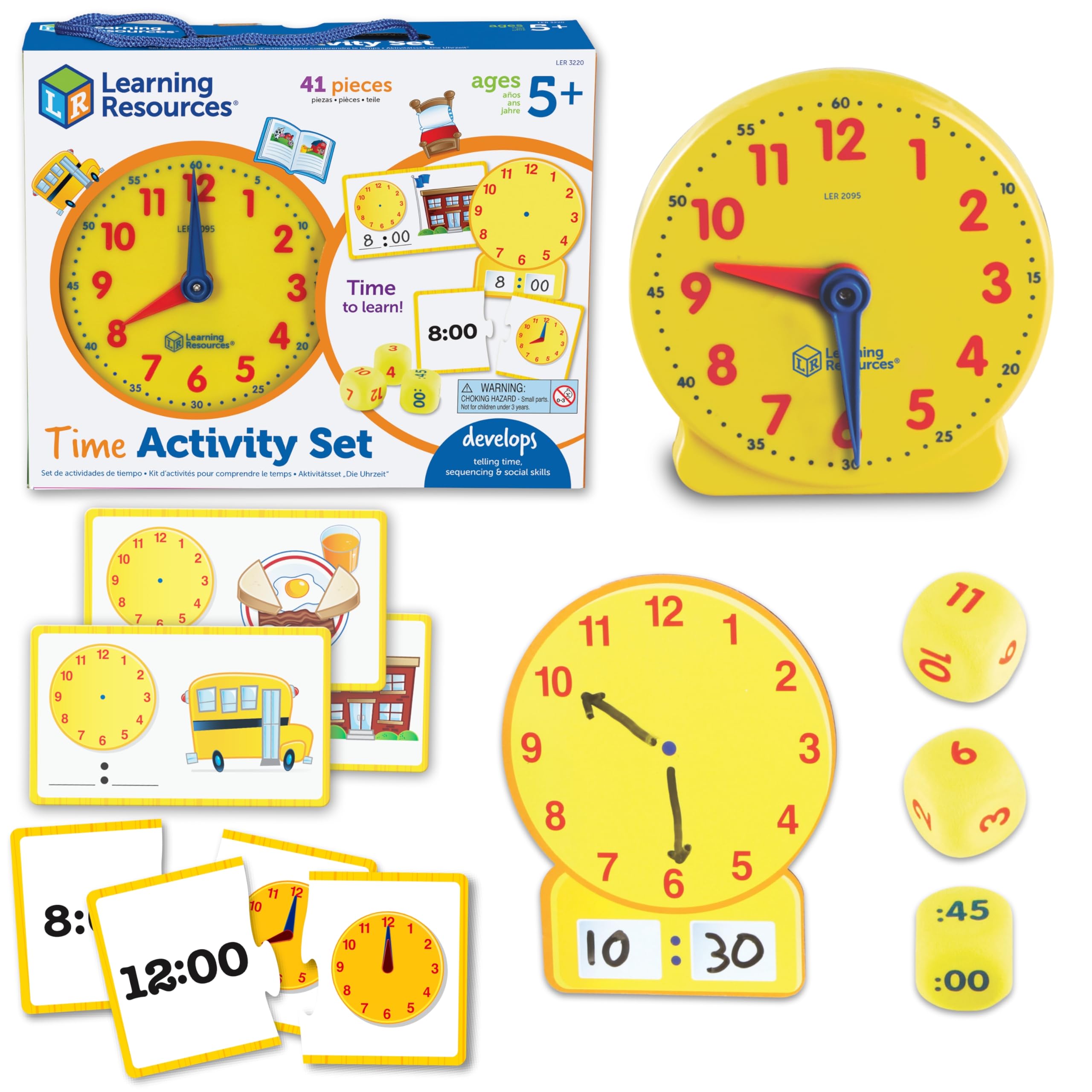
LR Time Activity Set

LR Time Activity Set

Time-telling

Customer rating 4.8/5
Check Price

Worth Noting

  • Gear-linked hour hand moves with the minute hand, so independent hour-hand setting isn't possible.
Age Range
5+
Activity Cards
Double-sided cards
Pieces & Color
Clock, cards, dice
Material & Build
Plastic
Read the full review

The only dedicated time-telling kit in this roundup, it pairs a gear-linked clock that moves like a real one with a write-and-wipe clock, double-sided cards, dice, and puzzles — content that reads as a game for 5–7 year olds rather than a skill drill. Plastic components feel sturdier than the budget price suggests.

This suits parents introducing analog time at home and classroom learning centers. The gear-linked hour hand follows the minute hand and can't be set independently, so lessons needing free hour-hand positioning fall outside its reach — it excels at timed demonstrations and whole-group practice instead.

Save the geared clock for demonstrations — the write-and-wipe clock gives kids a free hand to set on their own.

Bottom line: Best for parents of 5–7 year olds and classroom centers that want a guided, game-like first step into analog time; the geared hands keep it out of reach for independent hour-hand practice.

#7

edx Pattern Blocks

edx Pattern Blocks

Geometry & patterns

Customer rating 4.7/5
Check Price

Worth Noting

  • Pieces run small; with toddlers under three in the home, the tray belongs on a high shelf.
Age Range
3+
Activity Cards
None
Pieces & Color
250 blocks, 6 shapes
Material & Build
Thick plastic
Read the full review

250 standard six-shape blocks in the classic pattern-block colors, cut from thick plastic that holds up to free play and repeated classroom use. Shapes and hues match the standard reference set, so pieces swap cleanly with any existing curriculum kit — a real advantage for families already running Saxon math or homeschool lessons.

This set lands best with K–3 students working on geometry, symmetry, and fractions-of-a-whole, where the six shapes make patterns and relationships tangible during both guided lessons and independent play. Pieces run small, which rules out unsupervised toddlers; the intended audience is the stated 3+ age bracket.

Keep the tray on a high shelf when toddlers are around — the set suits ages three and up.

Bottom line: This is the set to reach for when the lesson shifts from counting to shape and symmetry — budget-priced, built to last, with a 3+ rule for households with toddlers.

#8

hand2mind Foam Counters

hand2mind Foam Counters

Quiet counting

Customer rating 4.8/5
Check Price

Worth Noting

  • Soft foam wears faster than plastic under daily handling
Age Range
—
Activity Cards
None
Pieces & Color
200 counters, 2 colors
Material & Build
Soft foam
Read the full review

The soft foam delivers genuine classroom value: counters land silently in whole-group counting, sorting, and probability lessons at a budget-friendly price. A few pieces can arrive with the red side partly flaked — cosmetic rather than functional — and the single-purpose design leaves multi-function connecting sets as the better pick for broader curricula.

Bottom line: Budget-friendly fit for a classroom that needs silent, high-volume counting and probability work; choose a durable connecting set if multi-function play pieces matter more.

#9

Cltoyvers Wooden Abacus

Cltoyvers Wooden Abacus

Tactile counting

Customer rating 4.7/5
Check Price

Worth Noting

  • On some units the frame can wobble and a few arrive smaller than expected
Age Range
3–5
Activity Cards
110 math cards
Pieces & Color
100 beads, 10 wires
Material & Build
Wood, water-based paint
Read the full review

100 wooden beads on 10 wires with 110 number-and-equation cards slipping into a display slot make counting and place-value work tactile and screen-free for pre-K–2. Some units arrive with a frame that can wobble and a few measure smaller than expected — this suits steady lap-and-table use more than a large display piece.

Bottom line: Best for pre-K–2 families wanting a tactile, screen-free counting tool for lap-and-table practice rather than a statement display piece.

How to Choose

Snap Tension & Assembly Ease

Snap tension is the force needed to push cubes together and pull them apart — the biggest difference between otherwise identical sets. The classic MathLink cubes lock firmly, but that firmness frustrates 4- and 5-year-olds who lack the hand strength to separate them.

Softer-snapping sets let pre-K kids build independently at the cost of a looser feel and occasional fit variance. For children 5 and under, choose the easier click over the brand name.

Piece Count & Color Coding

Piece count sets the ceiling on what a set can model: 100 cubes cover single-digit addition, while a 131-piece base-ten set lets a first-grader physically regroup across hundreds.

Color coding does the real teaching. Base-ten sets that color each place value and fraction towers that shade each denominator make regrouping and equivalency visible — buyers report these sets cut lesson time. Single-color counters only support counting and sorting.

Activity Cards & Guides

Included cards and guides turn a box of loose pieces into a structured lesson, so no prep is needed from a parent or teacher.

The tradeoff is reach: guided kits cover a narrower skill band than plain pieces, and the extra cost buys the cards, not better materials. Buyers with their own teaching sequence get more freedom from bare cubes; grab-and-go buyers get their money's worth from the cards.

Age Range & Piece Size

The age printed on the box marks the lower bound for hand size and choking safety, not the skill ceiling. A 1-inch counter is fine for a 4-year-old but a real choking risk near a curious toddler.

Match the minimum age to the youngest child who can reach the table. Households with a younger sibling should choose larger pieces or store small sets out of reach entirely.

Durability & Material

Foam is quiet and soft, ideal for whole-class counting, but foam edges wear and the coating can flake. Plastic survives years of daily snapping, yet hard plastic cracks on a first drop to tile.

The practical test is snap-tension stability: plastic that connects firmly outlasts thin stamped plastic and foam. For a single child at home, quality plastic wins; for a quiet, high-volume classroom, foam has a place.

Frequently Asked Questions