When AI Helps Students Learn—and When It Does the Learning for Them
A task-by-task guide to using AI for schoolwork without handing over the thinking the assignment is meant to build.
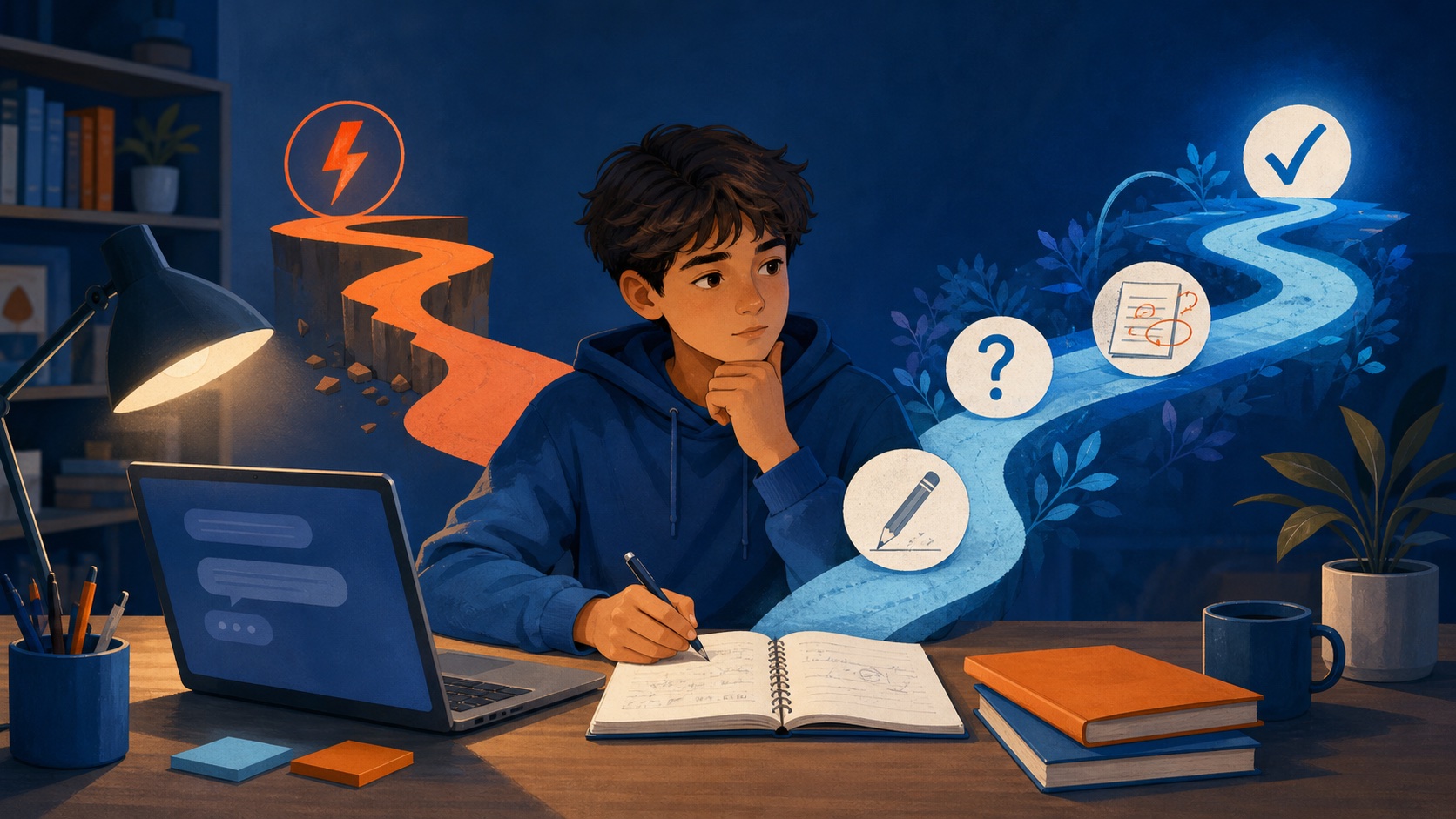
AI should take over friction, not the thinking a student is supposed to practice. Before using it for schoolwork, identify the assignment’s learning target. Then let AI clarify, hint or respond to a student’s attempt—but do not let it produce the evidence of learning on the student’s behalf.
This distinction matters because AI use is already normal. In a nationally representative 2025 survey, 54% of U.S. teens said they had used chatbots for schoolwork, and one in ten said chatbots helped with all or most of their work. The useful question is no longer simply whether students use AI. It is which part of the learning they hand over.
Start With the Learning Target, Not the Tool
The same AI action can support one assignment and defeat another. Text-to-speech may remove an irrelevant reading barrier in a science investigation, for example, but it bypasses the target if the teacher is assessing oral reading fluency. Asking for a sample outline may be reasonable when the goal is to compare organizational strategies; it is a shortcut when creating the outline is the skill being assessed.
What should the student be more able to do alone after completing this task?
If the answer is “solve this kind of equation,” AI must not solve the first equation the student sees. If the answer is “revise an argument for clarity,” AI can act as a reader and point to a confusing sentence, but it should not replace that sentence. If the answer is “remember key science concepts,” AI can generate questions, but the student still needs to retrieve the answers before seeing feedback.
This approach is consistent with current AI-literacy frameworks. The OECD and European Commission framework for primary and secondary education treats AI literacy as the ability to understand systems, evaluate outputs and use them ethically and creatively. UNESCO’s student framework likewise puts human agency and accountability ahead of mere tool operation.
The AI Delegation Ladder
This ladder keeps the student in charge of the work. It is not a rule that every assignment must use all six steps. It is a way to decide how far AI may enter the process without taking over the target skill.
- Define and attempt.The student restates the task, identifies what is known and makes a real first attempt before opening AI.
- Clarify.AI may explain directions, define an unfamiliar non-target term or help break the schedule into manageable steps.
- Hint.AI gives one bounded cue or asks one useful question without revealing the solution.
- Respond.The student produces the answer. AI comments on that attempt rather than supplying a replacement.
- Verify and transfer.The student checks sources, revises deliberately and completes a similar task without AI.
- Disclose.The student can say plainly what AI did and follows the teacher’s rules for acknowledgment.
The safest default is to move down the ladder only as far as the student needs. If clarification is enough, do not ask for a hint. If a hint is enough, do not request a worked solution. This preserves what learning scientists call retrieval, explanation and productive effort rather than turning every difficulty into an answer request.
Green, Yellow and Red Uses
Usually supports learning
- Quiz me from these notes, one question at a time.
- Point to the first step where my solution goes wrong. Do not solve it.
- Ask me two questions that would make this argument clearer.
- Give me a new problem with the same underlying concept.
Depends on the target
- Brainstorm ideas before the student has generated any.
- Summarize a reading the student is expected to understand.
- Create an outline for an assessed essay.
- Translate or simplify material when language is part of the assessment.
Usually replaces learning
- Solve the assigned problem before the student attempts it.
- Write or rewrite the submitted response.
- Invent sources, quotations, observations or personal experience.
- Hide prohibited AI use or disguise AI text as the student’s own.
“Yellow” does not mean forbidden. It means the adult and student need to name the learning target first. A student with a documented support need may appropriately use a tool that would be unsuitable in a different assessment. School rules, privacy requirements and the student’s learning plan still apply.
Four Schoolwork Examples
Middle-school math
A weak prompt is: “Solve 3/4 + 2/3 and show the steps.” The student receives a polished procedure but has supplied none of the reasoning. A learning-preserving prompt is: “I got 5/7. Do not tell me the answer. Ask one question that helps me check whether my denominators can be added directly.” After responding, the student closes the tool and solves a parallel problem unaided.
High-school writing
AI works better as a demanding reader than a ghostwriter. The student drafts the paragraph first, then asks: “Identify one claim that lacks evidence and ask me a question about it. Do not rewrite my sentences.” The student decides whether the criticism is valid, finds evidence and writes the revision. The final prose remains evidence of the student’s writing.
Studying for a science test
AI can turn teacher-provided material into practice questions, but the learning happens when the student tries to retrieve an answer before seeing feedback. The U.S. Institute of Education Sciences’ practice guide on study and instruction supports active retrieval and deep explanatory questions. Ask the tool to wait for an answer, mark uncertainty and stay within the supplied material; then verify any disputed explanation against the class source.
Accessibility support
Speech-to-text, text-to-speech, translation or help organizing steps can make a task accessible. The boundary is the assessed skill. If decoding is not the science lesson’s target, reading support may preserve access to the science. If decoding is the target, the same support changes what is being measured. Students with an IEP, 504 plan or other formal accommodations should use the supports specified by their team and ask before adding a new AI tool.
Use the Three-Part Learning Ownership Test
Before a student submits AI-assisted work, ask three questions:
- Was it allowed?The teacher’s directions and school policy take priority. If the rule is unclear, ask before using AI on the assessed work.
- Did the student still practice the target skill?AI may remove a barrier or provide feedback, but it should not create the performance the assignment is meant to measure.
- Can the student own the result?The student can explain the reasoning, complete a nearby task without AI, verify important claims and describe the assistance honestly.
If any answer is no, move AI one or more steps back up the delegation ladder. A fluent explanation alone is not perfect proof of learning, but explanation plus a short transfer task is much more informative than an AI detector or a polished final page.
What the Evidence Can—and Cannot—Tell Us Yet
Claims about AI and learning often run ahead of the research. A 2026 evidence review summarized by the U.S. Institute of Education Sciences found that strong causal K–12 studies were still scarce. Its cautious conclusion was that student-facing tools show mixed effects: teacher-mediated systems and tools designed to give hints can help, while general-purpose tools may hinder learning when they replace cognitive effort.
One quasi-experiment involving 127 middle-school students illustrates why completion and learning must be separated. Students using a chatbot produced longer, higher-scoring assignments and submitted more of them, but scored lower on knowledge tests and on refining source material. The study was conducted in China with one tool, so it should not be treated as a universal verdict. It does show why a better-looking assignment cannot by itself prove deeper learning. The study record and abstract are available through ERIC.
Current surveys add context, not causation. In August 2026, Common Sense Media reported that 70% of surveyed U.S. teens used AI for schoolwork. Among users, 63% said they used it to get an answer in some form, while 39% felt they missed learning when AI completed assignments. These are students’ reports of their behavior and experience, not an experiment showing long-term cognitive harm.
We do not yet know the long-term effect of routine generative-AI use across ages and subjects. We do have enough evidence to avoid equating faster completion with learning and to favor designs that preserve attempts, hints, feedback, verification and later independent performance.
A One-Assignment Trial for This Week
Families and teachers do not need a surveillance system to set a better boundary. Try this on one assignment:
- Write the learning target in one sentence.
- Choose the lowest useful rung on the AI Delegation Ladder.
- Require a visible first attempt before AI enters.
- End with one explanation or similar task completed without AI.
- Have the student record one line: “AI helped me by ___; I decided ___.”
Then look at the result. Did the student become more capable, or merely finish more quickly? That question is more useful than whether the final page “looks like AI.”
Schools also need transparent local rules. The U.S. Department of Education’s guidance emphasizes parent and teacher involvement, AI literacy and privacy. Before a student enters school material or personal information into any service, check the teacher’s instructions, the school-approved tools and the service’s age and data terms.
Frequently Asked Questions
-
It depends on the teacher’s rules, the learning target and how the assistance is represented. Using a prohibited tool, submitting AI-generated work as one’s own or bypassing the skill being assessed is not acceptable. Permitted hints, feedback or practice questions may support learning when the student still does and discloses the substantive work.
-
A temporary no-AI boundary can be appropriate when a child needs to establish a foundational skill or when a teacher prohibits it. A blanket ban is less useful than teaching a student to preserve the target skill, verify outputs, protect personal information and follow classroom rules.
-
Attempt the task first. Ask for one hint or question at a time, instruct the tool not to reveal the solution, respond in the student’s own words, and finish with a similar problem or explanation without AI. Verify important claims against class materials or reliable sources.
-
Ask the child to explain the reasoning and complete a short, similar task later without AI. A polished assignment shows completion; independent explanation and transfer provide better evidence that learning occurred.