Counting vs. Number Sense: A Child Can Recite Numbers Without Understanding Quantity
Six playful probes for checking whether a young child connects number words to quantities, comparisons and part-whole relationships.
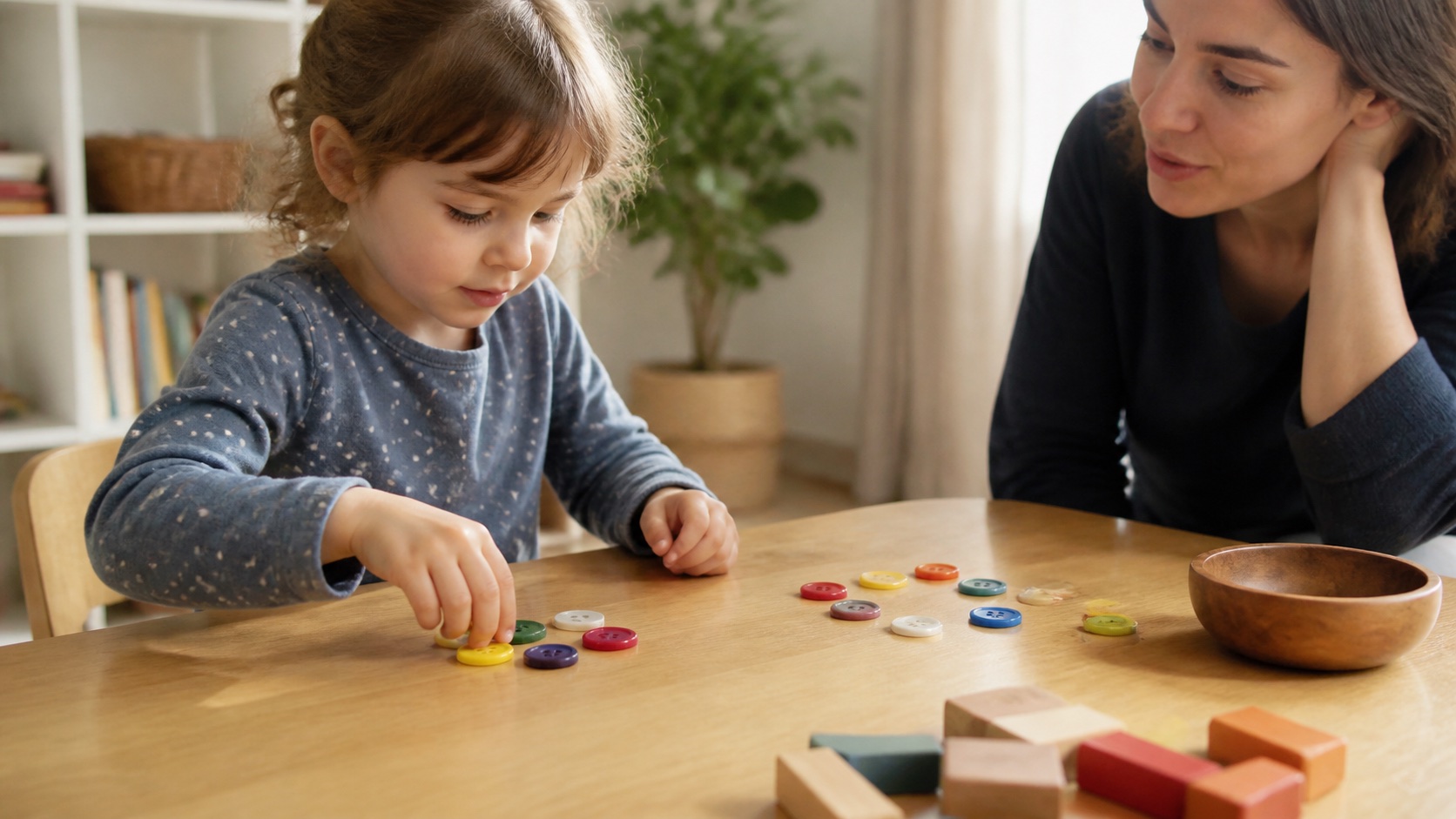
Reciting “one, two, three…” is language memory; number sense begins when those words organize quantities and relationships. A child may count to 100 yet double-count objects, forget that the last number means “how many,” or believe a spread-out row contains more than a compact row.
Do not respond with a longer counting target. Use small collections to observe one-to-one counting, cardinality, production, comparison, one-more relations and composing numbers. Teach the first missing relationship through play and everyday routines.
What Rote Counting Shows—and Hides
Knowing the stable number-word sequence is useful. It supports object counting, later number comparison and calculation. But recitation alone does not show that each word is assigned to one object, that the final word represents the whole set or that six is exactly one more than five.
The Institute of Education Sciences practice guide Teaching Math to Young Children recommends a developmental progression: recognize small quantities, use one-to-one counting and cardinality, compare collections, connect quantities to number words and numerals, and operate on collections.
The following probes are observations, not a standardized test or age-based diagnosis. Use familiar objects and stop before the interaction feels like an exam.
Run the Six-Part Number Meaning Check
See small amounts
Briefly show one to three objects. Can the child say how many without counting each item?
Count one-to-one
Can the child touch or move each object once while saying one number word for it?
Know the total
After counting, can the child answer “How many?” without starting the count again?
Produce a set
Given a mixed pile, can the child give you exactly a requested number of objects?
Compare and order
Can the child identify more, fewer and equal, including when spacing tries to mislead perception?
Compose and change
Can the child see one number as parts and predict one more or one less without recounting everything?
Record strategies and errors, not a score. The first unstable relationship is the best teaching target.
Check One-to-One Counting
Place five to eight buttons in an irregular arrangement. Ask the child to find how many. Watch whether the finger, objects and number words stay synchronized.
Skips objects
Move each counted object into a new line or container so “counted” becomes visible.
Counts one object twice
Slow the touch-word pairing and use fewer objects before increasing the set.
Correct total by accident
Rearrange the same objects and count again to see whether the procedure is stable.
Order changes the answer
Count the same set from another starting point and discuss why the quantity remains unchanged.
Use different objects and arrangements. A memorized row of dots can look like understanding while a scattered collection exposes the counting process.
Test the Cardinality Principle
After the child counts a collection, immediately ask, “So how many are there?” A child who repeats the entire sequence may not yet use the last number word as the total.
Model: touch each object once, emphasize the final word, circle the whole set with your hand and say, “Five—there are five altogether.” Cover the collection and ask how many are hiding. Then uncover it to verify.
IES family guidance explains that cardinality links the final count word to the total amount. This small idea is a gateway: number words begin to refer to exact quantities rather than only positions in a song.
Ask the Child to Make a Number
Request, “Please give the bear six crackers,” using pretend or real objects. Production is harder than recognizing a counted set because the child must hold the requested quantity, stop at the correct point and treat the completed collection as a whole.
If the child keeps counting past six, provide an empty plate and move one object per number word. When the child reaches six, ask, “Did we make six? How can we check?” Let the child verify rather than correcting from outside.
Vary the objects, size and arrangement so “six” becomes abstract: six buttons, six jumps and six spoon taps share quantity despite looking and sounding different.
Compare Quantities, Not Row Length
Make two equal rows of five objects. Spread one row farther apart and ask which has more. Do not treat a perceptual answer as a failure; invite one-to-one matching or counting.
Then compare clearly different sets and introduce “more,” “fewer,” “same” and “difference.” Ask how the child knows. Move from concrete comparison to number words: if one set has five and another has six, six is more because it is one step beyond five in the count sequence.
Longitudinal research has found that early competence involving counting, comparison and calculation is strongly related to later mathematics achievement. One study followed children from kindergarten through third grade and reported strong, persistent relations. Prediction does not mean a home probe determines a child's future; it shows why relationships matter alongside recitation.
Build Part-Whole Knowledge
Show five counters as two red and three blue. Ask, “How many altogether? What are two parts that make five?” Rearrange them as four and one, then hide one part and ask what must be missing.
Part-whole thinking prepares addition and subtraction. It also makes numbers flexible: seven can be five and two, six and one, or three and four. Avoid rushing to written equations before the child can act out and explain the relationships.
Use fingers, plates, steps and blocks. Ask for multiple ways to make the same total and let the child challenge the adult with a hidden-part problem.
Use Ten-Minute Everyday Number Routines
Rotate one relationship at a time
- Set the table: make one plate per person and decide how many are needed.
- Snack shop: order an exact quantity, compare plates and make one more.
- Quick look: flash one to five dots, hide them and ask how the child saw the amount.
- Build it two ways: make the same number with different color parts.
- Number walk: find numerals and connect each to a real quantity or position.
- What changed? add or remove one hidden object and predict the new total.
End while the child is still engaged. Repetition across varied contexts matters more than completing a large worksheet.
Use Apps and AI Only After Naming the Relationship
A counting app can reward tapping in sequence without showing whether the child understands quantity. Ask which relationship the activity targets, then repeat it with physical objects and conversation.
AI can generate number stories or suggest variations, but an adult should inspect the content and operate the tool for young children. Keep personal information out of prompts. After the screen closes, ask the child to build, compare or change the quantity in the real world.
If success exists only with animated cues, repeated answer choices or automatic correction, record that as supported performance—not yet transfer.
Know When to Ask for Educational Support
Children develop early number ideas at different rates and may show uneven skills. Share observations with the teacher when a child persistently cannot coordinate one object with one count word, connect the last word to the total, produce small requested sets or compare quantities despite repeated playful instruction.
Ask what the child demonstrates in class and whether language, attention, vision, motor demands or access to instruction affect performance. Do not use one home activity to diagnose a learning disability.
The goal is not earlier arithmetic performance. It is a connected number system in which words, symbols, quantities and relationships make sense together.
Frequently Asked Questions
-
Not necessarily. Reciting the sequence is useful, but number sense also requires counting objects accurately, knowing the total, producing quantities, comparing amounts and understanding part-whole relationships.
-
Cardinality is understanding that the last number word used when counting tells how many objects are in the whole collection.
-
Worksheets can provide limited practice, but young children also need to act on real quantities, explain comparisons and build numbers with objects. Paper symbols should connect to those experiences.
-
Use small everyday collections: set the table, make snack amounts, compare towers, show quick dot patterns and find multiple ways to split the same number.
-
Discuss persistent difficulty with the teacher when the child does not progress with one-to-one counting, cardinality, producing small sets or comparing quantities despite repeated, appropriate instruction.