Why Does My Child Make Careless Mistakes in Math? Diagnose the Error Before Adding Practice
A six-source error map for finding out whether repeated math mistakes come from meaning, translation, procedures, fluency, monitoring or task conditions.
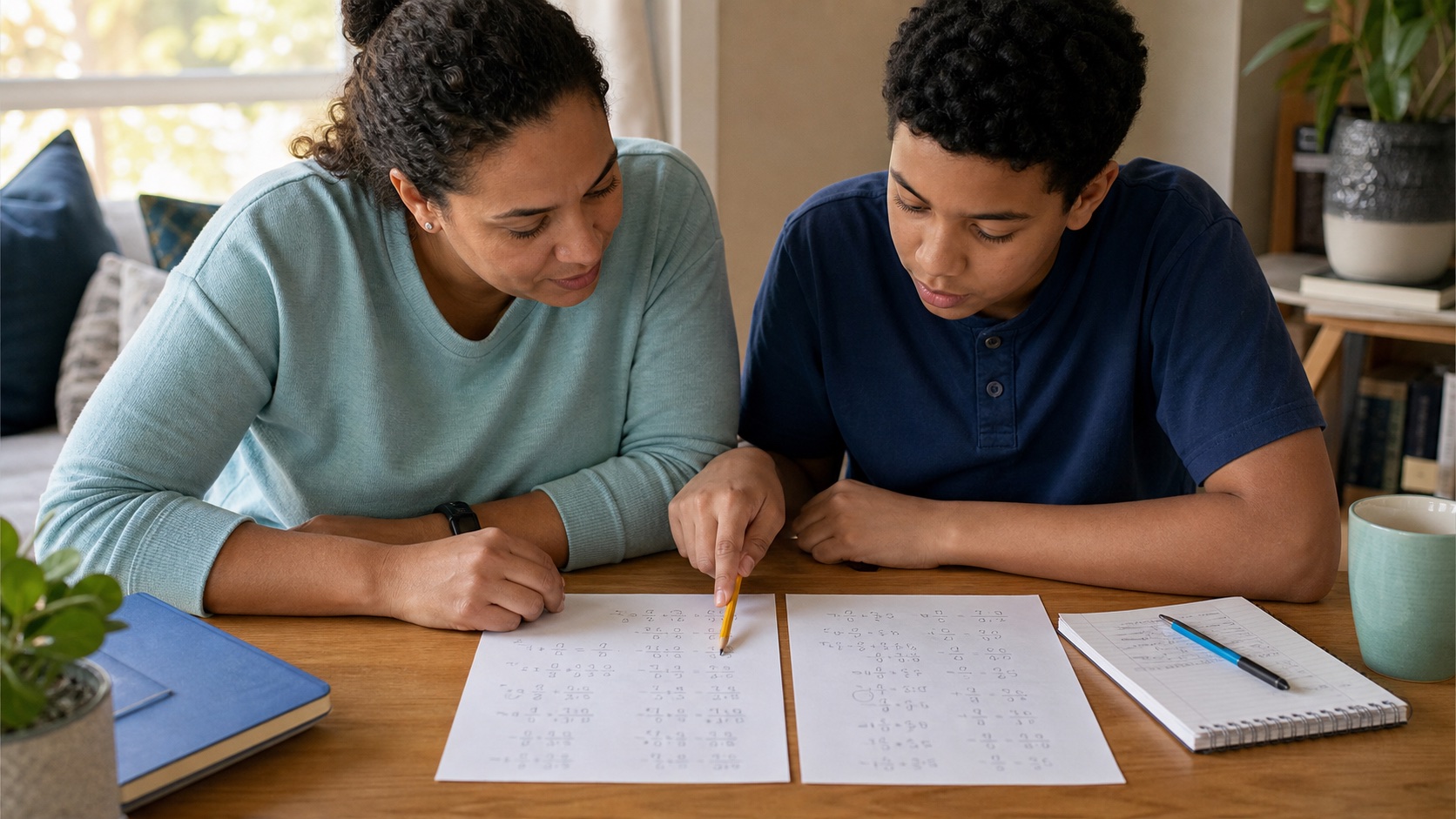
“Careless” describes how surprising a math error looks to an adult; it does not explain why the error happened. A child who loses a negative sign, chooses the wrong operation or writes 35 for 53 − 28 may need three completely different responses. Telling all three children to slow down gives none of them new information.
Find the first place the work diverged, collect several matched examples and test one explanation at a time. The Six-Source Math Error Map below separates problems with meaning, translation, procedure, retrieval, monitoring and task conditions. The goal is not to excuse mistakes. It is to make accuracy teachable.
Replace the Character Judgment With Diagnostic Data
A correct answer tells little about the route; an incorrect answer can reveal a great deal. Two students may both miss 53 − 28. One subtracts the smaller digit from the larger in each column and obtains 35 every time. Another knows regrouping but copied 53 as 35 once. The first has built a coherent but incorrect procedure. The second may have made a recording slip.
The difference matters because responses can work against each other. More independent worksheets may strengthen a misconception. A long concept lesson may frustrate a student who needed one specific recording routine. Extra checking time may do nothing when the student checks by repeating the same flawed process.
The U.S. Department of Education-supported National Center on Intensive Intervention defines error analysis as reviewing student work to identify common error types and better align intervention with need. Vanderbilt’s IRIS Center similarly recommends collecting work, identifying a pattern, determining a likely reason and selecting a matched instructional response.
Write “copied 47 as 74 on line two,” not “rushed.” Write “added the two quantities although the question asked how many remained,” not “didn’t read.” Description is evidence; the cause is still a hypothesis.
Use the Six-Source Math Error Map
Several sources can operate in one problem. Start with the earliest plausible source, then test it.
Meaning or model
The student has an inaccurate idea about quantity, an operation or a relationship. The same rule appears across examples and the child may explain it confidently.
Translation or selection
The student misreads language, notation, a diagram or the requested quantity. Computation may be correct for a different problem.
Procedure or sequence
The concept is partly present, but a method, condition or transition is fragile: regrouping, common denominators, order of operations or sign rules.
Retrieval or fluency
Basic facts and component calculations are slow or unreliable, consuming attention needed for the larger problem.
Recording or monitoring
A digit, sign, unit, calculator entry, alignment or final transfer changes even though the underlying reasoning remains intact.
Load or context
Performance changes with time pressure, anxiety, fatigue, distraction, dense layout or the number of steps that must be held in mind.
This map is an editorial observation tool, not a clinical assessment. A repeated sign error does not establish ADHD; slow fact retrieval does not establish dyscalculia; worse test performance does not by itself establish math anxiety. The categories tell you what evidence to gather next.
Find the First Divergence, Not the Final Wrong Answer
Work backward only until you find the earliest moment the student’s representation, choice or execution differs from a sound path. Later errors may simply be consequences.
- Wrong model: For 53 − 28, the student says each column means “larger minus smaller.” The divergence occurs before calculation; reteach what regrouping represents.
- Wrong translation: A word problem asks how many stickers remain. The student correctly adds the two numbers. The arithmetic is not the first problem; selecting the relationship is.
- Fragile sequence: The child can explain equivalent fractions with a model but adds denominators when the visual is removed. The bridge from meaning to symbolic procedure is unstable.
- Fact load: The child chooses the correct long-division method but repeatedly stops to reconstruct multiplication facts and loses the partial remainder.
- Monitoring slip: Every line follows logically except −7 becomes 7 during copying. The student immediately finds it when asked to compare adjacent lines.
- Context effect: The method is accurate in short, untimed sets but breaks down on a dense timed page. The changed condition is evidence, not proof of a particular diagnosis.
Ask the child to narrate the work without defending it: “What were you trying to find here?” “Why did this step make sense?” “Where did this number come from?” Avoid revealing the error in the question. A child who can reconstruct the reasoning gives you more information than one asked only to correct an answer.
Build a Two-Week Error Fingerprint
One mistake is an event. A diagnosis needs a pattern. The IRIS process recommends at least three to five problems of the same type when looking for a consistent error. At home, collect authentic examples across roughly two weeks rather than creating a high-pressure extra test.
Record six things for each useful error
- Task: topic, format and whether it was homework, classwork, a quiz or a test.
- First divergence: the earliest visible step, choice or transcription that changed the path.
- Child’s explanation: their reasoning in their own words, recorded briefly and without correction.
- Immediate response: whether the child can find and fix it with no cue, a location cue or conceptual help.
- Condition: time, fatigue, distraction, page density, calculator use and emotional state—described without diagnosing.
- Transfer: performance on one changed problem after help is removed.
Do not log every imperfection. Choose errors that repeat, cost important understanding or differ sharply by setting. Also record correct work that resembles the error; contrast reveals what the child can already do.
At the end of two weeks, look for concentration. Are most errors at the same conceptual boundary? During language-heavy problems? When basic facts interrupt multiple steps? Only near the end of long sessions? A scattered set may be ordinary variability. A concentrated fingerprint suggests a testable instructional response.
Run a 90-Second Replay Before Assigning More Practice
Take one representative error after emotions have settled. Cover the teacher’s correction and use this short replay:
- Restate: “Tell me what the problem is asking us to find.”
- Reconstruct: “Walk me through what you did. You do not need to fix it yet.”
- Locate: “Compare these two neighboring steps. What changed?”
- Test: Give a similar problem with one feature changed and no help.
The response provides a rough fingerprint. If the student cannot state the quantity or relationship, investigate translation and meaning. If the explanation is sound but execution fails at the same transition, investigate procedure. If one location cue produces an immediate correction but the changed problem repeats the slip, monitoring has not yet transferred. If accuracy returns when the page is shortened or time is removed, investigate load and context.
Self-correction is encouraging, but it is not the same as prevention. A child may recognize an error once an adult announces that one exists. The meaningful question is whether the child detects or avoids it on the next problem without that announcement.
Match the Response to the Source
Choose one response, use it on a small matched set and then remove the support.
Meaning or model
Return to quantities and relationships. Use a number line, base-ten model, area model or concrete example; ask the child to predict and explain before repeating the symbolic procedure.
Translation or selection
Have the child name the unknown, label units, sketch the relationship and paraphrase the question. Teach mathematical language directly rather than hunting only for keywords.
Procedure or sequence
Compare a correct and incorrect worked example. Explain why each step is valid, practice the difficult transition and fade a short step card.
Retrieval or fluency
Use brief, focused, spaced practice on the component facts or calculations. Preserve strategies and understanding; do not bury the student in mixed worksheets.
Recording or monitoring
Create one targeted checkpoint: scan only signs, compare copied numbers, align place values, estimate magnitude or verify a calculator entry. Retire it when the pattern changes.
Load or context
Compare shorter and longer sets, untimed and appropriately timed work, or uncluttered and dense formats. Build tolerance gradually while preserving access to the mathematics.
The 2021 What Works Clearinghouse practice guide supports systematic instruction, explicit mathematical language, carefully chosen representations and deliberate word-problem teaching for elementary students who struggle. It also includes timed activities as one route to fluency. That is different from treating speed as the definition of understanding or using time pressure before a method is secure.
Concepts, Procedures and Facts Are Interwoven
Parents often hear that a child either “understands the concept” or “just needs practice.” Mathematics is less separable than that.
The National Academies’ five strands of mathematical proficiency connect conceptual understanding, procedural fluency, strategic competence, adaptive reasoning and productive disposition. A child can understand what multiplication means yet lack efficient facts; that load can disrupt a multistep task. Another can execute a memorized algorithm quickly without noticing that the answer is unreasonable.
NCTM’s procedural-fluency guidance argues that concepts and procedures should be explicitly connected. Memorizing an unexplained procedure can produce errors the student does not recognize, while understanding without enough accurate practice can leave execution too effortful.
Fact retrieval also varies among learners. A longitudinal study of children with low mathematics achievement and mathematical learning disability found distinct patterns involving fact retrieval, procedures and number knowledge. It does not mean every slow fact is a disability. It supports the narrower point that “more careful” is not a single remedy for multiple components of performance.
Treat Anxiety and Working-Memory Load as Hypotheses
Worry can occupy attention that a multistep problem needs, but parents should not infer anxiety from one poor test. A meta-analysis of 131 studies of school-age students found a moderate negative association between mathematics anxiety and performance (r = −.34), stronger for some advanced, multistep and grade-related measures. The evidence is correlational: anxiety may impair performance, repeated difficulty may increase anxiety, and both can reinforce each other.
A study of 202 primary-school children also found that the relationship among math anxiety, performance and visuospatial working memory differed by task and working-memory profile. This cautions against a simple story in which every pressured error is either “nerves” or “not knowing.”
Look for contrasts: Does the child explain accurately in conversation but lose steps under evaluation? Does performance change when one problem is shown at a time? Are errors clustered late in a session? Does the child express dread, physical discomfort or avoidance? Share repeated patterns with the teacher. The response may involve instruction, task design, routines and emotional support—not merely relaxation or harder drilling.
Use Checking That Can Falsify the Answer
“Check your work” often means reread the same path while expecting it to be correct. A useful check approaches the answer from a different direction.
- Estimate: Is the size and sign plausible before exact calculation?
- Inverse: Does addition undo the subtraction, or multiplication undo the division?
- Substitute: Does the proposed value satisfy the original equation?
- Represent differently: Does a diagram, number line or second method agree?
- Answer the question: Does the final statement name the requested quantity and unit?
- Target the fingerprint: If negative signs are the known risk, perform one sign-only scan rather than rereading everything.
Checking should be short enough to use independently and specific enough to catch the observed pattern. If a checklist grows to twelve reminders, it becomes another working-memory task. Keep one or two checks, collect evidence and replace them when the error changes.
AI Can Organize Errors, but It Cannot Diagnose From a Photo
An AI tool can help a parent turn notes into a table, generate matched practice or suggest questions to ask. It can also misread handwriting, infer a misconception from one example, teach a method that conflicts with the class or reveal the answer before the child thinks.
If AI is used, remove names and school records, provide several anonymized examples and ask it to describe the earliest visible divergence—not diagnose the child. Verify the mathematics and compare its hypothesis with the student’s explanation and teacher’s evidence. Our guide to AI tutoring versus homework help explains why genuine diagnosis requires a student attempt, a matched response and a new unaided problem.
Keep the child in the loop. Ask them whether the proposed pattern fits, where it does not and what evidence would change the conclusion. This preserves the Reconstruct–Transfer–Disagree habits that AI assistance can otherwise bypass. A generated label should never become a hidden judgment about ability.
Know When the Pattern Needs a Teacher
Bring the error fingerprint—not only the grade—to the teacher when:
- the same conceptual or procedural error continues after clear, matched instruction;
- difficulties span foundational number magnitude, place value, facts and procedures;
- there is a large, repeated gap between oral reasoning and written production;
- performance changes sharply across classroom, homework and test settings;
- math triggers persistent distress, avoidance or negative beliefs about ability;
- a sudden decline appears across math or other areas;
- the child already has accommodations or support that may need coordination.
Ask what patterns appear in class, which prerequisite skills have been assessed, what instruction has already been tried and how progress will be measured. A teacher or school team may use screening, diagnostic interviews or formal assessment when warranted. Parents should not diagnose ADHD, dyscalculia, a visual problem or an anxiety disorder from homework errors alone.
The practical rule is simple: stop saying “be careful” and start naming evidence. Find the first divergence, test three to five matched examples, change one condition, teach one response and check a new problem after support is gone. Accuracy improves when the child knows what to notice—not when the child hears that mistakes should not happen.
Frequently Asked Questions
-
Understanding is only one part of performance. The child may have a fragile procedure, slow fact retrieval, difficulty translating the question, a copying or monitoring slip, or increased load under time pressure. Compare several matched problems and find the first step that changes rather than assuming one cause.
-
Usually not before identifying the pattern. Select representative errors, ask the child to reconstruct the reasoning and practice a small set matched to the likely source. Redoing an entire mixed worksheet can create frustration and may rehearse an incorrect method.
-
Use a check that could disprove the answer: estimate its size, apply the inverse operation, substitute into the original equation, compare with another representation or scan for one known error type. Generic rereading often repeats the same reasoning and misses the same problem.
-
No. Individual mistakes and home observations cannot diagnose either condition. Repeated patterns across tasks and settings can justify a conversation with the teacher or school support team, who can review instruction, prerequisite skills, broader functioning and whether formal evaluation is appropriate.
-
Math anxiety is associated with lower performance and can add working-memory load, especially on demanding or evaluative tasks. It is not the only explanation, and one poor test is not a diagnosis. Compare performance across settings and discuss persistent distress or avoidance with the teacher.