STEM Toys Product Guide

8 Best Solar Power Kit for Kids in 2026: The Ones That Run

Help picking a solar power kit for kids that actually works: which kits truly move in sunlight, which offer indoor battery backup, and which builds kids can manage alone.

8 Best Solar Power Kit for Kids in 2026: The Ones That Run editorial illustration

Most solar robot kits promise a model that zips across the patio the moment sunlight hits it. In practice, the tiny panels these sets ship with rarely produce enough power unless the sun is unblinking and direct. That is why a kit that also runs on a battery makes all the difference on cloudy days and inside the living room.

The other reality is that big '12-in-1' or '30-in-1' numbers advertise build variety, not reliability. Many children end up with a model that never moves because a motor arrived dead or the instructions were too confusing to follow alone. The difference between a kit that runs and one that gathers dust comes down to power source and build complexity, not the bold number on the box.

Across the category, simpler builds with fewer configurations show more dependable solar function, so real-world performance tracks with simplicity, not piece count.

#1

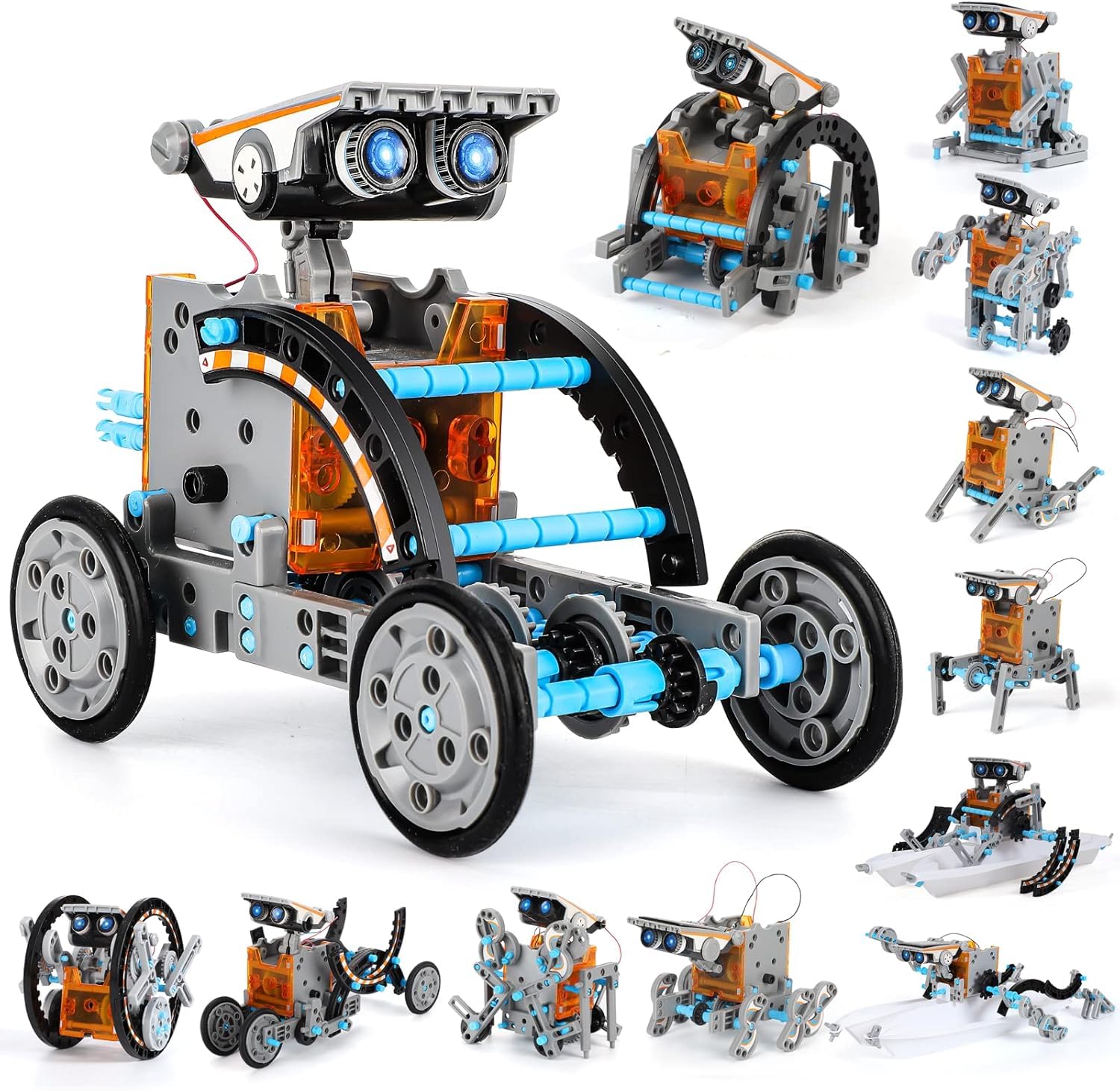
KIDWILL 14-in-1 Solar Robot
KIDWILL 14-in-1 Solar Robot

All-round versatility

Customer rating 4.4/5
Check Price

Worth Noting

  • Some parts fit tightly
  • Solar-only runs need intense direct sunlight, and an occasional motor may arrive without working.
Material
ABS plastic
Power Source
Solar + battery
Assembly Ease
Parent help for ages 8-10
Configurations
14-in-1 / 196 pieces
Read the full review

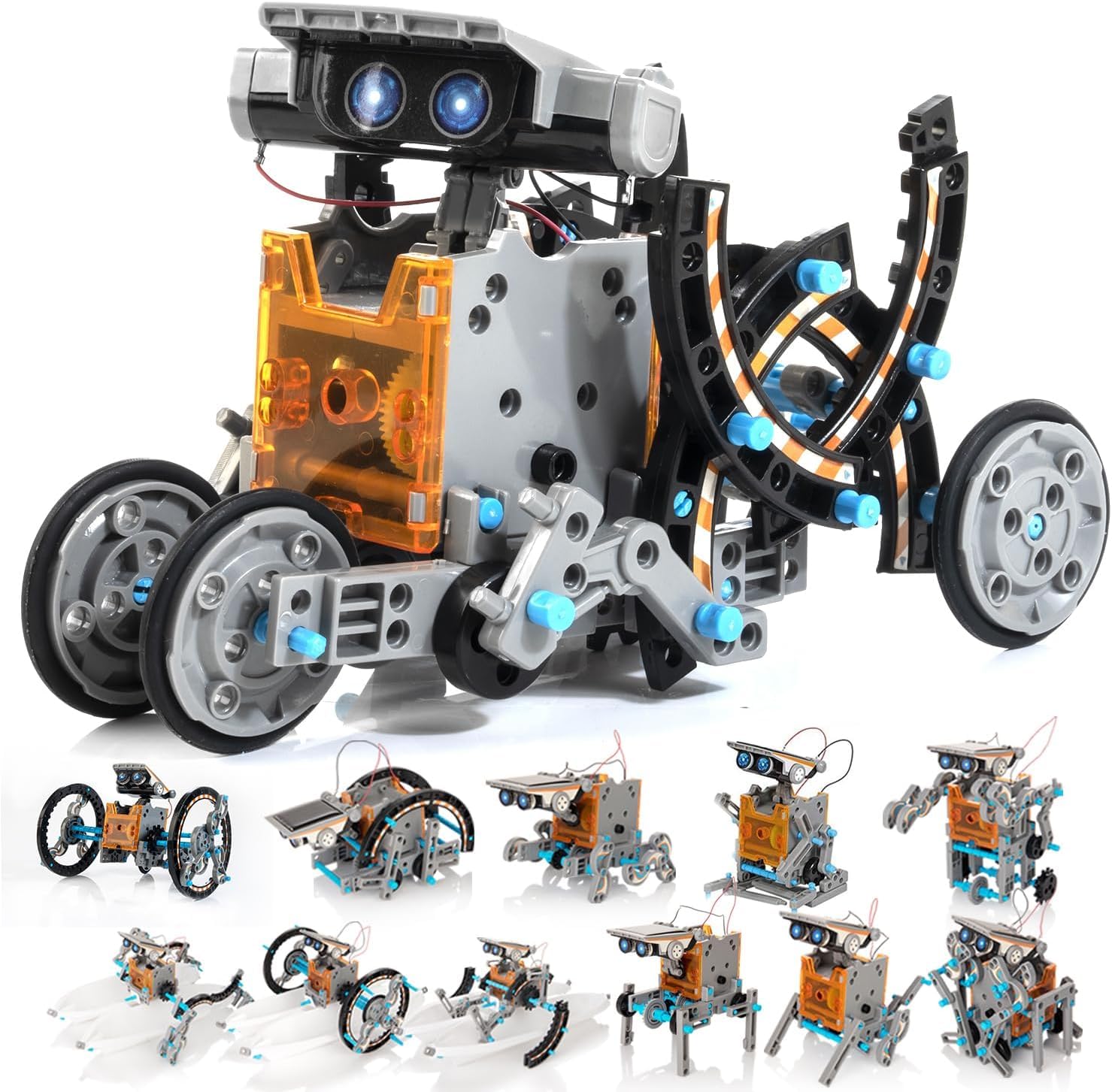
The KIDWILL sidesteps the category's biggest letdown with a single AAA battery backup, so the robot keeps moving when the sun slips behind a cloud — something the solar-only wooden kits in this set can't manage. The 14-in-1 layout rebuilds into 14 different robots from one ABS-plastic set, and each configuration introduces a new mechanical motion, extending the kit's play life without extra purchases. Parents note genuine educational payoff in fine motor skills and engineering thinking, which gives this the strongest educational value among the multi-config kits here. Illustrated step-by-step instructions walk through each build, and it also carries strong gift appeal — kids are genuinely delighted to receive it.

This suits advancing builders aged 8-13 who enjoy reconfiguring a single robot into new shapes, plus gift-givers after a rebuildable multi-config kit. Parents wanting both indoor battery play and sunny-day solar runs get a dual-power setup that sets it apart in this range. The quality holds up at a budget price point, which is why it lands as the value pick of the group.

Keep a single AAA battery loaded — the robot runs indoors on it and flips to solar when the sun is out.

Bottom line: For a gift that keeps a young builder coming back, the KIDWILL pairs 14 rebuilds with a battery backup the solar-only kits here lack — the strongest value in the set.

#2

SCAEMO 4-Set Wooden STEM Kit

SCAEMO 4-Set Wooden STEM Kit

Sunlight demos

Customer rating 4.6/5
Check Price

Worth Noting

  • Small pieces can slip away during assembly and are easy to misplace.
  • Wood-frame builds can crack or disconnect within a day of assembly.
Material
Wood
Power Source
Solar + wind + electric
Assembly Ease
No glue, no tools
Configurations
4 projects
Read the full review

The SCAEMO 4-set's panels fire up within seconds of direct sun and drive the motor until the light drops; there's no battery backup, so indoor or overcast play is out, where the top pick's dual-power build keeps moving. That tradeoff buys four genuinely working projects for the money.

This is a strong fit for kids aged 6-10 who want quick, visible wins and a classroom demo that actually runs. The build trades durability for function — a fragile wooden frame and small parts reward careful hands, which suits supervised assembly more than rough play.

Place finished models in direct, unblocked sunlight — the solar panels need clear exposure to drive the motor.

Bottom line: Right for classroom solar demos and quick-win builders who want four working projects for the money.

#3

CYOEST 4-Set Building Kit

CYOEST 4-Set Building Kit

Younger builders

Customer rating 4.6/5
Check Price

Worth Noting

  • Pieces can crack when the wood is forced together
Material
Wood
Power Source
Solar + wind + electric
Assembly Ease
No screws, no glue
Configurations
4 projects
Read the full review

The CYOEST four-project set drops screws and glue entirely, letting an 8-year-old assemble each kit mostly on their own — the easiest build in this lineup. Four separate projects (solar car, wind vehicle, solar plane, fan) turn a budget purchase into a weekend of hands-on building rather than a single robot.

It fits first-time STEM builders aged 8-10 and parents sharing a guided project. The thin wood pieces reward gentle handling, making this a family-bonding kit — not a toy for hard play.

Assemble the wood with light pressure and adult supervision — pieces click together without force.

Bottom line: A budget-priced four-project set that gives younger builders their first independent solar build — best when an adult is nearby to guide the gentle assembly.

#4

Wesfuner 30-in-1 Solar Robot

Wesfuner 30-in-1 Solar Robot

Maximum variety

Customer rating 4.5/5
Check Price

Worth Noting

  • Small-print instructions can be misread, setting a build back to an earlier step.
  • A motor can arrive dead, leaving an assembled robot sitting motionless.
Material
ABS plastic
Power Source
Solar + battery
Assembly Ease
Parent help required
Configurations
30-in-1 / 243 pieces
Read the full review

A single set that rebuilds into 30 different robots from 243 pieces offers the widest configuration range of any kit here, running on solar or battery. Where the 14-in-1 all-rounder favors quick turnaround, this one turns each build into an afternoon project, and kids stay engaged to the finish. Best for patient kids 8-12 who love long building sessions and gift-givers after a big, impressive unboxing; assembly demands focus, so it's a poor fit for younger or impatient children. The substantial box makes a strong first impression on arrival, and each config brings its own working mechanism.

Plan for a full afternoon on the first build — this set rewards slow, careful assembly.

Bottom line: Choose this for a child who savors the build itself — patient hands get the most projects per box in this set.

#5

4M Green Science Solar Rover

4M Green Science Solar Rover

First introduction

Customer rating 4.4/5
Check Price

Worth Noting

  • The thin plastic can crack under pressure, so a steady adult hand helps on the first build
  • The rover only rolls under intense direct sunlight, staying still indoors or under cloud cover
Material
Aluminum / plastic
Power Source
Solar only
Assembly Ease
Parent support
Configurations
Single build
Read the full review

The 4M Solar Rover delivers one quick, satisfying build rated for ages 5+, making it the simplest gateway into solar power in this lineup. Where the top pick divides attention across 14 rebuildable configurations, this single rover gets a young beginner to a finished, moving toy fastest. The instructions are clear enough that the build needs only light adult supervision.

This fits ages 5-7 taking a first step into solar mechanics, plus quick classroom demos. It is a gentle-first-step kit rather than a rough-play toy, and it needs a bright, sun-drenched spot to roll — the acceptable tradeoff at a budget price.

Bottom line: For the youngest beginner, this is the fastest route from unboxing to a moving solar rover — a single satisfying build with no multi-kit assembly fatigue.

#6

Sillbird 12-in-1 Solar Robot

Sillbird 12-in-1 Solar Robot

Budget bestseller

Customer rating 4.3/5
Check Price

Worth Noting

  • Shoppers wanting confirmed durability before purchase find no independent verification; the kit's popularity is the main assurance.
Material
ABS plastic
Power Source
Solar + battery
Assembly Ease
Parent help often
Configurations
12-in-1 / 196 pieces
Read the full review

Sillbird's kit is the category's most-bought 12-in-1: 196 pieces reconfigure into a dozen robots, and dual solar-battery power keeps it running indoors or on cloudy days, all at a budget price. Real-world performance and part quality are not independently confirmed, so purchase confidence rests on the kit's popularity rather than a verified owner track record.

Bottom line: Best for gift-givers after the category's most-bought budget 12-in-1 who are comfortable adopting on popularity alone.

#7

Lucky Doug 12-in-1 Solar Robot

Lucky Doug 12-in-1 Solar Robot

Budget multi-robot

Customer rating 4.2/5
Check Price

Worth Noting

  • Only runs in full direct sunlight
Material
BPA-free ABS
Power Source
Solar only
Assembly Ease
Parent help likely
Configurations
12-in-1 / 190+ pieces
Read the full review

This budget 12-in-1 from Lucky Doug packs 190+ ABS pieces into twelve STEM builds young builders can rotate through, powered by a solar panel. It ranks below the dual-power kits in this set, which add a battery backup for steadier function.

Bottom line: For a patient young builder who wants many builds from one box on a budget, this is an affordable first STEM kit.

#8

COBFDHA 6-in-1 Space Robot

COBFDHA 6-in-1 Space Robot

Space-themed learning

Customer rating 4.4/5
Check Price

Worth Noting

  • Younger builders may find instructions confusing and parts hard to fit without an adult's help
Material
ABS plastic
Power Source
Solar or battery
Assembly Ease
Parent help needed
Configurations
6-in-1 / 120 pieces
Read the full review

Six space-themed builds deliver genuine learning for kids who love outer space — feedback on the educational payoff runs strongly positive, especially among 8-year-olds. The tradeoff is the build itself: instructions can be confusing and the engine/gear assembly may arrive faulty, so this is a parent-child project rather than an independent first build.

Help with the early assembly and confirm the motor spins once built — testing early catches fit issues before final setup.

Bottom line: For space-loving kids who enjoy a build challenge and have a patient adult to lend a hand, this delivers real learning at a budget price — plan to help assemble and test the motor.

How to Choose

Solar-Only vs Dual Power

The tiny photovoltaic panels in these kits generate only a few milliamps, enough to spin a small motor only under unclouded, direct sun. Indoors beneath typical room lighting, most solar-only models stay still. Battery backup lets the same build run on cloudy days or inside, which is why dual-power sets consistently meet expectations.

Configurations and Piece Count

A '12-in-1' or '30-in-1' label means one motor, gearbox, and set of parts can be rebuilt into different models, not that the box holds a dozen finished robots. More configurations add long-term play value for an eager builder, but they also add disassembly, instruction-following, and more chances for a tiny part to get lost. Save the high-configuration kits for children who genuinely enjoy rebuilding.

Assembly Age Fit

Most of these are not snap-together toys. Gears and axles must be seated precisely, and the folded instruction sheets are often dense black-and-white diagrams that assume an adult is involved. A child aged 8-10 normally needs a parent on hand for at least the first build. For independent projects, choose tool-free kits with large, clearly labeled pieces and shorter steps.

Material Durability

Plastic robot kits use ABS, which handles repeated rebuilding and rough handling far better than budget wooden kits. Thin plywood can crack if pieces are forced together too hard, sometimes within a day of assembly. Durability is the deciding factor when the finished model will be played with regularly instead of demonstrated once.

Verified Solar Function

The solar panel is the weakest link in every kit here. Real-world results show that simpler, fewer-piece designs deliver more consistent solar function because a direct-drive connection has less to go wrong than a complex multi-gear drivetrain. Battery backup is practical insurance, and any solar robot should be tested outdoors in full sunlight before you assume the motor is defective.

Frequently Asked Questions