STEM Toys Product Guide

9 Best Planetarium Projectors of 2026: Star-Filled Learning for Kids

Kid-friendly planetarium projectors that balance image clarity, scene variety, and durability for early astronomy learning at a fair price.

9 Best Planetarium Projectors of 2026: Star-Filled Learning for Kids editorial illustration

A planetarium projector in a kid's room is less about decoration and more about putting the night sky low enough to reach. Most families discover, though, that crisp stars and legible planet labels don't always survive the trip from the box to the ceiling. Blurry 'HD' slides and rotation motors that die after a few weeks are the two biggest disappointments in this category.

The right choice comes down to one honest trade-off: you can have a durable, teacher-designed educational tool with a small set of sharp images, or you can have an immersive rotating starfield with dozens of scenes but a shorter expected lifespan. Matching that trade-off to your child's age and how you plan to use it matters more than the price tag.

Whether your goal is a toddler's first space toy or a hands-on STEM activity for a school-age kid, the picks below are organized by the job they do best, so you can find the one that fits your ceiling and your bedtime routine.

#1

Learning Resources Shining Stars

Learning Resources Shining Stars

Preschoolers (3-7)

Customer rating 4.5/5
Check Price

Worth Noting

  • Ships with just 3 discs and no expansion path, so the scene variety stays limited.
  • On arrival, a unit may not power on, or it can stop responding after a few minutes
Power
3 AAA batteries
Scenes
24 images, 3 discs
Rotation
None
Brightness
Good in dark room
Read the full review

The Shining Stars Projector serves one purpose: bringing early space science within reach of a three-year-old. Its three discs carry 24 planet, star, and constellation images that project clear and colorful onto a dark ceiling. A single button cycles through the whole set, so a preschooler can run the show solo with no menu for an adult to read.

It fits families who want a first space toy that plays like a story tool more than a light show — the kind of routine that settles a child at bedtime while satisfying early questions about the sky above them. That modest ambition is the point: older kids (8+) after a full-room rotating starfield will find the immersive option in this set the better match, so this one is best aimed at the 3-7 crowd.

The body is simple and sturdy — the reason it shows up in early-childhood classrooms rather than just bedrooms. Three AAA batteries drive the projection, which lands clear on a ceiling or wall with no focus dial or app to fuss with, and the light stays gentle enough for a sleep-friendly glow.

Rotate the three discs across the week — the limited scene variety suits short attention spans best, keeping each image feeling new.

Bottom line: The right call when a first space toy should teach more than it dazzles — sturdy enough for daily use and simple enough for a three-year-old to drive.

#2

Fussion Galaxy Projector

Fussion Galaxy Projector

Bedroom atmosphere

Customer rating 4.2/5
Check Price

Worth Noting

  • In a room that can't be made dark, the projection turns dim and loses impact
  • Image detail varies between units
Power
USB-C
Scenes
13 scene discs
Rotation
360°, 2 speeds
Brightness
Needs dark room
Read the full review

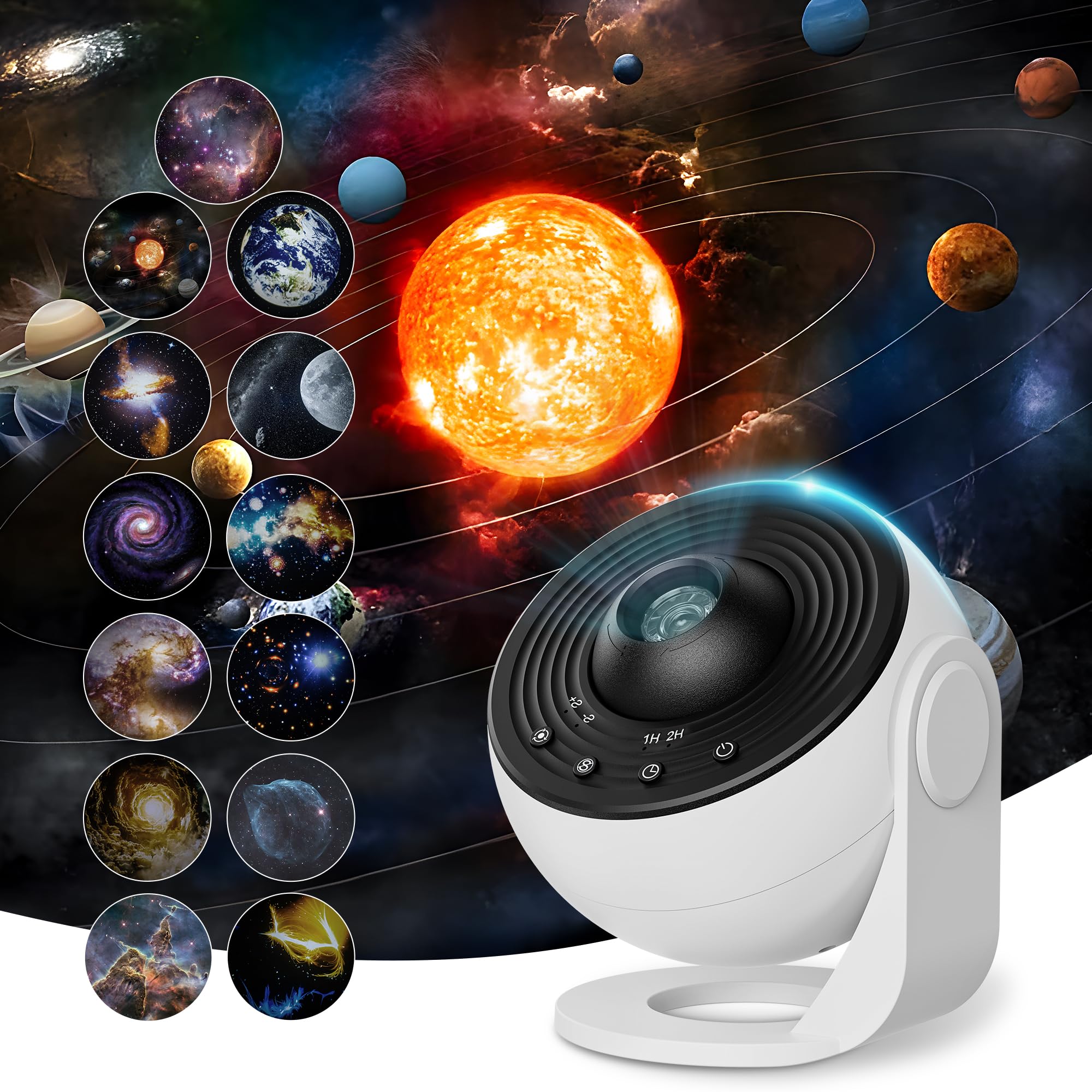
The 13-scene rotating starfield casts a calming bedtime glow across the ceiling — the immersive effect families buy this for, with kids happily swapping discs to pick a different projection each night. This suits households prioritizing atmosphere over educational detail; pin-sharp constellation labeling is not its strength. Sharpness and brightness vary between units, so the fullest effect emerges in a near-dark room — a boundary that fits the bedtime ritual rather than the classroom.

Place it in a room that can go fully dark at bedtime — brightness levels are tuned for near-total darkness.

Bottom line: Right for a bedtime setting where the room can go dark and the goal is atmosphere, not educational detail — the immersive starfield it delivers is what families love.

#3

MuliVid Galaxy Pro

MuliVid Galaxy Pro

Clear planet images

Customer rating 4.3/5
Check Price

Worth Noting

  • In brighter rooms the projection reads dim
  • During initial set-up, some units arrive with a rotation motor that never turns
Power
USB-C
Scenes
13 discs
Rotation
360°
Brightness
Needs dark room
Read the full review

The MuliVid Galaxy Projector Pro is the sharpest budget projection in this set — the crisp black-and-white Moon and clearly identifiable planets stand out at this price. Where the immersive starfield option favors soft, drifting scenes, the MuliVid offers defined outlines better suited to kids picking out planets by sight.

This fits space-themed nurseries and bedrooms, where it earns its place as an affordable match for families who want crisp planet imagery. Occasional units stop working after months of use — worth factoring into the decision.

Bottom line: The pick for space-themed rooms where kids want to name what they see — clearest planets at the lowest price in the set.

#4

Playz Solar System Kit

Playz Solar System Kit

Kit building (8+)

Customer rating 4.4/5
Check Price

Worth Noting

  • An occasional missing piece arrives in the kit, and the power button can stick in the on position.
Power
Batteries (included)
Scenes
1 projector disc
Rotation
4-speed orbit
Brightness
Moderate
Read the full review

The build itself is the point — kids aged 8 and up assemble 75+ pieces, paint the planets, and wire a 4-speed orbit motor into a working projector. Students genuinely love the hands-on process, and the clear step-by-step instructions let kids finish the build without adult hand-holding.

This suits classrooms, science fairs, and young builders who enjoy the making more than the image. The honest tradeoff: the orbit motor can refuse to run on some units, and the projection stays softly focused, so this is a build-and-discover project rather than a crisp planetarium.

Bottom line: For kids who'd rather build than watch, this delivers the most hands-on science in the set — the finished projector is a bonus on top of the making.

#5

VanSmaGo Galaxy

VanSmaGo Galaxy

Gift giving

Customer rating 4.3/5
Check Price

Worth Noting

  • Sharpness varies between units
  • The 360° rotation can stop after a couple weeks of use
Power
USB
Scenes
13 discs
Rotation
360°
Brightness
Good in dark room
Read the full review

The VanSmaGo Galaxy Projector leads with scene variety — 13 discs that switch between planets, stars, and a shooting-star effect, delivering ceiling images that come out sharp and colorful. That breadth makes it a dependable gift rather than a precise teaching tool.

For gift-givers, kids' room nightlight use, or families who like rotating through a variety of images, this is the low-cost, low-pressure choice. Sharpness isn't guaranteed — some units project crisply while others look soft — so detail-seekers are better served by the crisper budget option in this set. Rotation can also stop after a couple of weeks, less noticeable if you stick with the static scenes.

Dial in the focus ring for your ceiling height — a few of the 13 discs project softer than others.

Bottom line: Best for gift-givers who want maximum scene choice and bedtime ambience without paying a premium.

#6

Science Can Solar System Kit

Science Can Solar System Kit

Bilingual learning

Customer rating 4.3/5
Check Price

Worth Noting

  • Projection quality is unverified, so brightness and long-term output remain open questions.
Power
Batteries
Scenes
24 slides, 3 discs
Rotation
Planet orbit
Brightness
—
Read the full review

Eight orbiting planets, 24 space slides, and English/Spanish facts make this a unique bilingual build-and-project experience for ages 3+. The dome doubles as a night light. Since real-world output can't be confirmed, early science discovery is the primary value — treat nightly projection as secondary.

Bottom line: Fits bilingual and STEM-focused families wanting a hands-on build, best when projection is a bonus rather than the main attraction.

#7

FlyEagle Galaxy

FlyEagle Galaxy

Room ambience

Customer rating 4.2/5
Check Price

Worth Noting

  • In a room meant to feel starry, rotation can be nearly imperceptible and brightness may run dim, muting the effect.
Power
USB-C
Scenes
13 film discs
Rotation
360°
Brightness
Underwhelming
Read the full review

Thirteen interchangeable discs project a dreamy galaxy across the ceiling, a magical glow that kids and classrooms genuinely enjoy. Projection comes off soft and blurry even when focused, and a unit can quit or never power on within the first week. That reads as atmosphere, not legible constellations.

Bottom line: Use it as a sporadic room-glow accent for casual decor, where its soft projection fits naturally.

#8

FlyLily Astronaut

FlyLily Astronaut

Astronaut-loving kids

Customer rating 4.4/5
Check Price

Worth Noting

  • Slide images can fade within weeks of regular use, dulling daily projections
Power
USB-C
Scenes
13 HD discs
Rotation
360°
Brightness
—
Read the full review

This astronaut-helmet projector charms kids 5-9 with its picture-worthy design and crisp, focused images across 13 discs — a crowd-pleaser for space-themed rooms. The tradeoff: slide images can fade within weeks and unit performance can be inconsistent, so the mid-range price fits short-term delight more than years of daily use.

Bottom line: Best as a one-off gift for a young space enthusiast who will enjoy the look and scene rotation, not for families counting on dependable nightly use for years.

#9

Rossetta 3D

Rossetta 3D

Multi-sensory rooms

Customer rating 4.2/5
Check Price

Worth Noting

  • For nightly centerpiece use, rotation can halt and units may go quiet
Power
USB-C
Scenes
60 3D scenes
Rotation
360°
Brightness
—
Read the full review

The 3D nebula scenes, built-in speaker, and cute egg shape deliver a real spectacle kids love. At this premium price, though, the experience favors dazzle over dependability — the speaker is modest, the remote can arrive non-functional, and rotation can stop. It suits families wanting a statement centerpiece, not those buying for crisp projection.

Bottom line: Buy it as a premium display centerpiece for a tech-loving family that wants an immersive light-and-sound show for weekend evenings — not as a nightly night light.

How to Choose

Projection Clarity and Focus

A cheap lens makes even a high-resolution slide look soft on the ceiling. Most budget projectors use plastic optics that can't resolve fine detail, so a planet disc labeled 'HD' still projects a fuzzy Saturn. Look for reviews that mention focus adjustment and whether it actually holds once set.

For young kids who just need a recognizable moon or a bright star pattern, moderate sharpness is fine. For a child who wants to identify planets by name, choose a unit with a dedicated focus knob and positive sharpness feedback, like the MuliVid, rather than trusting the resolution claim on the box.

Scene Variety and Content

The number of discs determines how long the projector holds a child's attention. A three-disc set with 24 images may satisfy a preschooler for months, while a 13-disc set offers novelty that keeps older kids engaged. The trade-off is that more discs often mean thinner plastic and shorter slide life.

Check whether the scenes are educational (labeled planets, constellations) or purely decorative (galaxy swirls, nebula gradients). For a kids' room with a learning angle, prioritize discs that show recognizable planets and constellations over abstract art.

Brightness as a Night Light

Most projectors in this price range need near-total darkness to look good — a dim output is a common complaint even among the best budget picks. If the projector doubles as a night light for a toddler who is afraid of the dark, expect to run it in a room with a low-wattage lamp or a slightly open door.

For a child who needs a gentle glow to fall asleep, the Fussion's softer output actually works well. If you want both a visible starfield and a usable night light, plan for either a brighter unit or a supplementary lamp.

Rotation Reliability

Rotation is the first feature to fail on budget projectors — motors are cheap, and a unit that rotates smoothly on day one can grind to a halt in a month. A non-rotating projector still projects; you just lose the moving-starfield effect. Decide whether rotation is essential or just a nice-to-have before paying extra for it.

If you're buying for a child who will likely drop the projector or handle it daily, a simpler unit without a motor (like the Learning Resources) removes the most fragile component entirely. For a bedroom ceiling that stays put, a rotating model with a decent review base is a fair bet.

Power Source and Timers

USB-powered projectors plug into a wall adapter and run as long as they're connected — convenient for nightly use, but a cable can be a trip hazard or a chew risk for toddlers. Battery-powered units (AAA) are safer for little hands but need frequent replacement unless you invest in rechargeables.

An auto-off timer is worth having for bedtime: a 30-minute or 4-hour shutoff means you don't have to sneak back in to turn it off. Check whether the timer is mechanical or digital, since budget units with timers can be inconsistent.

Frequently Asked Questions