Music Learning Product Guide

10 Best Music Theory Workbooks of 2026: Match Depth to Your Level

Which music theory workbooks truly cover scales, chords, and ear training versus thin primers that stop at note reading — matched to your age and level.

10 Best Music Theory Workbooks of 2026: Match Depth to Your Level editorial illustration

Most music theory workbooks advertise themselves as complete courses, yet plenty cover little more than basic note reading. Adult beginners often find children's primers too slow while experienced players hit repetitive fundamentals. The gap is rarely quality — it's scope.

Workbook depth shows up in measurable ways: page count, whether ear training is built in, and how the material sequences across skill levels. Bundled audio also deserves scrutiny, since companion files frequently prove hard to follow or poorly integrated with the lessons.

The right workbook is the one that matches your current level and how you actually learn — daily pacing, drill-heavy practice, or teacher-style instruction. Match that and the book earns its shelf space; miss it and even a well-rated title collects dust.

#1

Alfred's Essentials Complete

Alfred's Essentials Complete

All-round self-study

Customer rating 4.7/5
Check Price

Worth Noting

  • Opening lessons feel basic for learners with prior theory background.
Age Level
Teens, adults
Answer Keys
Yes
Ear Training
Yes, built in
Learning Format
Complete self-contained course
Read the full review

The single volume combines three complete levels of lessons, built-in ear training, and workbook exercises, carrying a beginner from note names through intervals, scales, and key signatures without a second purchase. That one-book scope is what separates it from the single-level primers and the daily-chapter programs elsewhere in this set, and it is why the book runs 120 pages rather than a slim fundamentals booklet.

Self-taught students work through the daily lessons without a teacher, and the logical progression keeps independent pacing manageable. Music teachers reach for it as a classroom curriculum that spans multiple terms, and Audio Production students reference it to fill practical theory gaps rather than starting from zero. The plain, uncluttered layout reads easily on a first pass.

This suits self-taught beginners who want a complete, structured course in one volume, plus teachers who need a curriculum that spans several terms. Learners arriving with some theory background will find the opening section basic — a patience question rather than a flaw, because the second and third levels carry the genuine depth and the ear training builds aural skill rather than passive note-reading.

At 120 pages the price lands below buying three separate level books, and because lessons, exercises, and ear training share one binding, the cost per lesson is among the lowest in the category. Ear training sections prepare students for formal theory study and graded exams. It is not aimed at advanced musicians seeking deep jazz or contemporary harmony, nor at children under ten who still need reading fluency and a lighter, gamified pace.

If the opening lessons feel familiar, skim ahead — the pace picks up markedly in the second and third sections.

Bottom line: The one book that carries a self-taught beginner from note reading to intermediate theory without a second purchase — the clearest single-volume route in the category.

#2

Read Music in 30 Days

Read Music in 30 Days

Structured adult beginners

Customer rating 4.6/5
Check Price

Worth Noting

  • A few concept explanations read as brief for readers wanting deeper detail
Age Level
Adult beginners
Answer Keys
Yes
Ear Training
Listening, online audio
Learning Format
Daily lessons plus audio
Read the full review

The 30-day daily lesson format is the defining feature here, delivering a clear, sequenced path from note names to reading simple melodies. Each chapter ties a written concept to online audio and listening exercises, so the material reinforces itself through repetition. Where the complete-course volume in this set spreads lessons and ear training across three levels, this book condenses the same fundamentals into a focused month-long track — the tradeoff being less breadth for a tighter, more deliberate pace.

This suits adult beginners who respond well to a fixed daily goal; the 30-day framing is the point. Self-motivated learners and choir or band newcomers needing practical reading skills quickly will find it especially effective. Slower learners may feel the pace pressure, and those wanting open-ended exploration will find the structure prescriptive rather than liberating.

Set your own pace — the 30-day label is a guide, and the chapters work just as well spread across six weeks.

Bottom line: The right pick for adult beginners who want a defined month-long plan with audio reinforcement; committing to the daily schedule is what unlocks its value.

#3

Theory Made Easy K1

Theory Made Easy K1

Young children 4-6

Customer rating 4.8/5
Check Price

Worth Noting

  • A progressing 4-to-6-year-old quickly reaches the end of the basic rhythm and note-reading pages
Age Level
Ages 4-6
Answer Keys
Included
Ear Training
Not included
Learning Format
Sticker, game activities
Read the full review

Teachers report that young students in the 4-to-6 range choose this workbook's sticker-and-game pages over other assignments — engagement the complete course in this set rarely inspires at this age. The bright illustrations and playful activities keep a learner returning between lessons, and each new concept appears only after repetition has settled the previous one, so progress feels steady rather than pressured.

For parents and piano teachers introducing a 4-to-6-year-old to music theory, the pages match a child's short attention span, and reinforcement comes through stickers and coloring instead of drills. That same appeal fades once a student moves past absolute basics — children can outgrow the material after a session or two, so treat this as a starter primer and expect to graduate to the three-level complete course in this set.

Bottom line: The right starter for parents and teachers of a 4-to-6-year-old who learns best through sticker-led play — plan to move on to a fuller course soon after.

#4

Berklee Theory Book 1

Berklee Theory Book 1

Conservatory-bound musicians

Customer rating 4.6/5
Check Price

Worth Noting

  • The online audio companion can be hard to follow and isn't woven into the page text.
  • Lessons assume working note-reading, so true beginners may find the pace demanding.
Age Level
Adults, some foundation
Answer Keys
Yes
Ear Training
Audio companion only
Learning Format
Textbook with exercises
Read the full review

The Berklee imprint sets this apart — a conservatory-grade curriculum that teaches theory through its history, math, and physics rather than rote memorization. Where the top pick packs three levels into one volume, this book goes deep on fundamentals, and its study exercises build understanding that outpaces years of prior training. All of it fits into a modest 120 pages that feels denser than it reads.

This book assumes working note-reading, so a learner still building that foundation may meet a fast pace — absolute beginners should start with a fundamentals primer first. That positions it as the choice for serious adult students, guitarists, and modern instrumentalists chasing college-caliber material, with the honest tradeoff that the companion online audio can be hard to follow and sits apart from the printed lessons rather than guiding them.

Bottom line: Learners who already read notes and want depth over breadth will find the strongest theory foundation in this set — the all-in-one course wins on scope, this wins on rigor.

#5

ABRSM Grade 1 Workbook

ABRSM Grade 1 Workbook

Syllabus exam prep

Customer rating 4.7/5
Check Price

Worth Noting

  • Covers only Grade 1
  • Exam-syllabus scope feels narrow for casual learners wanting general theory
Age Level
School-age students
Answer Keys
Yes
Ear Training
Exam-based listening
Learning Format
Exam-oriented workbook
Read the full review

The practice questions in this ABRSM workbook mirror the Grade 1 theory exam formats closely, giving students a true-to-test experience the multi-level course in this set can't match. Explanations stay clear and approachable for newcomers, and the layout moves through the syllabus topic by topic. The single-grade focus keeps the content precise, not sprawling.

This workbook suits students preparing for the ABRSM Grade 1 theory exam and teachers running an accredited curriculum. Content is tightly scoped to the syllabus, so casual learners looking for general theory will find it narrow and regulation-bound — a boundary worth accepting only on the exam path.

Keep the companion answer book nearby to check your work as you finish each topic.

Bottom line: A precise fit for the ABRSM Grade 1 exam path; anyone outside that route will hit the syllabus's narrow boundaries.

#6

Master Theory Book 1

Master Theory Book 1

Budget fundamentals

Customer rating 4.8/5
Check Price

Worth Noting

  • No ear training or listening exercises; learners seeking aural work need a fuller course.
  • Just 32 pages of material; a fast learner finishes quickly and needs the next book.
Age Level
Beginners, teens
Answer Keys
Yes
Ear Training
Not included
Learning Format
Simple written workbook
Read the full review

Priced at the budget end of the set, this workbook earns its place through clarity rather than bulk. Its 32 pages move through note-reading basics with a generously spaced, uncluttered layout, so each short lesson lands as a quick win — a deliberate contrast to the multi-level complete course that runs well past 100 pages. It sets the simplest possible expectations for someone who has never touched notation, which is exactly why it works as a confidence-building primer.

Best fit is the complete beginner — adult, teen, or school-age — after a cheap, low-pressure start, plus parents and teachers assigning quick supplementary pages; young students can work through the pages independently. Its very slim scope covers only beginning fundamentals, so plan to continue into the later books of the series within a session or two.

Bottom line: For a confident, budget-priced first step, this is the low-risk place to start — just plan for the later books in the series.

#7

Practical Theory Complete

Practical Theory Complete

Fast-paced learners

Customer rating 4.7/5
Check Price

Worth Noting

  • Swift pacing can outpace complete beginners who need extra repetition to solidify concepts
Age Level
Teens, adults
Answer Keys
Review quizzes included
Ear Training
Not included
Learning Format
Short 10-minute lessons
Read the full review

This spiral-bound workbook condenses core theory into 10-minute lessons with a review quiz at each section, carrying motivated beginners from note basics to writing simple compositions in one compact volume. The self-explanatory format suits independent study and teachers with limited lesson time. The tradeoff is pacing: at 96 pages it moves quickly, and learners who need heavy repetition may want the slower drills of a longer course. Fast learners get great value; repetition-heavy learners will find the scope thin.

Bottom line: Best for music teachers and fast-moving beginners who want quick progression with limited lesson time — provided students learn confidently without needing extensive repeat drills.

#8

Music Theory Workbook

Music Theory Workbook

Textbook companion

Customer rating 4.6/5
Check Price

Worth Noting

  • Needs a companion textbook
Age Level
Adult self-learners
Answer Keys
Yes
Ear Training
Not included
Learning Format
Practice drills
Read the full review

Systematic practice drills that reinforce scales, chords, and harmony concepts — a strong self-study companion when paired with the Hal Leonard Music Theory Book. The 128-page format works well as drill-and-review material for adults who already own a theory text; without that instructional foundation, beginners will lack the explanations needed to work the exercises alone. Treat it as reinforcement rather than a standalone course.

Work each exercise twice before checking the answer key — the second pass strengthens retention.

Bottom line: For musicians with some theory background who want structured drills to reinforce concepts, the workbook delivers genuine practice value at a mid-range price.

#9

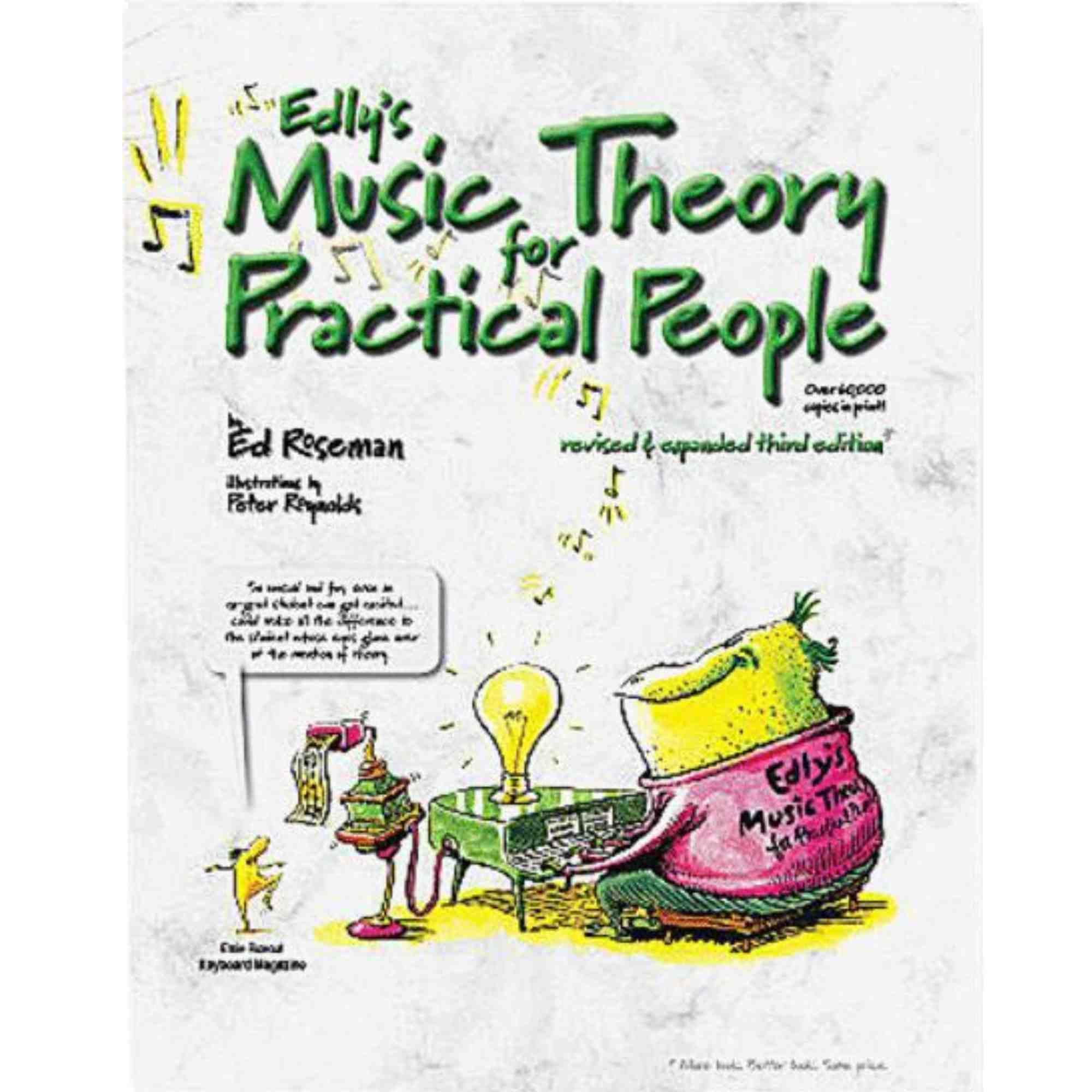
Edly's Music Theory 3E

Edly's Music Theory 3E

Humor-loving hobbyists

Customer rating 4.6/5
Check Price

Worth Noting

  • The humor-first layout can feel scattered for readers who prefer a strict, linear curriculum.
  • Some readers find the witty presentation confusing rather than clarifying.
Age Level
Adult hobbyists
Answer Keys
Yes, included
Ear Training
Not included
Learning Format
Illustrated prose, humor
Read the full review

Cartoons and plain-spoken prose walk hobbyist musicians through rhythm, harmony, and form without the sterile tone typical of textbooks — the humor lands well for readers who want engagement over drills. Style is the catch: some readers find the presentation confusing despite the witty delivery, so a quick preview before purchase helps. Mid-range pricing and 196 pages with an answer key suit adult self-study readers seeking a broad overview across classical, blues, and jazz.

Bottom line: Ideal for adult hobbyists who enjoy humor and illustration in self-study — flip through a few pages first to confirm the teaching style clicks before committing.

#10

Theory Time Fund. 1

Theory Time Fund. 1

Young beginners 5-7

Customer rating 4.8/5
Check Price

Worth Noting

  • Covers grade-one fundamentals only, so quick learners outgrow it before the next volume.
Age Level
Ages 5-7
Answer Keys
—
Ear Training
Not included
Learning Format
Structured practice pages
Read the full review

Clean pacing and steady repetition make grade-one fundamentals stick with 5-to-7-year-olds, with pages children genuinely enjoy and exercises that break every concept to the very basics. This low-frills approach deliberately skips the stickers and games its main competitor leans on. The tradeoff is scope: 48 pages cover grade-one fundamentals only, so quick learners outgrow it before reaching the next volume — best for families who value steady pacing over gamified engagement.

Bottom line: Best for parents and teachers who want low-frills, steady practice for a young beginner moving through grade-one fundamentals at a measured pace.

How to Choose

Match Scope to Your Goal

A workbook labeled 'complete' often covers nothing more than beginner-level fundamentals. Page count is the most reliable signal: genuine multi-level courses run past 100 pages, while single-topic primers stop around 32 to 50.

The trade-off shows up later. A primer that compresses basics into 30 pages leaves you exactly where you expected to be advanced, while a multi-level course builds each concept on prior foundations so later material like harmony and sight-reading has somewhere to attach.

Don't Skip Ear Training

Ear training requires audio, and how that audio is delivered matters. Workbooks with listening exercises built into each lesson reinforce what you read, while books that treat audio as an afterthought leave the ear-work disconnected from the theory.

The hidden trade-off is that bundled audio is frequently hard to follow or poorly integrated. A workbook whose audio flows smoothly is worth a premium; one where you must hunt for files and navigate clunky menus will quietly go unused.

Check Self-Assessment Options

Self-study hinges on answer keys. A key lets you catch an error while the concept is fresh, and without one a wrong assumption can persist for chapters until it surfaces as confusion on later material.

Workbooks that pair exercises with answer keys or review quizzes let you verify understanding without a teacher, which matters most for adult learners studying alone.

Pick a Format You'll Actually Use

Format determines whether you finish. Drill-heavy workbooks reward short daily sessions, while textbook-style reading suits learners who want concepts explained before practicing.

A daily-chapter structure imposes a schedule that helps motivated adults stick with it but pressures slower learners. Match the pacing to your real availability — a book built for six days a week will stall when life interrupts.

Match the Reading Age

Kids' workbooks gamify with stickers and repetition; adult workbooks assume independent motivation. The exercise density and pacing differ so sharply that adults feel patronized by children's books, while young students struggle with adult-oriented pages.

Reading-age labels are a real constraint. A 4-to-6 workbook covers only a few sessions of material, so check the stated range and accept that young-child options are primers, not courses.

Frequently Asked Questions