Math Learning Product Guide

14 Best Fraction Tiles for Kids in 2026: Durable Sets That Teach

How to choose durable fraction tiles for kids by matching set size, magnet strength, and piece count to how you actually teach, at home or in class.

14 Best Fraction Tiles for Kids in 2026: Durable Sets That Teach editorial illustration

Fraction tiles look simple on the shelf: color-coded bars and circles that make equivalent fractions click. The catch appears in daily use — many magnetic sets lose grip on whiteboards, and pieces sized for a child's hand are hard to see from across a room.

That makes the magnetic-versus-non-magnetic choice the first thing to settle. Non-magnetic tiles in a sturdy tray typically outlast their magnetic rivals and teach fractions just as well on a tabletop. Magnetic sets earn their place at the board, provided the magnets actually hold. A set that slides mid-lesson is worse than no magnets at all.

For most home and small-group teaching, a well-built set you can pass around beats one that depends on board adhesion. Budget sets cover wholes to twelfths; larger sets reach sixteenths for older students. Match piece count and values to the child's level, not the extras on the box.

#1

EAI Fraction Tiles

EAI Fraction Tiles

Tabletop teaching

Customer rating 4.7/5
Check Price

Worth Noting

  • For small-group sessions comparing several fractions at once, 51 pieces can run short
Magnets
No
Material
Plastic
Piece Count
51
Read the full review

The numbered tiles sit snugly in a sturdy tray that takes repeated classroom handling in stride, with no magnets to weaken and no parts to replace. Young hands sort and compare the pieces easily, and the printed labels let kids verify their own placements while building equivalent-fraction comparisons. The pieces hold their position on the tabletop mid-lesson, so instruction flows without pause. One set serves a full small-group session, teaching fractions through active manipulation rather than passive display.

The tradeoff is the absence of magnets: nothing adheres to a whiteboard, so the set stays on tabletops. For hands-on learning at home, classroom work that never touches a magnetic board, and one-on-one tutoring, that limitation drops away — the tray speeds setup and cleanup between lessons. Uniform labeled pieces also let a child practice independently while a parent supervises from nearby. Parents get a manipulative that works day after day without maintenance, and tutors can keep one set ready for any student. The budget-friendly price makes it an easy addition to a home or classroom supply list. Buyers who lead whole-class board demonstrations should select a magnetic set instead.

Pair the set with a simple fraction worksheet or your own activity ideas, since it ships without a lesson guide.

Bottom line: For families and tutors building fraction skills at a table, this is the set to reach for — it teaches effectively session after session with no upkeep.

#2

LR Fraction Tiles

LR Fraction Tiles

Board demonstrations

Customer rating 4.6/5
Check Price

Worth Noting

  • Compact piece size suits close-up teaching but shrinks visibility for a large class.
  • On a vertical whiteboard, tile adhesion can be inconsistent
Magnets
Yes
Material
Soft foam
Piece Count
51
Read the full review

The recognizable brand pairs color-coded magnetic tiles from wholes to twelfths with a layout that helps a young learner see how two halves or four quarters fill a whole before the concept is named. Soft-foam pieces feel light and are easy for small hands to arrange, which keeps one-on-one or small-group lessons moving.

Home teaching and small-group stations are the sweet spot for these tiles, where they rest flat on a table. Whole-class whiteboard demonstrations would need larger pieces with stronger magnets, so plan around tabletop lessons rather than vertical display.

Lay tiles on a flat table or lap desk — the magnets hold well on level surfaces.

Bottom line: Parents building fraction sense at the kitchen table get an affordable, effective introduction. Keep the tiles flat and the color-coding carries the lesson.

#3

Meetory Fraction Set

Meetory Fraction Set

Small group practice

Customer rating 4.6/5
Check Price

Worth Noting

  • Small circle pieces are hard to see from a distance, so close-up table work suits them best.
Magnets
Yes
Material
EVA
Piece Count
134
Read the full review

With 134 pieces reaching sixteenths, this is the widest practical range for fraction comparisons — kids can lay 1/2 beside 4/8 and see the equivalence directly. Magnets hold tiles on a whiteboard or fridge, and the range makes equivalent fractions and value comparisons the set's core strength. For small-group work and home practice, no other option below covers more ground.

The tradeoff is circle size — pieces stay small, so visibility drops on a big board. Whole-class board modeling calls for larger pieces, but at a desk or in a small group, this range is exactly what fraction comparisons need.

Set tiles on a desk or tray rather than a wall board — small circles read best at close range.

Bottom line: For home practice and small groups that want the widest value range, this is the set to pick. Whole-class board demos call for larger pieces.

#4

Coosilion Fraction Set

Coosilion Fraction Set

Visual learners

Customer rating 4.7/5
Check Price

Worth Noting

  • Foam pieces may slip on a vertical whiteboard
Magnets
Yes
Material
EVA foam
Piece Count
102
Read the full review

The 102 EVA foam tiles hold the attention of visual and tactile learners, and the 16 activity cards turn fraction practice into guided hands-on work. Coosilion's edge over rival sets here is learner engagement, not format — where some competitors sell on circle-and-bar variety, this one wins on how absorbing the tiles feel.

This set fits small-group or one-on-one tabletop sessions for kids who learn by touching and seeing. Its track record is shorter than the top pick's, so buyers who weigh long-term history heavily may prefer the EAI tray set.

Bottom line: Hands-on engagement is Coosilion's whole argument, and the tactile tiles plus activity cards carry it — the magnetic set for small-group fraction practice.

#5

SB Fraction Set

SB Fraction Set

Young beginners

Customer rating 4.5/5
Check Price

Worth Noting

  • Stops at twelfths, so a child ready to explore sixteenths outgrows the set and needs a larger system.
Magnets
Yes
Material
EVA foam
Piece Count
51
Read the full review

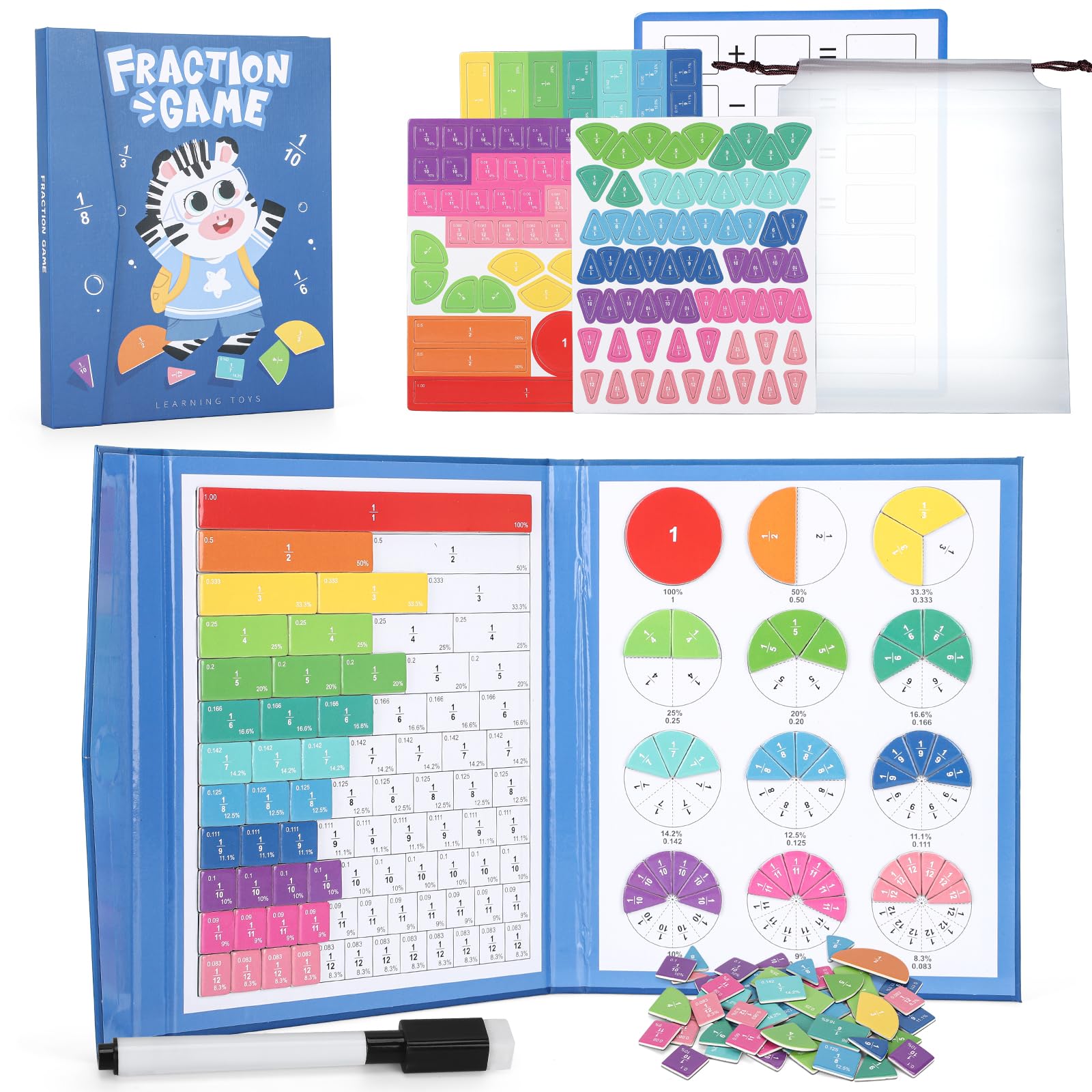
The stochastic box set delivers 51 magnetic pieces covering wholes through twelfths for roughly the price of a paperback, and kids engage with the color-coded tiles readily. The EVA foam pieces pair fraction circles with their bar equivalents, supporting hands-on comparison from the very first lesson.

For budget-conscious parents introducing fractions at home, this is the most affordable complete kit available, a low-risk way to gauge whether a child takes to fraction practice.

Bottom line: Best for a parent testing whether their child warms to fractions without a big outlay; once lessons reach sixteenths, a larger set takes over.

#6

Torlam Fraction Set

Torlam Fraction Set

Tabletop home use

Customer rating 4.6/5
Check Price

Worth Noting

  • Magnets may not hold on vertical surfaces, so whiteboard mounting is not guaranteed.
Magnets
Yes
Material
EVA foam
Piece Count
102
Read the full review

A 102-piece kit pairing circle and bar fraction models with 14 activity cards, Torlam lets children compare equivalent fractions across both formats at once — coverage the non-magnetic tray set in this lineup doesn't offer. The EVA foam pieces span wholes through twelfths and suit small-group tabletop work at home.

This is the pick for home learning and small-group sessions on a flat surface, where the foam tiles stay put without needing to stick anywhere. Because adhesion on vertical whiteboards is not guaranteed, plan for tabletop use rather than board demonstrations — a boundary worth checking before buying.

Bottom line: For home learners and small groups at a table, the circle-plus-bar coverage shows equivalent fractions clearly without needing a board. Choose this when hands-on comparison, not whole-class display, is the goal.

#7

DOCHENXIYU Puzzle

DOCHENXIYU Puzzle

Puzzle format

Customer rating 4.5/5
Check Price

Worth Noting

  • With the book held at an angle or carried, tiles can slip out of weak magnets and scatter.
Magnets
Yes
Material
Cardboard, basswood
Piece Count
120
Read the full review

Reviewers praise the book's educational value, with the puzzle layout making fraction practice genuinely engaging for young learners. The premium price and construction limits keep it below the sturdy tray-based set in this roundup for heavier classroom use.

Bottom line: Best for a child who learns by handling a book and works independently at a desk — portability and small-group rotations need a different set.

#8

Ralout Fraction Puzzle

Ralout Fraction Puzzle

Older kids

Customer rating 4.4/5
Check Price

Worth Noting

  • On a whiteboard, the weak hold becomes apparent; pieces may slip or fall, limiting it to flat surfaces.
Magnets
Yes
Material
Cardboard
Piece Count
156
Read the full review

At 156 pieces, this budget-friendly set works as an effective learning aid with generally acceptable quality for the price. The tiles are small and demand fine motor control, which frustrates younger hands; this best suits older kids who can grip the pieces comfortably.

Bottom line: For an older child practicing fractions one-on-one at a table, the low price and genuine learning payoff make this the practical choice.

#9

Simply Magic Yummy

Simply Magic Yummy

Food-themed fun

Customer rating 4.4/5
Check Price

Worth Noting

  • On a vertical whiteboard, magnetic adhesion may not keep pieces in place; tabletop work avoids the issue
Magnets
Yes
Material
Foam
Piece Count
112
Read the full review

Food-themed visuals turn pizza, cookie, and bread pieces into engaging fraction comparisons that younger kids pick up quickly, and the foam stands up to repeated handling. The set targets kitchen-table practice at home; the whiteboard-demonstration role other magnetic sets promise falls outside its reach.

Bottom line: Best for a young child comparing pizza and cookie fractions at the kitchen table, where the food theme keeps practice playful.

#10

Simply Magic Percent

Simply Magic Percent

Percentages

Customer rating 4.4/5
Check Price

Worth Noting

  • QR-code extras may fail to load, removing the digital learning content.
Magnets
Yes
Material
Foam
Piece Count
166
Read the full review

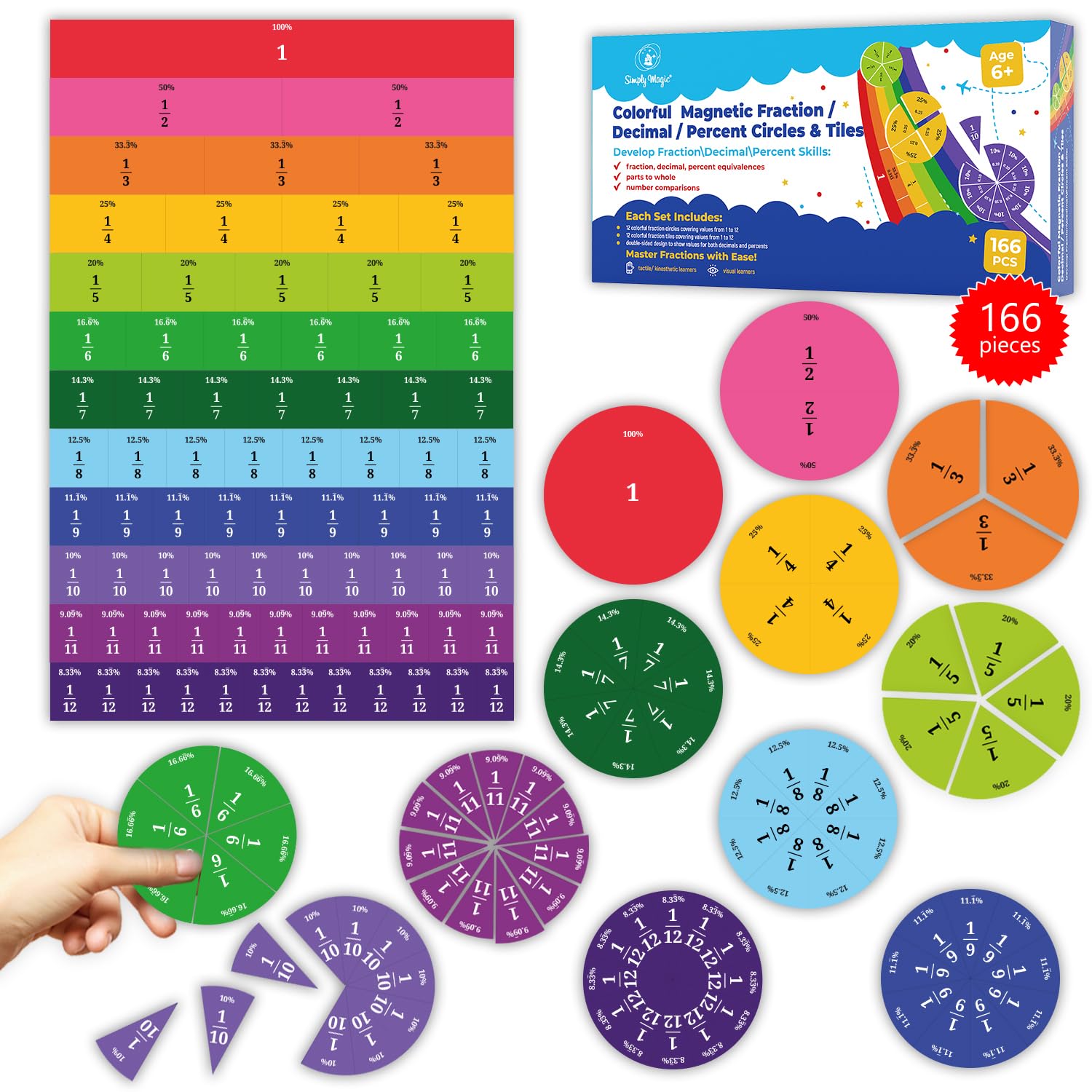
166 pieces pair fraction and percentage tiles so older students can compare both notations side by side. The QR-code extras can fail to load, and the premium price reflects the full kit rather than the physical tiles alone, so treat it as a tabletop percentages-and-fractions set and the learning value holds.

Bottom line: Fits an older child doing tabletop fraction-and-percentage practice who can skip the QR extras and accept the premium price.

#11

Distasio Fraction Set

Distasio Fraction Set

Small groups

Customer rating 4.5/5
Check Price

Worth Noting

Magnets
Yes
Material
EVA foam
Piece Count
102
Read the full review

The 102-piece foam set pairs tiles and circles with 16 activity cards that make fraction equivalents simple to teach, and kids engage with the pieces on their own. The track record is shorter than the top pick's, so long-term durability is less established — a minor gap for tabletop home learning.

Bottom line: Best for tabletop home learning where the bundled activity cards handle the lesson planning; not meant for whole-class whiteboard demonstrations.

#12

Oli's Fraction Tiles

Oli's Fraction Tiles

Basic fraction learning

Customer rating 4.5/5
Check Price

Worth Noting

  • The 51-piece count caps exploration around twelfths; students ready for sixteenths will outgrow it
Magnets
Yes
Material
EVA
Piece Count
51
Read the full review

Budget-priced rainbow tiles cover wholes to twelfths at the same 51-piece size as the top pick, giving a first-time learner a low-cost entry into fraction work. The soft foam pieces suit small hands. With magnetic foam sets, adhesion on a vertical whiteboard isn't guaranteed, so keep these on a tabletop.

Bottom line: Best for a first fraction lesson at home or in a small group — a starter set a child outgrows rather than a long-term classroom tool.

#13

Aizweb Fraction Set

Aizweb Fraction Set

Fruit theme

Customer rating 4.6/5
Check Price

Worth Noting

  • Once a child moves past twelfths, the single circle format caps how far fraction comparisons can progress
Magnets
Yes
Material
Foam
Piece Count
12 circles
Read the full review

The fruit motifs across 12 circles grab young attention and make fraction lessons feel like a game, nicely matched to toddlers and preschoolers making first contact with halves and quarters. Scope narrows quickly — only 12 circles reaching twelfths, with no bar models or activity structure — so this suits a tabletop introduction rather than a sustained teaching sequence.

Bottom line: Best as a first hands-on fraction toy for toddlers and preschoolers, where visual appeal matters more than teaching range.

#14

TOMMYHOME Fraction Tiles

TOMMYHOME Fraction Tiles

Standing display

Customer rating 4.7/5
Check Price

Worth Noting

  • Strip-only design covers linear comparison; circle models for part-whole teaching require a separate set.
Magnets
Yes
Material
Foam
Piece Count
—
Read the full review

Budget-priced foam strips with magnetic backing stand upright on a whiteboard for easy linear fraction display — a low-cost entry into the category. Its durability is less proven than the top pick's tray set, which suits casual home practice over a permanent classroom fixture. The strip-only format keeps sorting simple; circle models aren't included, so part-whole comparisons need a second set.

Bottom line: Best as a low-cost entry set for a child learning fraction strips at home; seek the top pick when a proven, durable classroom fixture is the goal.

How to Choose

Piece Count

Piece count decides how many comparisons a child can build at once. A 51-piece set covers wholes through twelfths, enough for one student to model equivalent fractions. Sets of 102 to 166 pieces add sixteenths and let several kids share one box.

More pieces also means more to manage. Tiles are small, so bigger sets are harder to keep sorted, and loose pieces vanish from shared classrooms faster than tray-stored ones. Buy the smallest count that covers the fractions you teach.

Magnetic vs Non-Magnetic

Magnetic tiles promise whiteboard demonstrations, but magnet strength varies sharply between sets. Thin foam with weak backing won't hold vertically, and once tiles slide mid-lesson the convenience disappears. A non-magnetic set in a tray never faces this problem.

For tabletop work, magnets add little. Non-magnetic tiles stay where you place them and often last longer because there's no backing layer to peel. Choose magnetic only when board display is part of your teaching.

Fraction Values

Values covered usually track piece count. Wholes to twelfths supports the fraction work most elementary grades need, including common equivalents like thirds, fourths, and sixths. Sets reaching sixteenths add precision for older students comparing unlike denominators.

Those extra values cost you physically. Sixteenths tiles are thinner and easier to drop or mix up, which frustrates younger children. Match the denominator range to the child's level rather than buying the largest set 'just in case.'

Activity Cards

Activity cards separate a useful set from a box of loose tiles. Good cards give guided exercises that show children how to compare fractions step by step, valuable when you aren't a trained math teacher. Sets with 14 to 16 cards cover the early-fraction curriculum.

Card quality varies more than quantity suggests. Some cards are glossy with repeating prompts; others fold in real problem-solving. If the child learns independently, confirm the cards match the fraction values the tiles include.

Material Durability

Material decides how long a set survives daily handling. Soft foam tiles are light and quiet but compress at the edges over time. Solid plastic tiles keep their shape and are the more durable choice for frequent use.

Cardboard-backed magnetic sets are the most fragile. The cardboard can dent and the printed surface peel, and once the magnet layer separates the piece is effectively dead. Foam or plastic outlasts paper-based designs by a wide margin.

Frequently Asked Questions