STEM Toys Product Guide

11 Best Electronics Kits for Kids in 2026: Match Age to Skill Level

Which electronics kit fits your child's age and skill — snap-together circuits for young builders or Arduino coding kits for teens.

11 Best Electronics Kits for Kids in 2026: Match Age to Skill Level editorial illustration

Electronics kits for kids promise a lot: 'no experience needed,' 'hours of projects,' 'learn to code.' In practice, the kits that get used differ from the ones that collect dust on two things — how clearly the instructions guide the build and whether the parts survive repeated handling.

The category splits by age and intent. Snap-together kits suit younger children who want to see a bulb light up or a fan spin. Arduino-style kits demand reading, typing, and patience, and they usually need an adult nearby. Choosing the wrong type is the most common reason a promising gift ends up abandoned.

The right kit matches how a child learns: clear, colorful projects for young builders and real programming for teens who want to make something that responds to the world around it.

#1

Snap Circuits Pro 500

Snap Circuits Pro 500

Deep circuit learning

Customer rating 4.8/5
Check Price

Worth Noting

  • Requires four AA batteries not included, so the first build waits on a separate purchase.
  • In a busy classroom or daily build routine, individual snap parts may wear
Projects
500+
Durability
Parts wear over time
Minimum Age
8+
Instructions
Pictorial and clear
Read the full review

The Snap Circuits Pro 500 piles more than 500 projects onto 75 snap-together parts — no soldering, no tools, just color-coded components pressed onto a spring board. Where simpler kits offer a handful of one-offs, this box carries a genuine progression through motors, switches, resistors, and photoresistors that builds real circuit logic. Project complexity steps up gradually, and because kids complete builds with their own hands, the lessons stick. That breadth of genuinely different circuits is what separates a box kids keep returning to from one that gets shelved. Components lock in and release cleanly under normal handling, keeping the set fresh through dozens of sessions.

This kit suits children eight and up who want a real deep dive into how electronics work; younger kids are better served by the dedicated beginner snap sets. In a busy classroom or during a child's daily build routine, individual snap parts may wear — handling pieces gently and storing the tray flat extends the set's life across years of projects. It also suits classrooms and co-ops where several kids build side by side. Families and homeschoolers seeking a long-term educational investment rather than a single-afternoon activity get the most from this box.

Press pieces straight down when snapping them in and store the tray flat so contacts stay firm for the next build.

Bottom line: This is the kit a curious child returns to for years — a single box that grows from first circuits to hundreds of working builds.
#2

ELEGOO UNO Starter Kit

ELEGOO UNO Starter Kit

Coding and robotics

Customer rating 4.7/5
Check Price

Worth Noting

Projects
22+ guided lessons
Durability
High-quality components
Minimum Age
11+
Instructions
Unclear for beginners
Read the full review

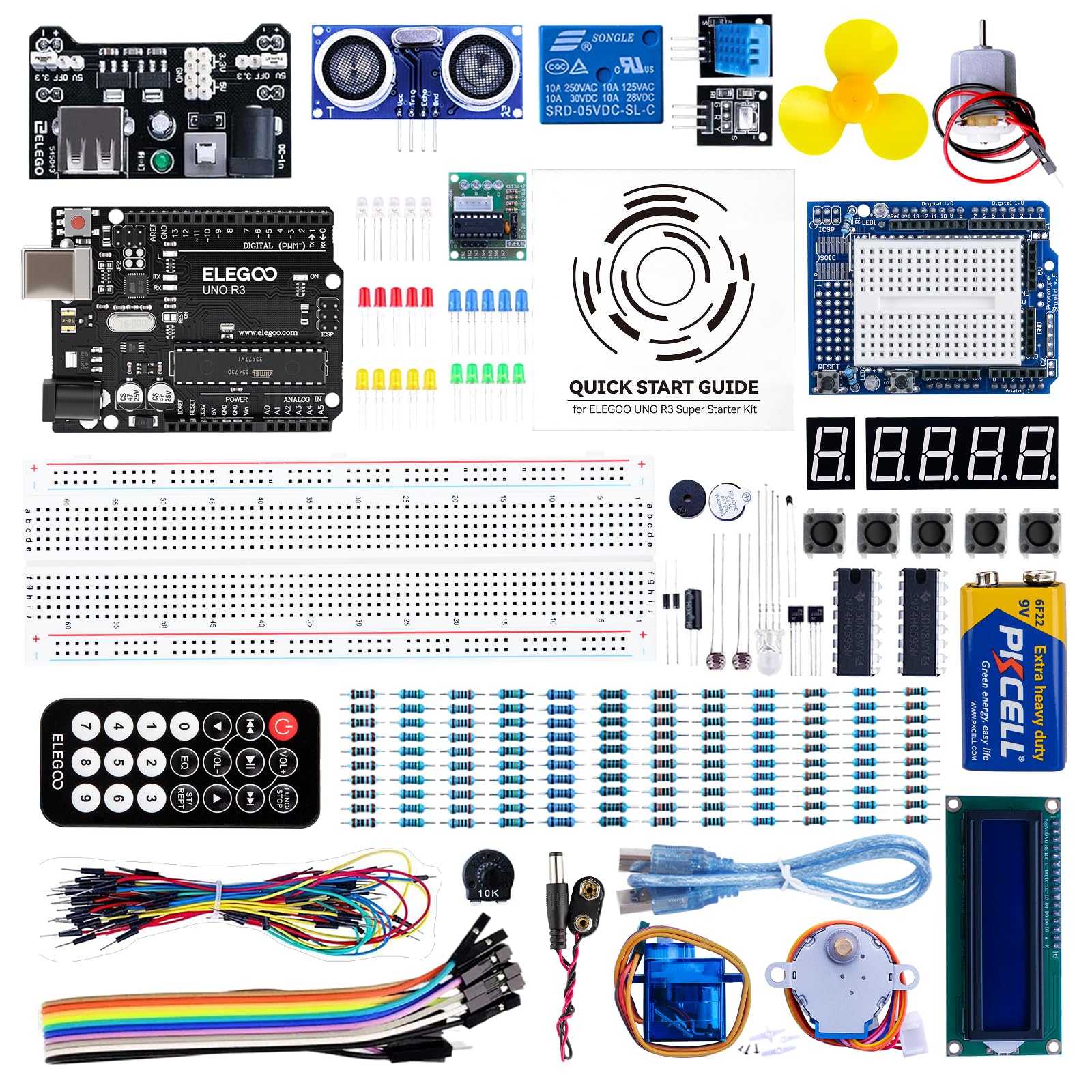
Over 200 components and 22 guided lessons introduce genuine Arduino programming at remarkable value, with no soldering required. Sensors, motors, and displays cover a wide range of starter builds. Where the higher-pin-count boards in this set chase expandability, the UNO R3 keeps complexity down — the more approachable starting point for first-time coders.

Best for teens and adults ready to write real code on an Arduino, not just assemble fixed circuits. The bundled manual expects some prior familiarity, so plan to pair the early lessons with free online tutorials — the community knowledge around this board is extensive.

Bottom line: This is the kit that turns 'I want to learn Arduino' into working projects — the right call for anyone ready to write their first line of code.

#3

Snap Circuits Beginner

Snap Circuits Beginner

Young first builders

Customer rating 4.7/5
Check Price

Worth Noting

  • Under rough play, the snap parts can pop apart or wear down
Projects
20+
Durability
Pieces break easily
Minimum Age
5–9
Instructions
Color-coded and simple
Read the full review

This beginner set pairs large, color-coded snap parts with a picture-based manual, so a 5-year-old can assemble its 20+ short builds without reading or tools. The projects stay hands-on and quick, making this the gentlest on-ramp to circuits — fun first, educational second — before moving to the deeper project-heavy Pro 500.

The right buyer is a family with a preschooler or early-elementary child who wants a budget-friendly first electronic toy. The plastic snap parts reward gentle handling and adult supervision, so lighter hands get the most out of the set.

Guide gentle snap-in and snap-out motion, and keep an adult nearby during builds.

Bottom line: A low-cost first taste of circuits for the youngest builders — just keep adult supervision part of the routine.

#4

Nat Geo Circuit Kit

Nat Geo Circuit Kit

Science-themed learning

Customer rating 4.7/5
Check Price

Worth Noting

Projects
120+
Durability
Occasional part defects
Minimum Age
8+
Instructions
Illustrated plus video
Read the full review

National Geographic pairs its 120 wire-snap projects with two teaching formats: a fully illustrated manual plus online video walkthroughs that carry young builders through each circuit. Projects graduate from basic switches to light-and-sound effects, snap together without soldering or tools, and carry the Toy of the Year mark parents recognize.

This kit suits kids 8-plus who learn by watching rather than reading, and families who put brand reputation and guided instruction ahead of a deep pool of community reviews. An occasional wire snap can arrive non-functional; because parts interchange across the set, a spare from an earlier build fills in, so keep one from each finished project.

Bottom line: When video-backed instruction and a recognizable name matter more than raw project count, start here rather than with the deeper catalog.

#5

CYOEST Bluetooth Speaker

CYOEST Bluetooth Speaker

DIY music projects

Customer rating 4.4/5
Check Price

Worth Noting

  • First-time pairing with certain phones can take a couple of attempts before the link holds
Projects
1 speaker build
Durability
Fragile wood chassis
Minimum Age
10+
Instructions
Clear build steps
Read the full review

CYOEST's kit trades the usual circuitry lecture for a genuinely usable outcome — a Bluetooth speaker teens piece together from wood and electronics, no soldering required. The satisfying hour-long build ends in a speaker they can play music through every day, far more engaging than a circuit board that gets boxed away. For music-loving teens, that finished device is the real payoff, which beats a theory lesson any day. Bluetooth pairing can be finicky with certain phones, so buyers expecting flawless wireless performance would do better with a prebuilt speaker.

If pairing stalls, switch the speaker off and back on before retrying — it usually connects cleanly on the second attempt.

Bottom line: For a teen who wants a speaker they built themselves rather than a circuitry course, this kit delivers a daily-use result on a budget; the pairing quirk only matters if flawless wireless is non-negotiable.

#6

EUDAX Physics Lab Kit

EUDAX Physics Lab Kit

High-school physics

Customer rating 4.5/5
Check Price

Worth Noting

  • Solo study stalls when the manual skips build steps; guided instruction bridges the gaps.
Projects
—
Durability
—
Minimum Age
14+
Instructions
Not thorough
Read the full review

The EUDAX kit is a classroom physics lab rather than a toy, pairing 79 electricity and magnetism pieces with the topics a high-school course covers. Where the 500-project snap kit rewards open-ended exploration, this set anchors each build to a specific curriculum unit, from circuits to electromagnets.

Best for a grades 9-11 classroom where an instructor leads each lab, since the manual is not thorough and the teacher supplies the extra guidance. Hands-on builds make circuit and electromagnet concepts stick, but the set assumes supervision — a lone teen will hit the manual's gaps quickly.

Keep 3 AA batteries on hand — the box ships without a power source.

Bottom line: A high school physics teacher gets a full coursework lab at a mid-range price, provided they bring their own lesson guidance.

#7

ELEGOO Mega 2560 Kit

ELEGOO Mega 2560 Kit

Advanced Arduino projects

Customer rating 4.7/5
Check Price

Worth Noting

  • Documentation is not beginner-friendly
Projects
35+ lessons
Durability
High-quality components
Minimum Age
13+
Instructions
Incomplete
Read the full review

The Mega 2560 handles the biggest builds of any kit here — 54 digital and 16 analog I/O pins plus 200+ components — giving students genuine expansion headroom for multi-sensor projects. Documentation is not beginner-friendly and the learning curve is steep, so newcomers lean on online tutorials. Against the UNO kit, it trades approachability for pure capability, suiting hobbyists who already know a breadboard.

Bottom line: Best for advanced students and hobbyists tackling wiring-heavy projects who accept learning from online resources. Newer builders should start with the UNO kit instead.

#8

CYOEST FM Radio Kit

CYOEST FM Radio Kit

Budget radio build

Customer rating 4.5/5
Check Price

Worth Noting

  • One radio project with no expansion path for further builds.
Projects
Single radio build
Durability
Fragile wood parts
Minimum Age
8–13
Instructions
Simple instructions
Read the full review

This no-solder FM radio build teaches kids 8–13 how tuning works, with clear sound and a genuinely satisfying assembly at a budget price. The wooden casing is delicate — pieces can crack under rough handling — so it suits careful hands and one-sitting fun rather than a lasting toy.

Bottom line: Best as a low-cost first build for a child who enjoys hands-on projects and will handle the parts gently — not for rough play or long-term reuse.

#9

Science Kidz Kit

Science Kidz Kit

High project count

Customer rating 4.7/5
Check Price

Worth Noting

  • For families planning daily teardowns, part durability is an open question
Projects
188
Durability
—
Minimum Age
—
Instructions
Color illustrated
Read the full review

The Science Kidz Kit packs 188 snap-together experiments at the lowest cost per project in this set, guided by a color-illustrated manual with no soldering or tools required. It lands below the bigger kits because part quality and long-term durability aren't documented — a value-first buy for casual builders rather than buyers who want proof before spending.

Bottom line: Best for budget-conscious families who lead with project count — the right fit when price and volume trump premium parts; heavier builders should step up to the top pick.

#10

Snap Circuits BRIC

Snap Circuits BRIC

LEGO circuit hybrid

Customer rating 4.7/5
Check Price

Worth Noting

  • For younger builders, the instruction book can be confusing, and an adult's guidance makes the build go smoother.
Projects
20+
Durability
—
Minimum Age
8+
Instructions
Unclear steps
Read the full review

This hybrid pairs LEGO-compatible bricks with 20 snap parts and 75 adapters, so kids electrify structures they already know how to build. The project list stops around 20 ideas and the instruction book can puzzle younger builders, so an adult's help makes assembly smoother. Families with existing brick collections get the most value — pure electronics fans will find more depth elsewhere.

Bottom line: Best for families with existing LEGO bricks who want to add circuit-building to their play — keep an adult nearby to help with the instructions and it clicks.

#11

Snap Circuits Radio Kit

Snap Circuits Radio Kit

Quick radio intro

Customer rating 4.6/5
Check Price

Worth Noting

  • The base is thin and can crack under heavy handling
  • Instruction steps can be confusing for a younger builder on a first pass.
Projects
Single radio build
Durability
Flimsy base
Minimum Age
8+
Instructions
Unclear steps
Read the full review

Twelve snap-together parts build a working FM radio in one sitting — a satisfying first project for a curious 8-year-old. Educational value is real: wiring a functional receiver teaches audio-electronics basics without soldering. The flimsy base and occasionally confusing instructions suit it to a one-off weekend build with a patient adult nearby, not a springboard into deeper circuit learning.

Bottom line: Fits a supervised rainy-afternoon build where the goal is one working radio and a taste of wiring — not a kit meant to grow with a child over years.

How to Choose

Number of Projects

Project counts are a marketing number, not a quality score. Snap-together kits reuse the same transistors, switches, and LEDs across dozens of experiments, so a 200-project kit often holds the same handful of parts as a 20-project one. What changes is how deeply the manual stretches each component's possibilities.

A higher count mostly means more variety and longer staying power, not more parts in the box. That breadth keeps a kit relevant for years, but for a reluctant builder a huge manual can feel overwhelming before it feels exciting.

Minimum Age

The listed minimum age tracks two things: part size and reading level. Kits for ages 5–9 use large snap components that are hard to swallow and rely on color-coded pictures instead of text. Kits rated 8+ mix in smaller resistors and denser manuals that assume solid reading skills.

Pushing a child below the recommended age usually ends with the adult building while the child watches. If your child sits near the boundary, size down rather than up — the smaller kit teaches the same first principles without the frustration.

Coding vs. Snap-Together

Snap-together kits need no code: kids align parts to a diagram and watch circuits close. Arduino kits are a different animal — they require writing and uploading programs on a computer, which assumes typing skills, patience with errors, and enough reading to debug. The two teach different things: circuit topology versus programming logic.

If the goal is understanding how current flows, a snap kit delivers that faster. If the goal is building interactive devices that respond to sensors, you need the Arduino path — and an adult who can help when the code won't compile.

Durability and Part Quality

Snap connections rely on spring-loaded press-fits that loosen with repeated assembly, and cheaper kits use thinner plastic that cracks at the stress points. Wood DIY kits are fragile by nature, with chassis that can splinter under rough handling. The heavier the expected use, the more this matters.

A kit used once a week by one careful child will outlast the same kit cycled daily by siblings. Weight durability more heavily for heavy use; a flimsier budget kit is fine for occasional supervised projects.

Clarity of Instructions

Instruction quality is the biggest gap between marketing and reality in this category. The best manuals use large photos or icons with numbered steps; the worst skip steps and assume prior knowledge, turning a fun afternoon into a hunt for a loose connection.

Check for video support or online tutorials before buying. A kit with mediocre components but clear guidance gets used; one with great parts and a confusing manual sits in a drawer.

Frequently Asked Questions