Music Learning Product Guide

11 Best Electronic Drum Set for Kids of 2026: Match Pad to Your Kid

Pick an electronic drum set for kids that matches your child's age and need for quiet practice, from toddler toy pads to serious practice kits.

11 Best Electronic Drum Set for Kids of 2026: Match Pad to Your Kid editorial illustration

Kids' electronic drum kits look deceptively similar at a glance: flat pads, a speaker, a pair of sticks. But after a few weeks of use, the differences become obvious — some pads go silent, others only work when plugged in, and the 'practice quiet' promise depends entirely on a working headphone jack.

The truth is that most roll-up pads under $60 share the same internal shell, so the brand name tells you little. What actually separates a good kid's drum from a frustrating one is how it handles headphone use, whether the battery charges reliably, and how quickly the sensors wear out under daily banging.

That's why this guide focuses on matching the drum to the child — a toddler learning letters and numbers has different needs than a 9-year-old ready for real practice. We'll walk you through the decisions that matter, so you buy something that gets played, not shelved.

#1

PAXCESS 7-Pad Roll-Up

PAXCESS 7-Pad Roll-Up

Portable first drum

Customer rating 4.6/5
Check Price

Worth Noting

  • In tight practice spots, the compact pads read small
  • Fast fills can show a tick of delay between hit and sound
Age Range
4-12
Pad Count
7
Power Source
Rechargeable
Bonus Features
MIDI out, roll-up
Read the full review

The most battle-tested roll-up pad in this set, the PAXCESS 7-Pad lays out a genuine 7-piece kit — snare, three toms, crash, ride, and hi-hat — that kids genuinely enjoy playing. As a first kit it hits the essentials: good sound through the headphone jack (the quiet-practice path parents actually want), a 2000mAh battery that stretches across a full afternoon, and a 2.4-pound roll-up body that stows flat for storage or travel. It also carries MIDI out for connecting to learning software as a child grows.

That portable package carries two boundaries worth naming for first-time buyers. The seven pads run smaller than a traditional kit's footprint — a non-issue for a child's hands, tighter for an older player — and a tick of delay can surface between hit and sound on fast fills, more so than in steady single-note play. This suits kids 4-12 who want a real-ish drum layout without the noise or full-size footprint; it's a poor match for toddlers under three and for serious young drummers who will outgrow mini pads.

Rest the drum on a firm, flat surface before play — a stable base keeps the compact pads triggering consistently.

Bottom line: For a household that wants a real-looking kit without full-size noise or footprint, the PAXCESS 7-Pad is the safest entry point in this set.

#2

EKEMOND 9-Pad

EKEMOND 9-Pad

Quiet practice

Customer rating 4.5/5
Check Price

Worth Noting

  • Under heavy daily play, pad surfaces can show wear
Age Range
3+
Pad Count
9
Power Source
Rechargeable
Bonus Features
Record, 10 songs
Read the full review

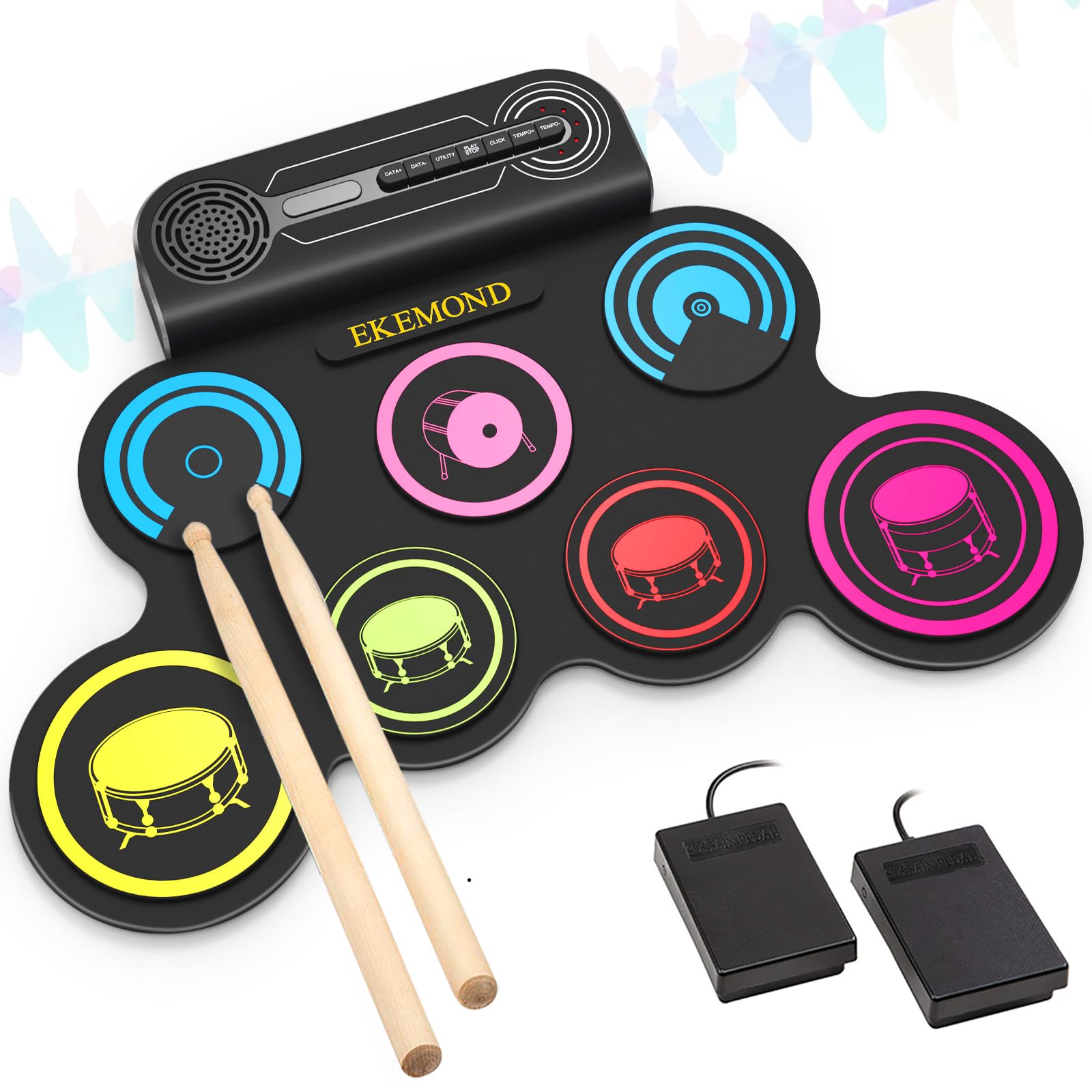
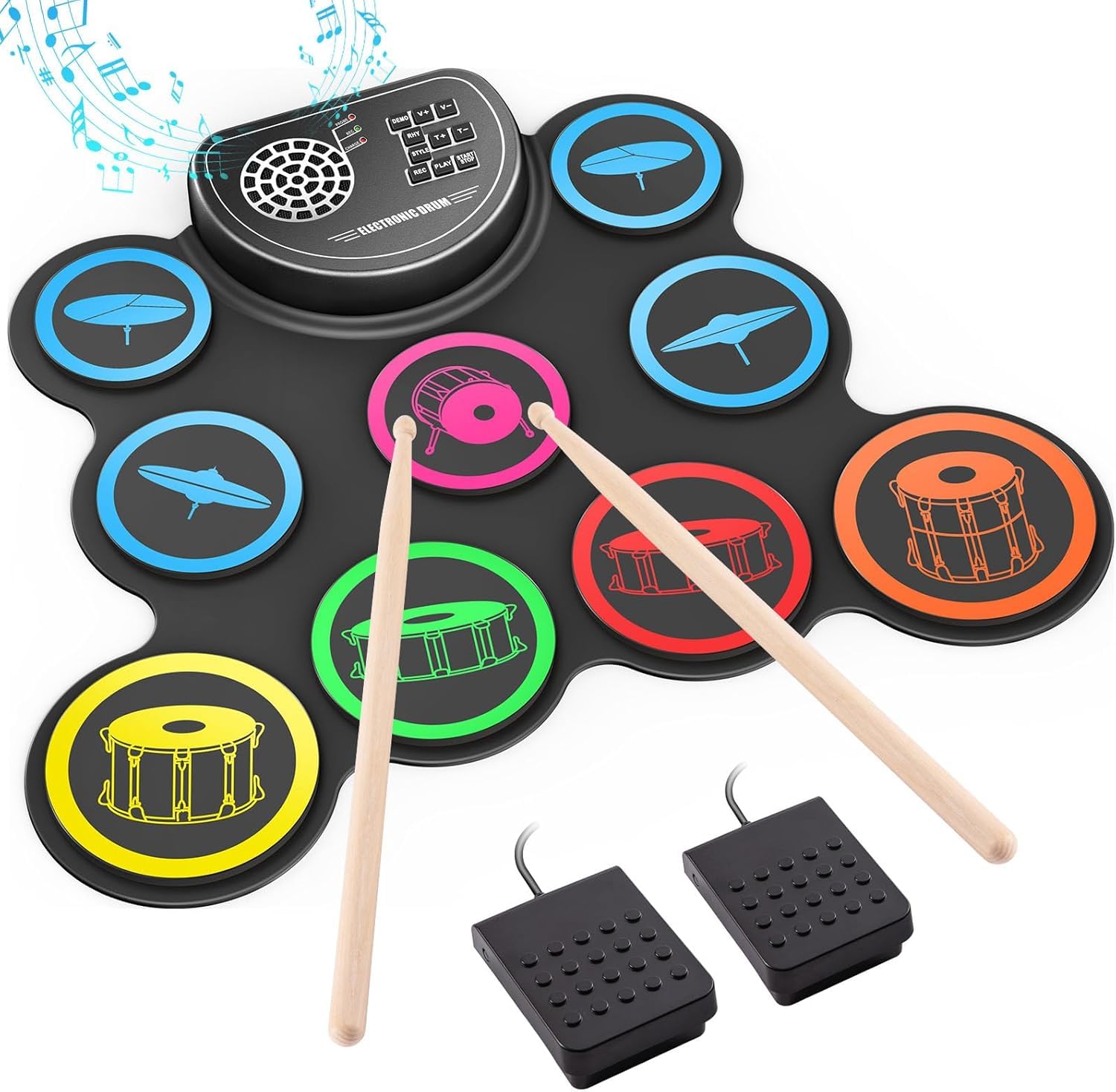
The four-tom, two-crash layout with a dedicated headphone jack earns the strongest parent approval on quiet play in this set — a fuller spread than the top pick's seven-pad. Pads respond to real stick technique, and the roll-up design packs flat into a bag for travel.

Best for kids 4-10 starting out on a realistic nine-pad arrangement in shared living spaces, where the headphone jack keeps practice silent. Under heavy daily play the pad surface can show wear, so this suits steady-but-casual sessions rather than a rigorous practice regimen.

Bottom line: The nine-pad layout with the most-loved headphone jack makes this the quiet-practice choice for kids 4-10.

#3

VTech KidiBeats

VTech KidiBeats

Toddler learning

Customer rating 4.7/5
Check Price

Worth Noting

  • Compact footprint leaves no room for a real drum layout.
  • A finicky power switch can leave a unit silent until batteries are reseated.
Age Range
2-5
Pad Count
3+cymbal
Power Source
AA
Bonus Features
Letters, numbers
Read the full review

Each of the three pads and the cymbal lights up in its own color while Free Play, Letters, Numbers, and Follow-Along modes walk toddlers aged 2–5 through the alphabet and counting as they drum. The KidiBeats is the one drum in this set built around preschool learning, where the feature-rich sibling kits aim at school-age kids.

Parents of 2–3 year olds get a sturdy first musical toy that holds up to enthusiastic banging, and the compact footprint fits naturally in a toddler's play space — the tradeoff is that this is a preschool toy, not a kit with a real drum layout. Some units can arrive with dead batteries or a finicky power switch, so swapping in fresh AAs before gifting avoids a silent first session.

Keep the pads at floor or low-table height where a toddler can reach comfortably.

Bottom line: This is the preschool answer to the school-age roll-ups in this set — a budget first drum that folds letter and number learning into the play, best matched to a 2–3 year old rather than a child expecting a real kit.

#4

VTech Kidi Star Drum Pad

VTech Kidi Star Drum Pad

School-age fun

Customer rating 4.7/5
Check Price

Worth Noting

  • Under heavy daily play, pads can show wear sooner than casual use would suggest
Age Range
5+
Pad Count
—
Power Source
AA
Bonus Features
Bluetooth, games
Read the full review

The Kidi Star Drum Pad packs 20 drum styles, 30+ play-along songs, Bluetooth, and Coach mode — a clear step up from the letter-and-number toddler pads. Kids 5-8 get variety that earns return visits: three games, a record function, and the ability to stream phone or tablet audio through the built-in speaker.

This fits families who want an engaging toy-style drum with staying power rather than a practice instrument — the roll-up pads in this set are more portable, but none match this feature depth. Quality control varies between units, so a return window is worth keeping; four AA batteries and mid-range pricing still make it a solid gift choice for kids 5-8.

Bottom line: For families with a 5-8 year old ready to move past toddler toys, this is the feature-rich choice — just confirm the return policy, since QC varies between units.

#5

HAMPBACK MK-0

HAMPBACK MK-0

Serious beginners

Customer rating 4.6/5
Check Price

Worth Noting

  • Headphone output and control-board settings can vary between units
  • A full-grown adult sitting in to demonstrate will find the kit too low
Age Range
8+
Pad Count
7
Power Source
USB
Bonus Features
Throne, warranty
Read the full review

The HAMPBACK MK-0 delivers the closest thing to a real drum kit in this set: 4x7-inch mesh pads provide genuine rebound, and the included throne and sticks make it feel like proper equipment rather than a toy. Assembly is quick, and the frame holds up to steady practice.

This suits a committed young beginner, roughly age 8 and up, whose parents either play drums or want a proper at-home practice feel. It sits at the premium end against the roll-ups in this set, priced closer to real equipment than to toys.

Bottom line: For a committed young beginner, this is the closest step toward a real kit in the lineup — worth the premium over a roll-up pad.

#6

ROCKSOCKI 7-Pad

ROCKSOCKI 7-Pad

Budget starter

Customer rating 4.4/5
Check Price

Worth Noting

  • The compact pad surface suits small hands but gets tight as kids approach 9
  • Included headphones can sit loose on small heads, and the wired-only jack may be mistaken for Bluetooth
Age Range
3-8
Pad Count
7
Power Source
AAA or USB
Bonus Features
Headphones, metronome
Read the full review

The ROCKSOCKI 7-Pad bundles a headphone jack, metronome, and dual AAA or USB power into a complete starter under $45. Out of the box it covers everything a young beginner needs — sound control, a timing aid, and a power option that works from wall outlet or batteries.

This suits kids 3-8 on their first drum, ideal as a budget gift where quiet practice matters more than pad size. The compact surface fits small hands but tightens as kids near 9, and the included headphones can sit loose — since Bluetooth isn't supported, the wired-only jack is worth confirming before checkout.

If the included headphones sit loose, any standard 3.5mm pair is a direct swap.

Bottom line: The complete budget starter for a small child's first drum — headphones, metronome, and flexible power come together under $45 with nothing extra to buy.

#7

Donner DED-20

Donner DED-20

Guided lessons

Customer rating 4.4/5
Check Price

Worth Noting

  • When a song picks up tempo, the foot pedals can slide out of position
Age Range
6+
Pad Count
7
Power Source
USB
Bonus Features
40 lessons, MIDI
Read the full review

Forty built-in Melodics lessons turn this into a practice teacher rather than a noise maker, and responsive silicone pads with realistic sound help that technique actually land. Build quality runs above typical pads in this set, while family-friendly play keeps sessions fun between lessons.

This suits kids six and up who want skill progression over instant noise, plus parents seeking school-at-home practice without an app subscription. The roll-up design travels easily, and dual speakers with a headphone out keep performances presentable without taking over the room.

Bottom line: The DED-20 is right for a young beginner whose goal is real progress, not just noise — the built-in lessons make it a genuinely educational starter pad.

#8

EKEMOND 7-Pad

EKEMOND 7-Pad

Budget entry

Customer rating 4.5/5
Check Price

Worth Noting

  • For regular practice, the 7-pad layout caps tones below the 9-pad sibling, so this suits trial runs.
Age Range
3+
Pad Count
7
Power Source
AAA or USB
Bonus Features
—
Read the full review

This roll-up reuses the EKEMOND platform's portability and headphone output at the lowest price in the set. The 7-pad layout and AAA/USB power keep scope modest — fewer tones than the 9-pad sibling — making this a trial or travel unit rather than a feature-rich daily kit.

Bottom line: Best as a low-cost trial for families unsure whether drumming will stick — move up to the 9-pad once the young player shows real interest.

#9

Vhffoso LED Drum Set

Vhffoso LED Drum Set

Light-up fun

Customer rating 4.6/5
Check Price

Worth Noting

  • The stand can wobble and the pedal plug may detach with repeated use
Age Range
—
Pad Count
9
Power Source
Rechargeable
Bonus Features
LED sticks, stand
Read the full review

Light-up drumsticks with a full stand make the unboxing feel like a real kit, and kids fixate on the glowing sticks. Built-in dual speakers add punch for play-along sessions. The appeal is the show, not longevity: the stand can wobble, the pedal plug may detach, and some units only play while charging. Best as a gift for short-term wow, not a daily practice tool.

Bottom line: Right for gift-givers who want a showy unboxing and accept the accessories wearing out — pass it up for a daily practice tool that needs to survive years.

#10

Sboet 9-Pad

Sboet 9-Pad

Budget 9-pad

Customer rating 4.4/5
Check Price

Worth Noting

  • Under heavy daily play across months, pad response can fade as sensors wear
Age Range
3+
Pad Count
9
Power Source
Rechargeable
Bonus Features
Record, 10 tones
Read the full review

This 9-pad pairs a full layout, record function, and ten hours of rechargeable play at a budget price, and family enjoyment runs high at 93% positive. The ceiling is sensor life — under heavy daily play, pad response can fade over months, which keeps it below the tougher pick in this set.

Bottom line: Best as a travel or secondary set for younger kids who play occasionally rather than daily — a scenario where the sensor tradeoff rarely surfaces.

#11

Marrilley 9-Pad

Marrilley 9-Pad

Budget travel

Customer rating 4.6/5
Check Price

Worth Noting

  • Pads may go silent under heavy daily play.
Age Range
3+
Pad Count
9
Power Source
Rechargeable
Bonus Features
Record, 10 tones
Read the full review

A 9-pad layout with a headphone jack and rechargeable battery comes in at a budget price. Sound is decent with minimal thumping, so kids can play without rattling the house. It suits occasional travel play better than steady daily practice, and MIDI connectivity isn't guaranteed.

Bottom line: Best for toddlers who want to make noise on a trip or in the car — a compact 9-pad that's easy to tote.

How to Choose

Headphone Jack: The Quiet-Practice Decider

Plugging in headphones silences the built-in speakers, which is the difference between a practice tool and a noise-maker. Many budget pads route all sound through speakers, so you can't mute them without unplugging the whole unit. A working headphone jack means your child can play while you work or a sibling sleeps.

Cheap jacks can introduce a small delay between your child's hit and the sound, which is frustrating for fast play. Test responsiveness by tapping each pad with headphones on before you commit.

Pad Count and Size: Setting Expectations

Seven-pad and nine-pad layouts look similar in marketing photos, but the actual footprint is often smaller than expected. A seven-pad roll-up typically measures about the size of a laptop, and each pad is just a few inches across. That means your child's hands will be closer together than on a real kit, and they may hit adjacent pads by accident.

More pads give more variety — a ninth pad usually adds an extra crash or tom — but only if your child can reach them all. On a small roll-up, a nine-pad layout can feel cramped. Measure the surface you plan to place it on, and if your child is under six, a seven-pad is often more forgiving.

Power Source: Rechargeable vs Disposable

Rechargeable batteries save money over time but introduce a failure point: the charging circuit. Some budget units stop charging after a few months, leaving you with a pad that only works while plugged in. Disposable AA or AAA power is simpler to replace and works anywhere, but you'll buy batteries often if the pad is played daily.

A few pads accept both AA and USB, which is the best of both worlds for occasional use. If you go rechargeable, charge it fully and test the cable immediately, then keep the box for a possible return.

Age Envelope: Matching the Drum to the Child

A toddler doesn't need a nine-pad layout or Bluetooth — they need a sturdy toy that survives being thrown and teaches cause and effect. School-age kids respond to variety, realistic sounds, and the ability to play along with their favorite songs. Buying a drum that's too advanced for a child's age leads to frustration, while one that's too basic leads to boredom.

Look for educational features that match developmental stage: letters and numbers for preschoolers, follow-along songs and games for early school, and built-in lessons or a full kit feel for older kids ready to commit.

Bonus Features: What's Actually Useful

Bluetooth and MIDI sound impressive but often overpromise on budget pads. Bluetooth can introduce lag, and MIDI connectivity may be unreliable or require extra setup. If your child just wants to bang, skip these extras entirely.

Built-in lessons, like the 40 Melodics lessons on the Donner pad, provide real educational value without a subscription. Headphones, metronomes, and record functions are practical for practice. LED lights and extra accessories add wow factor but can compromise durability — weigh novelty against long-term use.

Frequently Asked Questions