STEM Toys Product Guide

9 Best Digital Scales for Classroom Science 2026: Which Keep Accuracy

Find a classroom gram scale that keeps repeatable 0.01 g readings, handles student use, and recalibrates without extra supply headaches.

9 Best Digital Scales for Classroom Science 2026: Which Keep Accuracy editorial illustration

A 0.01 g claim on the box does not guarantee a repeatable measurement on the bench. Many budget pocket and kitchen scales drift between readings of the same object, and ultra-high review counts often reflect coffee and food portioning rather than scientific use.

Classroom weighing adds its own stress: student handling, crowded benches, and the need to recalibrate without hunting for a known mass. The balances that hold up share a few traits — calibration support, a leveling bubble, and a stable platform that does not shift with air movement or a bumped table.

This guide separates lab-marketed balances that keep their precision from kitchen scales marketed with a 0.01 g sticker. The picks below prioritize repeatable readings and student-proof build, with a clear trade-off between centigram precision and capacity you can plan around.

#1

Bonvoisin 600g x 0.01g Lab

Bonvoisin 600g x 0.01g Lab

General classroom

Customer rating 4.3/5
Check Price

Worth Noting

  • No calibration weight ships, so verifying accuracy calls for a known mass you supply
  • In labs demanding tight 0.01 g repeatability, centigram readings can vary between units
Capacity
600 g
Calibration
None included
Readability
0.01 g
Power Source
AC or batteries
Read the full review

A lab-marketed balance with a stable stainless pan and dual AC/battery power anchors the dependable classroom pick in this set, backed by one of the largest bases of verified owner feedback among lab-marketed units. The platform sits on a non-slip base that holds steady through repeated weighings, and the steel pan wipes clean between experiments. Readings settle quickly on a clear large LCD, and long-term owner feedback clusters around build quality and stability rather than drift.

Tare and counting functions suit repeated weighing of small student samples, and a stall-proof auto shut-off keeps the display live through a demonstration instead of cutting out mid-measurement. Six unit options cover grams, ounces, carats, and pennyweight, so a single unit handles most standard school lab work without a second scale. Plugged into the AC adapter, it runs a full lab period with no battery anxiety.

The right match for teachers who want a recognizable lab brand with an established feedback record, without a benchtop-unit price. Centigram accuracy can vary between units, so a 0.01 g reading on one sample may differ slightly on another - and no calibration weight ships, so a periodic check against a known mass belongs in the pre-lab routine. That tradeoff makes it a fit for everyday classroom experiments more than formal analytical work.

Capacity stops at 600 g, which covers most student experiments but not bulk materials or larger objects - a heavier-duty balance serves those needs better.

Run it on the AC adapter for full-period demonstrations so a battery swap never interrupts a weighing.

Bottom line: Routine 0.01 g classroom experiments are its lane - an established quality record matters more than chasing per-unit centigram certainty.

#2

Eosphorus 0.01g Lab Balance

Eosphorus 0.01g Lab Balance

Budget classrooms

Customer rating 4.3/5
Check Price

Worth Noting

  • Classroom activities weighing more than 600 g, such as bulk reagents or larger specimens, are beyond this scale's reach.
Capacity
600 g
Calibration
Pre-calibrated
Readability
0.01 g
Power Source
USB / AC adapter
Read the full review

This Eosphorus balance reads true to 0.01 g across repeated weighings, the cleanest accuracy record in this set at a mid-range price. It ships pre-calibrated with leveling feet, so consistent numbers come straight out of the box without extra setup. Seven unit modes cover the standard classroom measures, and USB or AC/DC power keeps a long lab session running without hunting for spare batteries.

This is the balance for budget-conscious schools outfitting several bench stations at once, where the day-to-day job is weighing chemicals, powders, and small home-science samples rather than large loads. Durability through years of daily classroom traffic has yet to be demonstrated, so high-traffic rooms should keep a spare unit on hand instead of depending on a single long-serving scale.

The compact footprint fits a classroom bench without crowding and sits comfortably on a kitchen counter for home experiments, one scale serving both settings. Outfitting several benches at once keeps the per-unit cost modest across an entire department.

Set it on a level, draft-free bench spot and let each reading settle a moment for consistent, repeatable numbers.

Bottom line: For a school outfitting several bench stations on a modest budget, this is the accuracy-first buy — clean centigram readings at a per-unit price that makes volume purchasing painless. It suits budget-conscious classrooms and dual kitchen-and-home-science weighing.

#3

RUISHAN 5000g x 0.01g

RUISHAN 5000g x 0.01g

Large samples

Customer rating 4.3/5
Check Price

Worth Noting

  • Premium pricing fits departments using the full 5 kg range; lighter labs may not justify it
Capacity
5000 g
Calibration
Weight included
Readability
0.01 g
Power Source
Cord included
Read the full review

One balance covers what normally takes two: the RUISHAN reads to 0.01 g across a 5 kg range, so a chemistry class can weigh a half-gram catalyst in the morning and two kilograms of media in the afternoon without switching instruments. That reach is what the standard 600 g classroom balance can't offer.

Test measurements against reference masses landed within ±0.02 g, and the included calibration weight lets a teacher re-verify accuracy before each lab session. The large 170 mm stainless pan accepts beakers and weighing boats, while the built-in level and adjustable feet keep it steady on uneven benches.

For a well-funded science department weighing both small reagent samples and bulk media, this balance replaces several cheaper instruments in one footprint. Supply your own battery for portable use — the included power cord carries bench work — and note that display stability can vary between units, so a quick zero check before a timed demo is sensible.

The build reads as proper lab equipment rather than a consumer scale — machined stainless, a clear LED display, and an included power cord that keeps long bench sessions running. That's the reassurance a department buying several units needs.

Bottom line: For chemistry and materials courses that jump between tiny samples and kilogram loads, this is the single balance covering both ends of the range. Pay the premium only if that full span is real course work.

#4

Eosphorus 0.01g Mass Balance

Eosphorus 0.01g Mass Balance

Student-proof use

Customer rating 4.3/5
Check Price

Worth Noting

  • Reliability varies between units
Capacity
600 g
Calibration
Not specified
Readability
0.01 g
Power Source
USB / AC adapter
Read the full review

Documented survival in active student use separates this balance from the budget-value sibling in this set — it's the only unit with direct evidence of holding up through real classroom handling. The included AC adapter removes battery anxiety, keeping it powered through consecutive lab periods without swap-outs, and a backlit LCD with 0.01 g readability covers the standard experiment range comfortably.

For teachers running high-traffic classrooms where student handling is the daily norm, this is the honest pick — it moves smoothly across a range of measurement jobs and earns its role as the department workhorse. The tradeoff to accept: some units drift out of calibration or stop responding after weeks to months, so a back-up balance is wise for rooms that can't absorb downtime.

At a mid-range price, the 600 g capacity spans nearly every standard experiment — weighing reagents, checking density samples, verifying titrant masses — and six unit modes cover conversions common in mixed curricula. Teachers who double the balance for baking or postage between periods get single-instrument convenience without mode resetting.

Bottom line: For high-traffic classrooms where student handling is the daily variable, this balance keeps back-to-back lab sessions running uninterrupted — the right call when durability matters more than raw capacity.

#5

Weigh Gram 200g x 0.01g

Weigh Gram 200g x 0.01g

Portable / home

Customer rating 4.6/5
Check Price

Worth Noting

  • Weights above 200 g — whole beakers and larger solids
  • Quality varies between units; an occasional one arrives faulty or stops reading early.
  • Centigram stability is not guaranteed on every unit; readings may drift and need re-checking.
Capacity
200 g
Calibration
100g weight included
Readability
0.01 g
Power Source
Battery
Read the full review

The Weigh Gram pocket scale is the budget buy for home and remote-learning science, pairing a 100 g calibration weight with a footprint that fits a pencil case. One buyer chose it for a daughter's at-home chemistry class; it reads to 0.01 g across a 200 g range with a backlit LCD and six unit options.

This suits students and families measuring small samples — reagents, powders, small solids — where the 200 g ceiling is enough, and where portability matters as much as precision. It trades the heavyweight capacity and stainless pan of the classroom workhorse above for a footprint that travels and a leaner price. Objects over 200 g, along with whole beakers and bulk materials, sit out of reach, so it pairs with an at-home desk more than a shared lab bench.

Operation runs simple: a tare, a unit switch, and a backlit readout get a result in seconds, and buyers often come back for a second unit. The tradeoff is unit variance — an occasional scale arrives faulty or stops reading early, and centigram stability is not guaranteed on every sample. A quick check against the included 100 g weight before each session keeps the numbers solid enough for classroom work.

Keep the included 100 g weight handy; a quick check before each session keeps the reading trustworthy.

Bottom line: For home and remote-learning chemistry on samples under 200 g, this is the budget buy that delivers — just respect the capacity ceiling when planning experiments.

#6

Bonvoisin 6000g x 0.1g

Bonvoisin 6000g x 0.1g

Bulk materials

Customer rating 4.5/5
Check Price

Worth Noting

  • Reads to 0.1 g only
Capacity
6000 g
Calibration
Not specified
Readability
0.1 g
Power Source
AC or batteries
Read the full review

The Bonvoisin 6000g x 0.1g brings real bulk capacity to the budget end of this set — a 5.71-inch stainless pan that weighs up to 6 kg of material under a large bright display that stays easy to read across a classroom. Battery and AC power both ship in the box, so a lab session can run off the mains for hours or move to a demo table without hunting for spares.

Weighing chemicals and bulk materials is accurate and easy — the counting mode tracks small uniform parts, the tare key resets for sequential additions, and six-unit conversions cover common classroom needs. The stainless platform stays stable under the larger samples this scale is sized for.

This is the right fit for a chemistry or materials-science classroom that weighs larger samples — salts, reagents, soil — at deci-gram precision. The trade is resolution: 0.1 g reads fine for bulk work, but experiments needing 0.01 g centigram precision belong on the higher-accuracy balance in this set, and this model's multi-year durability record is still accumulating. For a department buying one scale to cover big batches, that trade is easy to live with.

Bottom line: For a classroom weighing bulk materials, this delivers the most capacity per dollar in the set, with battery and AC power keeping sessions uninterrupted.

#7

MEIYA 1000g x 0.01g

MEIYA 1000g x 0.01g

Budget classroom

Customer rating 4.4/5
Check Price

Worth Noting

  • The compact pan handles powders and light samples, though larger objects overhang the surface.
  • For repeatable classroom measurements, the displayed weight can jump even with a still object on the platform.
Capacity
1000 g
Calibration
Not specified
Readability
0.01 g
Power Source
USB rechargeable
Read the full review

The MEIYA is a budget scale that suits a student science classroom — it weighs small powders and chemicals with ease, and the USB rechargeable battery keeps lessons running without hunting for coin cells. The stainless build shrugs off spills, and the included trays make quick tasks convenient.

It stops short of the top tiers on repeatability — the reading can jump on a still object, and the compact pan keeps bulky samples off the rating. For light, small-sample classroom experiments it does the job; work requiring steady centigram precision should look to the best-value lab balance.

A hard, level surface with a quick re-zero before each session gives the steadiest readouts.

Bottom line: Best for a budget classroom running light-sample weigh-ins, where a compact pan and the occasional readout jump won't derail a lesson — less suited to experiments demanding steady centigram repeatability.

#8

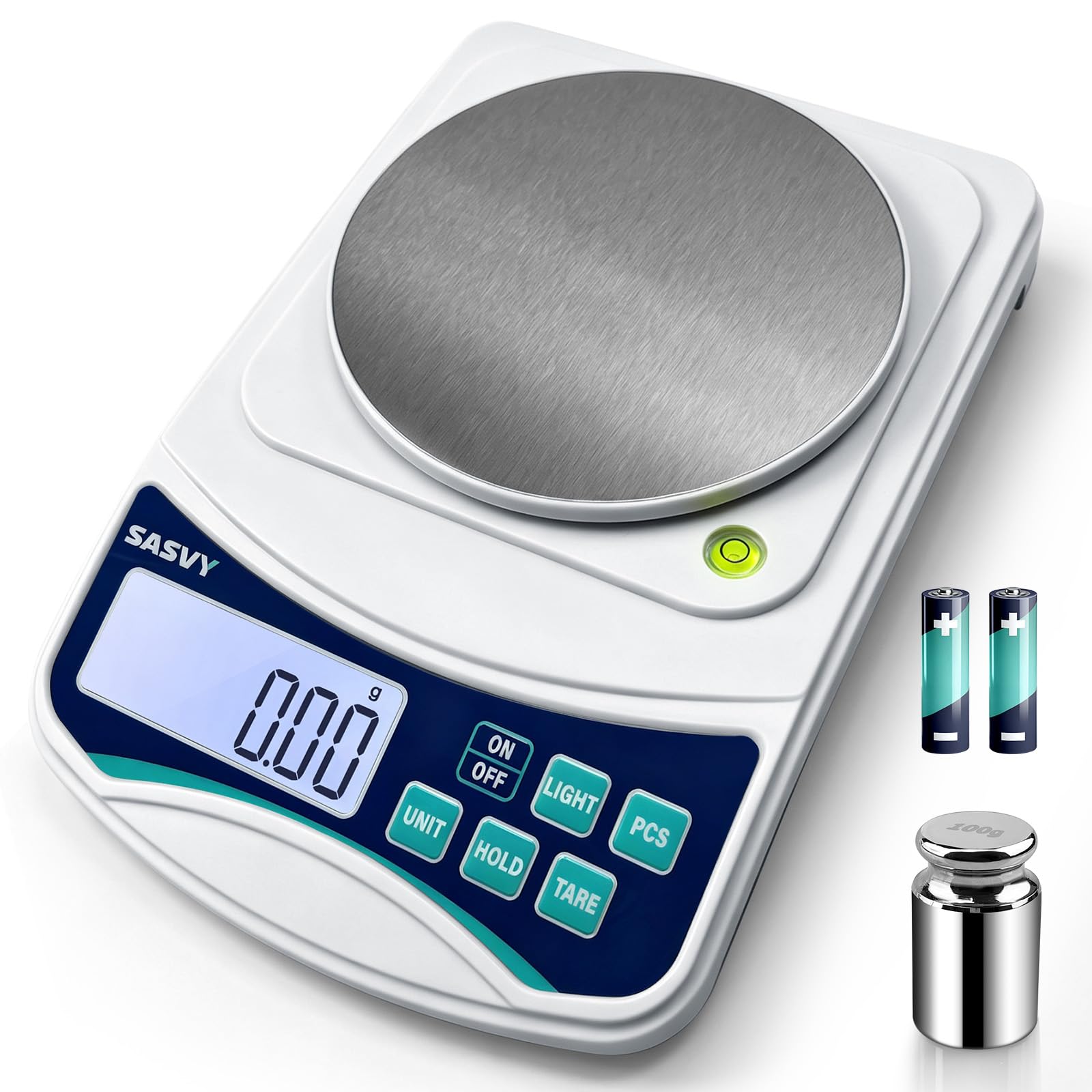
SASVY 1000g x 0.01g

SASVY 1000g x 0.01g

Self-calibration

Customer rating 4.2/5
Check Price

Worth Noting

  • On a vibrating bench or near an air vent, the light body lets readings shift with the disturbance
  • Display can drift between measurements, requiring re-zeroing to stay accurate
Capacity
1000 g
Calibration
100g weight included
Readability
0.01 g
Power Source
2x AAA batteries
Read the full review

Its 100 g calibration weight and level bubble make this the most self-sufficient option in the set — calibration is clean and tool-free, and accuracy holds for small parts, powders, and jewelry. The backlit LCD and adjustable feet round out a capable budget build.

The tradeoff is its very light body: on a vibrating bench or near an air vent, readings shift with the disturbance, which keeps it a notch below the balanced workhorses in this set. It suits a quiet, dedicated bench where you won't bump the table mid-weighing.

Bottom line: For a quiet, dedicated bench where self-calibration matters more than vibration resistance, this is the pick — the built-in weight and level bubble remove setup guesswork.

#9

MOCCO 600g x 0.01g

MOCCO 600g x 0.01g

Field / remote

Customer rating 4.2/5
Check Price

Worth Noting

  • Occasional units arrive unable to calibrate even with the included weight, needing an exchange.
  • Over time, some units drift or stop operating as directed, which matters most once results are graded.
Capacity
600 g
Calibration
200g weight included
Readability
0.01 g
Power Source
AC or batteries
Read the full review

Covers bench and field weighing for middle- and high-school science, and the included 200 g calibration weight removes a separate accessory purchase. Six-hundred-gram capacity with 0.01 g readability spans the usual gravimetric range, while the bubble level steadies it on uneven outdoor tables.

It earns its mid-range price for a field program or an occasional-lab schedule where a spare unit is on hand. A daily-graded chemistry room weighing multiple classes back-to-back is better served by the more-established balances in this set.

Check a new unit against the included 200 g weight before its first graded use, then repeat before any session where results count.

Bottom line: Reach for this when your science program weighs outdoors or intermittently and can keep a spare unit on hand; a daily-graded classroom is better served by a more-established balance in this set.

How to Choose

Readability vs. Repeatability

A 0.01 g (centigram) display does not guarantee that the scale will show the same value twice for the same object. In practice, budget pocket scales often drift between readings, while lab-marketed balances with calibration support hold steadier numbers. The hidden trade-off is that centigram readability demands more stability in the load cell and more protection from air movement and vibration.

For a high school classroom, 0.1 g readability is often enough for chemistry demos and density experiments, while 0.01 g matters for precise powder weighing or quantitative analysis. If you choose a centigram scale, plan to verify it with a known mass periodically rather than trusting the display's resolution.

Capacity and Classroom Fit

Capacity determines what you can place on the pan without overloading the sensor. A 200 g scale covers small samples and home chemistry, but a 600 g unit handles most standard experiments, and a 5000-6000 g balance is needed for bulk materials or large demonstration objects. The trade-off is that higher capacity at the same readability costs significantly more and often comes with a larger, heavier footprint.

Before buying, list the heaviest object students will weigh — a rock, a beaker of water, a bag of salt — and choose a capacity at least 20% above that. A scale that tops out at 200 g will frustrate any lesson that involves weighing a textbook or a full graduated cylinder.

Calibration Support

Classroom scales drift over time, and without a calibration weight you are stuck re-zeroing a scale that may be off by half a gram. The hidden trade-off is that calibration weights are not universal — you need a known mass close to the scale's capacity, typically 100 g or 200 g. Scales that include a weight and a documented external calibration procedure are dramatically easier to keep accurate.

If a scale has no calibration weight, you must source one separately or rely on the factory calibration, which degrades after months of student handling. A leveling bubble and adjustable feet help, but they do not replace a real calibration routine with a traceable mass.

Power Source

Battery-only scales die mid-lab session, especially when students forget to turn them off. AC-powered operation or a USB cable keeps the scale running through a full period, but adds a cord that can get in the way on a crowded bench. The trade-off is between portability and continuous operation.

For a fixed classroom station, choose a scale that accepts an AC adapter or USB power. For a cart that moves between rooms, battery power with an auto-off feature is fine — just budget for battery changes or a rechargeable model with a USB port.

Platform and Build

A small, lightweight platform shifts readings when a student leans on the table or a fan blows across the bench. Stainless steel pans are easier to clean and resist chemical spills, but a very light body may vibrate with air movement. The hidden trade-off is that stability often comes from weight and a wider footprint, which makes the scale less portable.

For student-heavy use, look for a non-slip base, a raised lip to contain spills, and a pan large enough for a beaker or a small rock. A scale that feels flimsy in the hand will likely produce erratic numbers under real classroom conditions.

Frequently Asked Questions