Math Learning Product Guide

12 Best Dice for Math Games in 2026: Standard-Size Picks for Classrooms

The best dice for math games depend on size, quantity, and material. These classroom-tested picks help teachers avoid undersized sets and flimsy dice.

12 Best Dice for Math Games in 2026: Standard-Size Picks for Classrooms editorial illustration

Many teachers ordering dice online end up with 14mm cubes when they expected the standard 16mm size. The difference is small in millimeters but noticeable in hand — smaller dice are tougher for young students to roll and read, and they can undermine the feel of a game.

The other big trade-off is quantity versus quality. Bulk packs under ten dollars often use thinner plastic or skip the durability testing that premium sets go through, and some high-volume listings have no verified customer feedback at all.

This guide sorts out which dice actually hold up in a classroom, which sizes work best for which grade levels, and when a specialized set like dice-in-dice or operation dice is worth the extra money.

#1

Okehlotos 50 16mm

Okehlotos 50 16mm

Whole-class games

Customer rating 4.7/5
Check Price

Worth Noting

  • Solid plastic hides the inner roll, so probability demonstrations benefit from a clear set instead
  • Surface finish can vary between individual dice, with a quick inspection on arrival worthwhile
Type
Dot
Material
Plastic
Quantity
50
Size (mm)
16
Read the full review

The Okehlotos 50-piece set is the everyday classroom standard: 50 dice at the correct 16mm size, ten bright colors, and a plastic storage box, all at a budget price. The size matches what standard math activity guides and board games assume, so students get authentic rolls rather than the smaller 14mm dice some bulk listings ship. The plastic surface stays clean through daily handling, the dice roll evenly during play, and the ten-color scheme makes group assignment instant — each table grabs its own shade while sorting stays simple.

This set covers a full classroom, with enough dice for small-group rotations, math centers, and family game nights without a second purchase. Buyers wanting a wider range of colors will notice some repetition across the 50 dice — a cosmetic limit that changes nothing about play. Anyone who needs standard-size dice in real quantity at a low price can fill the storage box and start rolling, whether the setting is a school shelf or a home game drawer.

Bottom line: For a classroom that just needs standard-size dice in real quantity at a low price, this is the set to build the game shelf around.

#2

Learning Resources Dice in Dice

Learning Resources Dice in Dice

Probability lessons

Customer rating 4.8/5
Check Price

Worth Noting

  • Under heavy classroom handling, the outer die can separate from the inner cube.
Type
Dice in dice
Material
Plastic
Quantity
72
Size (mm)
19
Read the full review

The clear outer die with a contrasting inner cube turns each roll into a visual lesson — students see the larger number outside and the lower number inside, making probability and place value concrete. Unlike soft foam dice for early sensory play, this plastic set targets the precision of classroom probability work.

The 72-dice bucket suits math teachers, homeschool families, and classroom centers running probability or operation drills. The outer halves can separate from the inner cube under heavy handling, so it's best for supervised centers rather than rough group play. The higher price buys a specialized manipulative that standard dice can't replicate.

Bottom line: For probability and place-value lessons, the visible inner cube changes how students interpret each roll, and the 72-dice count keeps centers stocked across the school year.

#3

Gejoy Math Teaching Dice

Gejoy Math Teaching Dice

Arithmetic practice

Customer rating 4.8/5
Check Price

Worth Noting

  • Only 18 dice per box, so whole-class games need multiple sets.
Type
Operation dice
Material
Plastic
Quantity
18
Size (mm)
16
Read the full review

Gejoy's set stands apart by pairing operation dice — plus, minus, multiply, and divide — with numbered cubes, so students roll their way into building equations rather than just matching dots. The compact 16mm white dice with black pips suit tabletop play across a small group, and the value sits squarely in the equation-building practice the set enables.

The mix rewards guided arithmetic work more than free play, which suits math teachers running a small teaching station or a homeschool lesson. Each roll pairs an operation die with number cubes to create a fresh problem, keeping practice active and game-like.

Bottom line: For turning arithmetic drills into an active equation game, the operation dice give small-group or homeschool instructors a tool a standard set can't match.

#4

Learning Resources Foam Dice

Learning Resources Foam Dice

Preschool and kindergarten

Customer rating 4.6/5
Check Price

Worth Noting

  • Pips can peel off with repeated handling, making numbers harder to read over time.
  • Foam bounce makes rolls less uniform, so outcomes are not truly random.
Type
Dots
Material
Foam
Quantity
2
Size (mm)
44
Read the full review

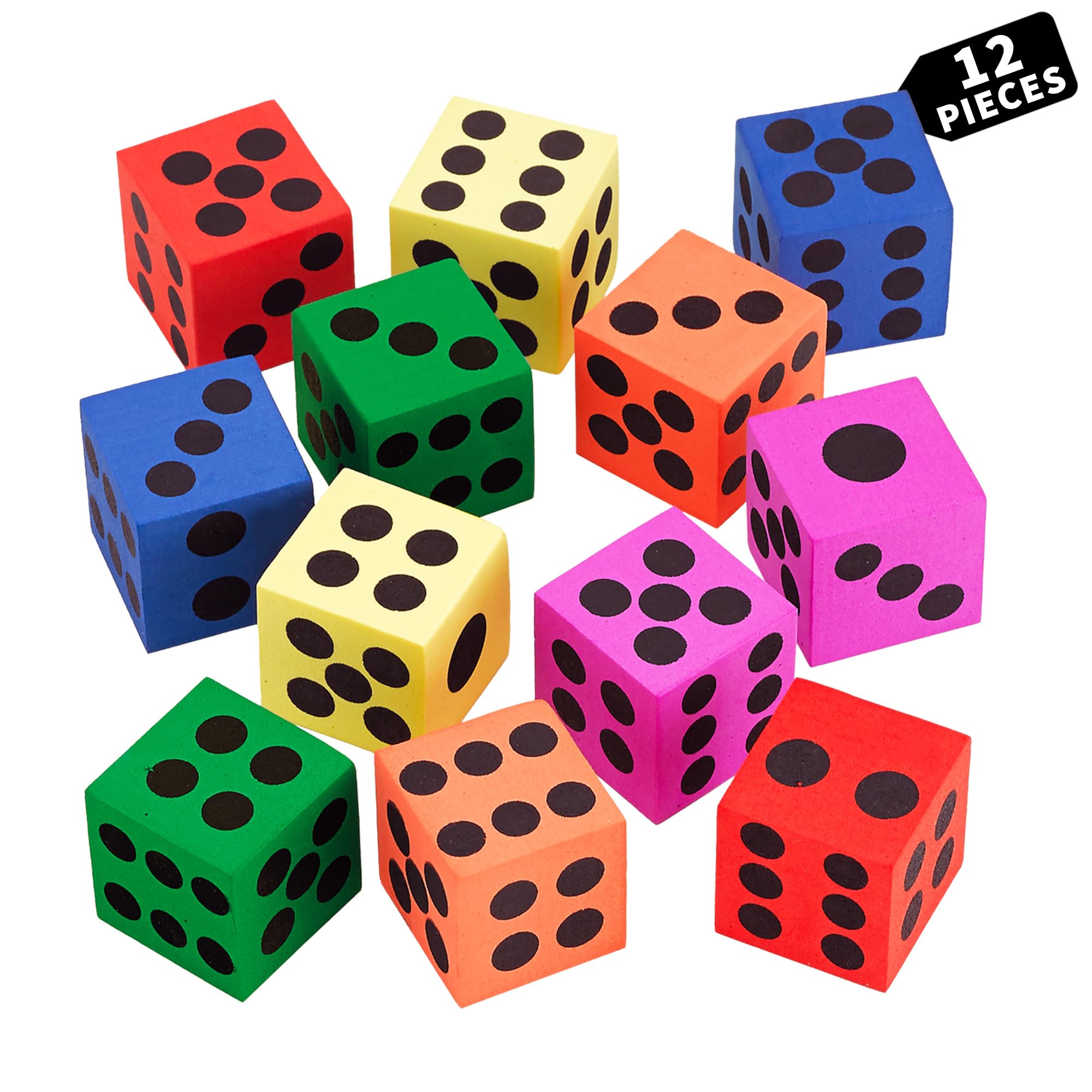
Where the 50-piece classroom set covers a whole group in hard plastic, these large 1.75-inch foam cubes land softly and stay quiet — a deliberate fit for young hands. Easy-to-count dots suit ages 3 and up, turning early number sense into a calm tabletop task.

Best for preschool, kindergarten, and special-needs settings where safety and low noise outweigh precision, this pair works well alongside a standard bulk set for older learners. Accept the trade-offs of foam: rolls bounce differently than plastic, and pips may wear off with heavy use.

Reserve these for counting games and quiet early-math centers, where bounce and pip wear matter less.

Bottom line: For preschool and kindergarten classrooms that value quiet, safe play over precision, this pair delivers — as long as you don't need bulk quantities or perfectly uniform rolls.

#5

50-Piece 14mm Dice

50-Piece 14mm Dice

Budget bulk use

Customer rating 4.6/5
Check Price

Worth Noting

  • Dice run 14mm, noticeably smaller than the standard 16mm some teachers expect.
Type
Dot
Material
Acrylic
Quantity
50
Size (mm)
14
Read the full review

Fifty vivid dice for under seven dollars make this the highest quantity-per-dollar pick in this roundup. The acrylic cubes arrive in ten bright colors that keep counting and sorting engaging, and the low price makes replacing a lost die painless. For classrooms that simply need plenty of dice on the table during a lesson, the value is hard to beat.

This hits the mark for budget-conscious classrooms that need many dice on the table for math centers, rotations, and quick practice games, where volume matters more than precision.

Hand each student a few dice for rapid arithmetic drills — rolls stay lively and desks stay clear.

Bottom line: A cost-effective route to putting dice in every student's hands for everyday math games — ideal when numbers matter more than exact size.

#6

hand2mind 12 Dice 3/4

hand2mind 12 Dice 3/4

Early elementary

Customer rating 4.7/5
Check Price

Worth Noting

  • A single 12-dice pack covers small groups but not whole-class games
Type
Number
Material
Plastic
Quantity
12
Size (mm)
19
Read the full review

The 19mm dice sit a size above the standard 16mm classroom set, and the bold printed numerals make them readable at a glance for young children still learning to count. Bright colors keep early math practice lively, and the larger face is forgiving for small hands learning to roll. These suit preschool and kindergarten small-group activities or a supervised math center — a single 12-dice pack won't cover a whole-class game, so plan for multiple sets if that's the goal.

Bottom line: Right for preschool and kindergarten small groups where readability matters more than dice count — not the pick for a full class of 30.

#7

Bicycle 5 Dice

Bicycle 5 Dice

Small group use

Customer rating 4.8/5
Check Price

Worth Noting

  • Under heavy daily use, the plastic can chip or lose pips
Type
Dot
Material
Plastic
Quantity
5
Size (mm)
16
Read the full review

Five standard 16mm dice at a budget price fit right into a small math center, with white pips that read clearly. They roll well for tutoring a small group. The limiting factor is the count: five dice can't cover a whole-class game, so they suit light, occasional play.

Bottom line: For a teacher who needs a few spare dice for a math center or a quick replacement set, this five-pack is a low-cost fit — just don't expect it to endure a full classroom's daily pounding.

#8

TecUnite 25 Polyhedral

TecUnite 25 Polyhedral
Customer rating 4.8/5
Check Price

Worth Noting

  • The unfamiliar 10-sided format reads differently than standard numbered cubes, so early arithmetic lessons need a different set.
Read the full review

Colorful 10-sided dice give older students a tangible tool for probability and statistics, with crisp numbers and a budget price across 25 pieces — well suited to group work and color-coded math centers. But these are not standard for early arithmetic; teachers of younger grades do better with numbered cubes, since the d10 reads differently and targets older learners.

Bottom line: Pick these when your lesson plan runs on probability and statistics for older students — the d10 format is exactly what those experiments need.

#9

SmartDealsPro 10 D6

SmartDealsPro 10 D6
Customer rating 4.8/5
Check Price

Worth Noting

  • For games where opaque dice are preferred, the translucent shells won't match expectations.
Read the full review

These 16mm translucent dice roll cleanly, and the bright colors keep them visible on a desk. As a compact pack they suit one student's practice session or a single math-center station. For a whole-class dice game, ten dice run out quickly — the pack stops being enough beyond small-group scale.

Bottom line: Best as a compact starter for a single math-center station or one student's practice — its scale fits that setting exactly.

#10

100-Piece 16mm Dice

100-Piece 16mm Dice
Customer rating 4.8/5
Check Price

Worth Noting

  • Acrylic dice feel lighter than resin and may show surface scuffs with routine classroom use.
Read the full review

At under ten dollars, this is the volume champion of the roundup, one hundred standard 16mm acrylic dice with a plastic storage box. How consistently all one hundred roll true is confirmed only after the box opens. It best suits classrooms that need maximum numbers quickly and accept that confirmation comes with delivery.

Bottom line: Reach for this when one math center genuinely needs one hundred dice on a tight budget. For smaller practice groups, or where assured quality matters more than raw count, the verified 50-piece roundup leader fits better.

#11

GWHOLE 40 16mm

GWHOLE 40 16mm
Customer rating 4.7/5
Check Price

Worth Noting

  • Carries fewer dice per dollar than the 50-piece budget sets elsewhere in this roundup.
Read the full review

Forty standard-size 16mm dice in eight colors cover small-group rotations and replacement needs at a budget price, delivering quantity without the premium of the top pick. The catch: no customer feedback confirms how the acrylic holds up through steady classroom use, so this suits teachers who buy on count and cost rather than on verified wear.

Bottom line: The practical pick for a teacher who needs a cheap stash of standard-size dice for small-group rotations and treats them as expendable classroom stock.

#12

Playbees Large Foam Dice

Playbees Large Foam Dice
Customer rating 4.7/5
Check Price

Worth Noting

  • Suited to early childhood
Read the full review

These 1.5-inch foam dice roll quietly and land softly, a safe fit for kindergarten and special-needs classrooms where active learners count by moving. The big, easy-to-read dots hold up to enthusiastic tossing. Foam bounces less uniformly than hard plastic, so outcomes skew — a genuine boundary for older students running probability trials, but a non-issue for early counting games.

Bottom line: This fits kindergarten and special-needs classes where moving, quiet counting matters more than roll precision; switch to hard plastic dice when probability lessons begin.

How to Choose

Quantity

The number of dice you need depends on how you plan to use them. A class of 25 students doing a paired addition game needs at least 50 dice, while a small group rotation can get by with 10 to 12. Bulk sets of 50 or 100 make whole-class activities possible, but they often come with trade-offs in size or quality.

If you are buying for a single math center or tutoring session, a 12-piece set is plenty. For whole-class games, aim for at least two dice per student so pairs can work simultaneously without waiting.

Size

The standard 16mm dice are what most people picture when they think of a game die. They roll well, fit comfortably in elementary hands, and are large enough for numbers to be clearly visible across a desk. The 14mm dice, common in budget bulk sets, are noticeably smaller — about 12% less surface area per face. This makes them harder to read for younger students and more likely to get lost.

For preschool and kindergarten, 19mm to 44mm dice are better. Larger dice are easier to grip and the bigger numerals or pips reduce the visual strain that comes with counting dots. Just remember that oversized foam dice bounce differently and won't give a perfectly uniform roll.

Material

Acrylic and hard plastic dice are the standard for classrooms. They hold up to years of rolling, keep their corners sharp, and the painted pips stay legible. Foam dice, by contrast, absorb sound and are soft enough for young children to throw safely, but the printed dots can peel off with heavy use.

The durability difference matters most in high-traffic environments. If dice will be passed around all day across multiple classes, stick with acrylic or hard plastic. Foam is best reserved for quiet centers, circle time activities, or special-needs settings where noise is a concern.

Type

Standard dot dice are the most versatile. They work for counting, addition, subtraction, and probability. Number dice with printed numerals are better for early learners who cannot yet count dots quickly. Combined sets that include operation dice — signed with plus, minus, multiply, and divide symbols — let students generate their own practice problems.

The specialized dice-in-dice design from Learning Resources deserves a special mention. The outer die with the inner cube gives students a concrete visual for combining numbers, which is powerful for teaching place value and probability. Just know that these are a teaching tool, not a substitute for standard dice.

Storage

Bulk sets come in one of two configurations: a plastic carrying box or a loose bag. The box is a clear advantage when dice need to be distributed and collected multiple times a day. A storage container keeps dice organized by color or type, which cuts down on setup time.

If the set comes loose in a bag, you will need to find your own container. A simple plastic bin or a segmented craft box works well. The time spent managing dice is time taken away from math instruction, so storage is a practical consideration every teacher should make.

Frequently Asked Questions