Books & Reading Product Guide

10 Best Decodable Readers of 2026: That Actually Build Phonics

Find decodable readers that genuinely teach phonics — not just character-branded boxes labeled 'phonics' for beginning readers.

10 Best Decodable Readers of 2026: That Actually Build Phonics editorial illustration

The word 'phonics' on a book box doesn't mean the words inside follow phonics rules. Many of the best-selling character-branded sets include irregular spellings and vocabulary a beginning reader simply can't sound out. That mismatch leaves parents frustrated when a child who knows their letter sounds still stumbles over a book labeled for their age.

This guide sorts decodable readers by what actually shapes early reading success: how strictly the text follows phonics patterns, how skills progress from short vowels through blends and digraphs, and whether the stories hold a child's attention. Those factors matter more than page count or marketing claims. You'll see which sets genuinely deliver decoding practice and which ones lean on licensed characters to mask weaker text.

You'll also learn why decodable books are deliberately small and what that means for practice volume and skill focus. The right set matches your child's current decoding stage, not just their year in school.

#1

Bob Books Set 1

Bob Books Set 1

Beginning readers

Customer rating 4.8/5
Check Price

Worth Noting

  • A couple of early titles blend in sight words, interrupting a strict decode-only run
  • Books run small with very thin pages, more like a card than a full-size picture book
Age Range
Ages 3-6
Book Count
12 books
Engagement
Simple line art
Skill Progression
Two-letter to sentences
Read the full review

Two decades of classroom validation back these 12 books as the category's standard starter, and the payoff shows up fast — kids sound out short words and gain reading confidence within weeks. The set builds from two-letter words to simple sentences across a gentle arc, and its word-count discipline, just a handful of words per page, keeps early frustration low. Children genuinely ask to read these books, a concrete sign the structure works rather than a claim on the box.

This set suits parents of preschoolers and kindergartners who want a budget-friendly, structured start, plus teachers who need a dependable whole-class staple and homeschools seeking a repeatable daily routine. The books run small with thin pages, and a couple of early titles fold in sight words rather than staying purely decodable — a boundary that matters only for families insisting on a strict decode-only program. Other buyers get a low-pressure on-ramp whose gentle pacing keeps new readers engaged, and twelve books at this price is the strongest literacy value in the lineup.

The compact format tucks into a backpack or diaper bag with ease, so the set works well as a travel reading option.

Bottom line: For families and teachers alike, this is the set that gets first-time readers past the starting line at a price that leaves room for the next stage.

#2

Charge into Reading Stage 1

Charge into Reading Stage 1

Strict phonics

Customer rating 4.8/5
Check Price

Worth Noting

  • Higher per-book cost than twelve-book sets, so the price-per-story runs steep.
Age Range
Ages 5-6
Book Count
5 books
Engagement
Activities and word lists
Skill Progression
One vowel per book
Read the full review

Each book in this stage targets a single short vowel with zero guessing — no picture cues, no sight-word crutches, just clean decoding practice from the first page. Where the long-running classic blends in early sight words, each book here stays strictly with its assigned vowel. The silly short-vowel stories and built-in word-list reviews keep the repetition purposeful rather than drill-like.

That purity suits strict systematic-phonics families, homeschoolers running an explicit program, and kids who need one vowel mastered before moving on. At five books per stage, practice volume runs thinner than the twelve-book sets — a boundary worth knowing before purchase.

Bottom line: Best for families who treat decoding as non-negotiable and run a structured phonics program at home.

#3

Charge into Reading Stage 2

Charge into Reading Stage 2

Blend practice

Customer rating 4.9/5
Check Price

Worth Noting

  • Only five books per stage
Age Range
Ages 5-6
Book Count
5 books
Engagement
Illustrated stories
Skill Progression
Blends after vowels
Read the full review

Building on Stage 1's short-vowel foundation, this set moves into consonant blends — one pattern per book, so a child locks in a single blend type before advancing. Each book pairs one blend (st, br, fl) with a genuine storyline and appealing illustrations rather than drill-style word lists, keeping early practice feeling like reading.

This is a deliberate follow-up for kids who have already mastered short vowels — teachers and homeschoolers get a strict, story-driven progression with targeted blend work. It won't suit absolute beginners still on short vowels, and the reputation here is younger than the Bob Books line, so families who weigh classroom history most heavily may lean toward the top pick.

Bottom line: The right follow-up for a child who has mastered short vowels and needs structured blend practice without sight-word crutches.

#4

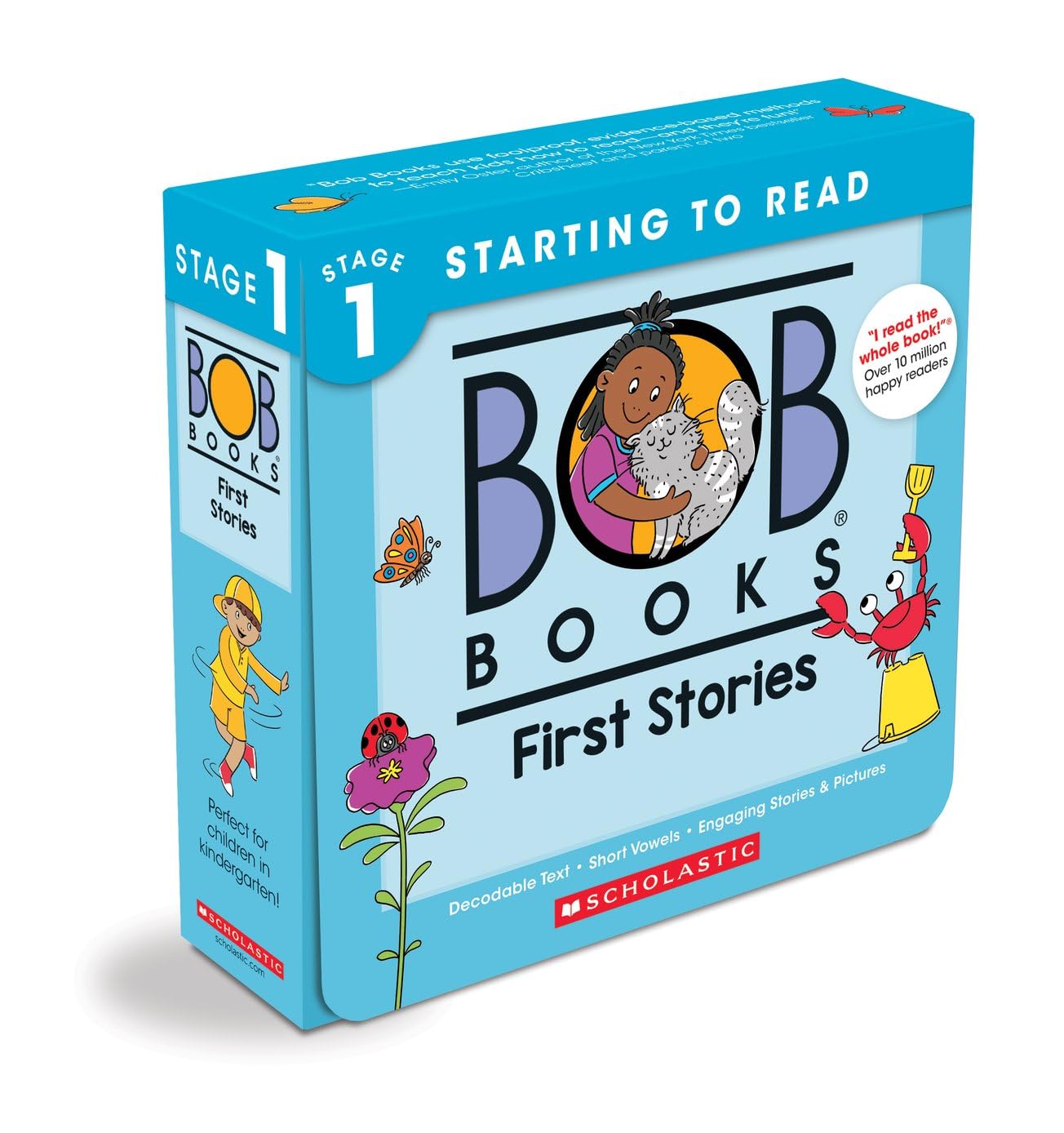
Bob Books First Stories

Bob Books First Stories

Hesitant beginners

Customer rating 4.8/5
Check Price

Worth Noting

  • A child may finish all twelve in one sitting
Age Range
Ages 4-6
Book Count
12 books
Engagement
Ultra-short stories
Skill Progression
Gentle beginning
Read the full review

Ultra-short stories build confidence without overwhelming true beginners — a softer start than the flagship Set 1, which folds in a few early sight words. Simple repetition and predictable phrases let a hesitant four-year-old finish a whole short book on day one, and that first complete read is what keeps them asking for the next.

This set suits the youngest beginners and hesitant starters, plus parents who want the Bob Books system with an easier entry. Its near-total absence of plot is expected at this stage — kids who already know letter sounds and want a faster climb should start elsewhere.

Read one or two stories per sitting to stretch the early wins.

Bottom line: For a hesitant four-year-old who needs a win before tackling a real story, this is the right starting point — switch to a faster progression once letter sounds stick.

#5

Minecraft Decodable L1

Minecraft Decodable L1

Reluctant readers

Customer rating 4.7/5
Check Price

Worth Noting

  • Single 75-page book, so practice volume ends with the story
Age Range
Ages 5-7
Book Count
Single book
Engagement
Minecraft gamification
Skill Progression
Level 1 CVC
Read the full review

A 75-page Minecraft adventure pairs short-vowel CVC decoding with XP-style leveling, so each correct read earns in-game progress. Chapter-end comprehension questions confirm real understanding rather than picture-guessing, and kids who balk at traditional readers ask to keep going day after day — a hook no other decodable in this set matches.

The single volume suits a 5-7 year-old Minecraft fan who refuses conventional readers, and it also holds traction with dyslexic and struggling readers. It is priced per book rather than per set, so expect a per-stage purchase rhythm instead of a one-time library.

Order the next stage volume alongside this one so reading momentum doesn't stall when the story ends.

Bottom line: For the Minecraft-obsessed child who rejects every traditional reader, this turns decoding into a daily game worth revisiting.

#6

Laugh-A-Lot Phonics

Laugh-A-Lot Phonics

Fun practice

Customer rating 4.8/5
Check Price

Worth Noting

  • Kids still learning short-vowel sounds meet storylines that assume prior knowledge
Age Range
Ages 4-6
Book Count
12 books
Engagement
Silly stories, stickers
Skill Progression
Short vowels
Read the full review

Twelve short-vowel stories carry genuine humor kids request by name — a playful contrast to the purely decode-only sets that lead with structure over fun. The bundled stickers and activity book stretch value past the printed pages, so daily practice reads as a reward rather than a chore, crucial for families pushing past the very first stage.

Best for children who already grasp basic short-vowel sounds and want story substance that keeps momentum moving through kindergarten to grade two. The twelve-book format plus activity extras suits parents and teachers rotating daily practice without monotony.

Begin with a simpler first-reader set, then switch to these once short-vowel sounds feel comfortable — they reward groundwork already laid.

Bottom line: Reach for these once short-vowel basics are in place — the humor keeps daily reading moving and the extras extend each book's usable life.

#7

Phonics First Little Readers

Phonics First Little Readers

Classroom use

Customer rating 4.7/5
Check Price

Worth Noting

  • The plain, text-forward pages offer little visual pull for children who respond to character-based stories.
Age Range
Ages 4-6
Book Count
—
Engagement
—
Skill Progression
Progressive difficulty
Read the full review

Progressive difficulty and genuine phonics practice make this a dependable classroom library addition for teachers who want a no-frills approach. The premium price targets classroom budgets, making it a niche purchase for educators rather than a broad family pick. Its value emerges over repeated lessons.

Bottom line: Fits classrooms needing dependable phonics practice; for home buyers, only if the child responds well to plain, text-forward readers.

#8

Paw Patrol Phonics Box

Paw Patrol Phonics Box

Character fans

Customer rating 4.6/5
Check Price

Worth Noting

  • In a toddler's hands, the thin paper and small size show wear sooner than sturdier sets
Age Range
Ages 3-5
Book Count
12 books
Engagement
Character appeal
Skill Progression
Short and long vowels
Read the full review

These twelve short-vowel stories turn Paw Patrol superfans into kids who beg for reading time — the repetition and easy text suit short attention spans wonderfully. What keeps it from ranking higher is the flimsy, small-format build, not the reading content.

Bottom line: Pick this when a Paw Patrol superfan needs motivation more than long-lasting pages — best for supervised read-along sessions.

#9

Yak Pack Comics Book 1

Yak Pack Comics Book 1

Older beginners

Customer rating 4.7/5
Check Price

Worth Noting

  • Families who want a separate physical book per story get one combined volume instead
Age Range
Ages 3-10
Book Count
Single volume
Engagement
Comic format
Skill Progression
Short vowels
Read the full review

The Yak Pack wraps short-vowel decoding in a comic format with comprehension questions, keeping grade 3-5 and ESOL beginners engaged without babyish art. It reads as one combined 65-page volume, so the story count per purchase trails the multi-book sets here — fine for high-interest practice, less ideal when separate books matter.

Bottom line: Best for ESOL classrooms or older beginners who need high-interest short-vowel practice and don't mind a single combined book.

#10

hand2mind Phonics Unit 2

hand2mind Phonics Unit 2

Teachers

Customer rating 4.6/5
Check Price

Worth Noting

  • Single reader book per unit at a premium per-book price
Age Range
—
Book Count
Single reader
Engagement
Curriculum-aligned
Skill Progression
Unit 2 CVC
Read the full review

Incremental CVC word practice aligned to the Guided Phonics + Beyond scope, backed by 3-year eReader access, makes this a precise fit for teachers running small-group intervention. Struggling readers get clear decoding practice that reinforces short-vowel skills without guesswork. The tradeoff is a single-book-per-unit format at a premium per-book price — economical for guided instruction, but a value mismatch for families wanting a multi-book home set.

Bottom line: Best for teachers already within the Guided Phonics + Beyond scope who need a CVC unit for small-group intervention — parents seeking a multi-book home set should look elsewhere.

How to Choose

Phonics Purity vs. Sight Words

True decodable books limit every word to sound-spelling patterns the child has already been taught. Many best-selling 'phonics' sets mix in sight words and irregular spellings that break that chain. When a beginner hits 'was' before learning the /w/ and /z/ sounds, they can't sound it out, so they guess or memorize instead. That guessing habit is hard to unlearn.

For strict systematic-phonics programs, that interruption is a dealbreaker. For a gentle home approach, a few sight words may be acceptable — just know what your curriculum requires before you buy.

From Short Vowels to Blends

Skill progression should follow a logical sequence: short vowels first, then consonant blends, then digraphs and long vowels. Books that bounce between patterns force a child to juggle multiple unsettled sounds, slowing fluency. A set that isolates one vowel or blend per book lets the child consolidate each skill before moving on. Look for sets that label their stage clearly, like 'Stage 1' or 'Level 1', and confirm the first books target just one pattern.

Practice Volume vs. Pace

Decodable books are deliberately short so a child can finish one in a single sitting. A 12-book set offers daily repetition, while a 5-book set may need pairing with another stage to keep momentum. That volume matters because reading success depends on repeated, consistent practice. But more books often means thinner, smaller pages to hold down the price; fewer books may come with larger, sturdier formats.

Match Reading Stage, Not Age

Age ranges on the cover are rough guides, not guarantees. A 5-year-old may be ready for blends while a 6-year-old still needs short vowels — match the stage level, not the birthdate. Watch for character-branded sets that advertise a low age but pack in words far beyond that stage's decoding ability. Check the first page's vocabulary before committing to a whole box.

Engagement Shouldn't Enable Guessing

Engagement is what keeps a child coming back, but illustrations can become a crutch. If a picture fully reveals every word, the child may stop sounding out and start guessing. The best readers use images that support the text without giving away each word — for instance, a picture that shows the scene but not the exact verb. Character-themed sets win on motivation but often cut corners on phonics accuracy.

Frequently Asked Questions