Student Tech Product Guide

8 Best Arduino Starter Kit for Students 2026: Value That Teaches

Which Arduino starter kits teach students without the premium price tag - matched to tutorial depth and how the learner works.

8 Best Arduino Starter Kit for Students 2026: Value That Teaches editorial illustration

Arduino starter kit titles overpromise. Nearly every box claims to be 'Most Complete' or 'Best for Beginners,' but the components inside are largely the same. What separates one kit from another is tutorial depth and build quality - whether a student finishes the course or stalls at a confusing wiring diagram.

The pricing is revealing. Arduino-compatible clones in the $35-$50 bracket deliver more sensors, more guided projects, and higher owner satisfaction than official-branded kits that cost three times as much. The official Arduino board only matters when a licensed curriculum requires it; for most classrooms and homeschools, a well-reviewed clone teaches the same skills.

That leaves matching the kit to how the student learns. A structured lesson plan fits classrooms and homeschools with a teacher nearby; a self-directed learner needs broader tutorials and a bigger component set to explore solo. This guide sorts the options by those needs.

#1

ELEGOO UNO Super Starter
ELEGOO UNO Super Starter

First-time students

Customer rating 4.7/5
Check Price

Worth Noting

  • A first-timer can lose a whole evening to IDE driver and port selection before the first blink runs.
Board
UNO R3 compatible
Components
120+ parts, sensors, LCD
Build Quality
Solderless build
Tutorial Depth
22 guided lessons
Read the full review

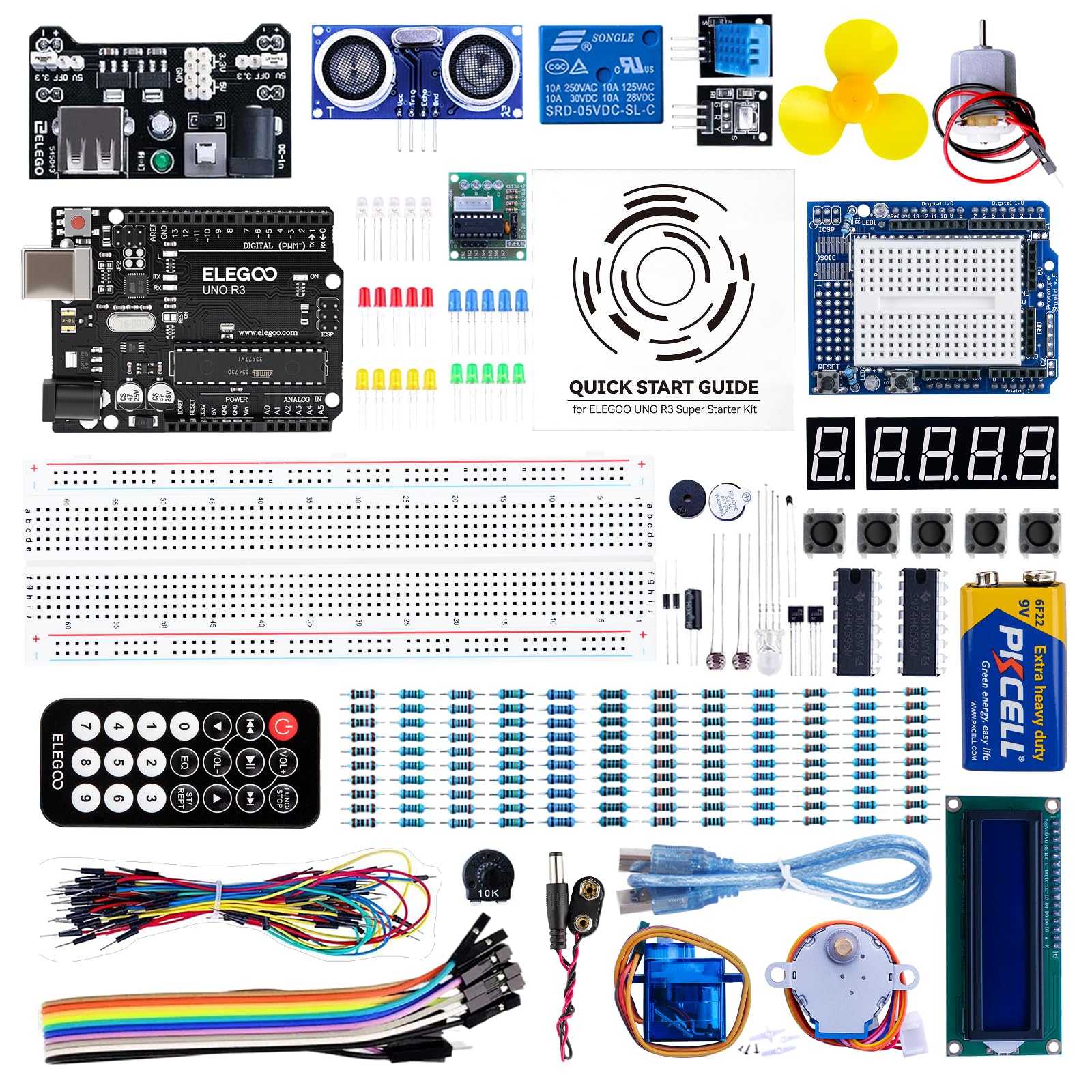
ELEGOO's UNO Super Starter stands as the best-tested beginner Arduino kit in this comparison, pairing the complete UNO R3 learning arc with component quality that holds up across repeated classroom and home use. The 22 guided lessons move from a first blinking LED up to ultrasonic distance sensing, DHT11 temperature reads, LCD1602 display output, joystick control, IR remotes, and servo and stepper motors, with working example code supplied for every project. More than 120 resistors, transistors, and LEDs, plus two 7-segment displays and a buzzer, give enough inventory that a student can rebuild a lesson or two without exhausting the kit. The companion PDF mirrors the lessons on screen, letting a learner read ahead or revisit a concept without losing their place.

The solderless breadboard, a 9V battery, and a DC adapter remove the classic early stumbling blocks - the first blink program runs within minutes of opening the box, no soldering required. The bundled USB cable and clearly labeled component bags keep a lesson moving without hunting for a dropped resistor mid-build. With the quick-start sheet in the box, a complete beginner gets from unboxing to a running LED in one sitting.

This is the box to hand a middle-schooler, a homeschool parent, or an adult self-learner who wants a single purchase that covers the whole basics without guesswork. The honest tradeoff sits in the printed tutorial: lesson depth varies, and absolute beginners who prefer interactive walkthroughs over text-and-diagram explanations can supplement a few sections with a free video course, treating the guide as a scaffold rather than a complete curriculum. Buyers who specifically require the official Arduino logo, or advanced students who will outgrow the UNO's digital I/O, should aim for original-board kits or the larger Mega offerings.

At a mid-range price, the Super Starter undercuts official-brand equivalents of similar scope while delivering the same learning path and considerably more parts - the reason it holds the default recommendation rather than a budget gamble. Dependable quality and clear value define the kit; a newcomer who starts here typically keeps building past the first few projects instead of hitting a wall and switching product lines. That staying power separates it from lower-cost clones that save money up front but lose learners to frustration.

Bottom line: For anyone starting someone on Arduino - student, child, or adult - this is the lowest-risk box in the set: a full beginner arc in one purchase, with components that keep working.

#2

REXQualis Super Starter

REXQualis Super Starter

Budget learners

Customer rating 4.7/5
Check Price

Worth Noting

  • PDF lessons cover each project but leave some wiring explanations thin for absolute beginners.
  • A component can arrive non-functional, stalling a breadboard session until a replacement ships.
Board
UNO R3 compatible
Components
LCD, motors, sensors
Build Quality
Pre-soldered LCD
Tutorial Depth
PDF + DVD tutorials
Read the full review

This kit ships with a 9V wall adapter in place of a battery clip, and the LCD module arrives pre-soldered — two setup frustrations in budget sets disappear before the first lesson. At a price below the category's default recommendation, it still carries a broad assortment: servo, stepper and DC motors, an ultrasonic sensor, an LCD1602 display, and a labeled storage box that keeps a learning desk tidy from the start. It's the rare budget set where the part count doesn't signal where corners were cut.

The right fit is a cost-conscious student or family wanting to gauge Arduino interest without a large outlay, or a classroom spreading the entry cost across several units. Buyers here accept two boundary conditions: tutorial lessons leave some wiring explanations thin, and an occasional component can arrive non-functional. Both are tolerable at a budget price.

What seals it is the build experience: the board connects cleanly to the Arduino IDE, the labeled storage box keeps every part traceable, and the bundled guide walks a first project from breadboard to running sketch without hunting for parts or a power source. For the entry price, the assortment and structure overdeliver.

Keep a free beginner Arduino video series open alongside the PDF — wiring explanations vary between lessons.

Bottom line: The pick for cost-conscious families and classrooms: it holds the part count and build experience at the lowest sensible entry price, with tutorial polish as the only real compromise.

#3

Arduino Student Kit (Official)

Arduino Student Kit (Official)

Classroom curriculum

Customer rating 4.6/5
Check Price

Worth Noting

  • Part count trails similarly priced clone kits, so buyers seeking maximum components per dollar get bigger bundles.
  • Guidance depth assumes a mentor, so fully self-directed study may need outside video supplements.
Board
Official UNO-based
Components
Core basics only
Build Quality
Complete set
Tutorial Depth
Interactive curriculum
Read the full review

The only kit in this set written by the Arduino education team, the Student Kit pairs an official UNO-based board with a multi-lesson curriculum shaped for students around ages 11-14. Lessons move progressively from basic circuits into programming, each activity reinforcing the previous one in a sequence a teacher can deliver. Where a printed MAKE book suits solo tinkerers, this curriculum assumes a class structure and rewards an instructor-led setting.

Teachers, homeschool parents, and families with students aged 11-14 get the most from this kit, which trades raw component volume for an authentic first-party learning path. The honest boundary for anyone studying alone: guidance expects an adult or mentor to scaffold lessons, so fully self-directed learners may want supplementary video courses. Inside a classroom, that structure is exactly the point.

The mid-range price buys curriculum and official hardware over component bulk, which suits structured lessons well. Clone kits at a similar cost pack in more parts, so the choice comes down to whether a guided sequence matters more than raw inventory.

Work through each lesson alongside the student so the sequence lands as intended — the curriculum rewards a mentor's pacing.

Bottom line: Teachers and homeschool parents building a course around an authentic first-party syllabus will find this kit worth the premium over clone bundles.

#4

ELEGOO Most Complete Kit

ELEGOO Most Complete Kit

Sensor variety

Customer rating 4.7/5
Check Price

Worth Noting

  • Some connection diagrams are hard to follow on the multi-module builds, and a few breadboard sockets may not grip components firmly.
  • Occasional components arrive non-functional from the box, so a replacement request may be needed.
Board
UNO R3 compatible
Components
200+ parts, 63 types
Build Quality
Pre-soldered modules
Tutorial Depth
30+ guided projects
Read the full review

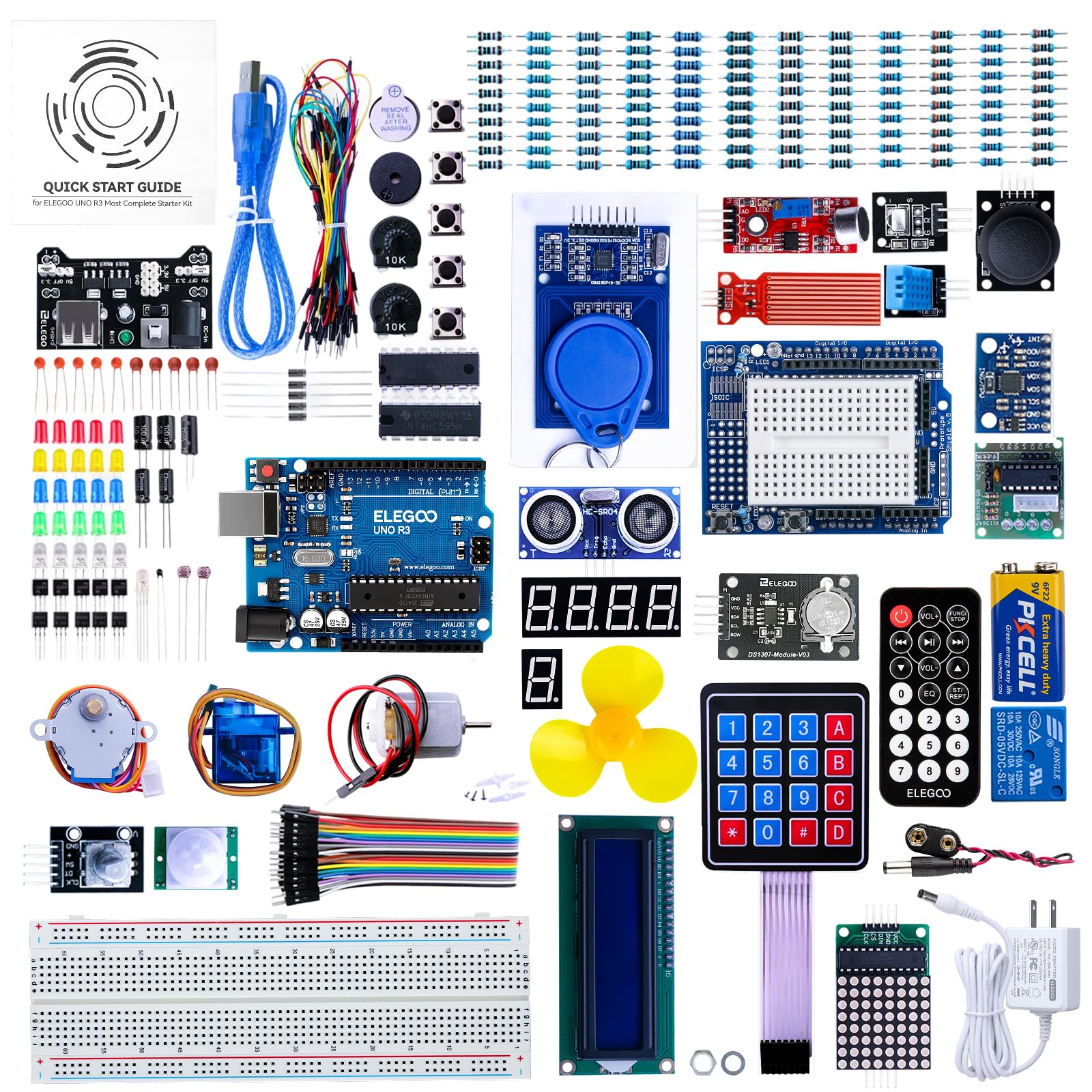
The ELEGOO UNO R3 Most Complete kit packs the broadest component selection in this review set — 200+ pieces across 63 types — at a mid-range price that beats what similar part counts usually command. Modules the basic starter kits omit appear here: an RFID reader, a real-time clock, a GY-521 accelerometer-gyroscope, a MAX7219 LED matrix driver, a PIR motion sensor, and ultrasonic and DHT11 environmental sensors. The UNO R3 board, pre-soldered modules, solderless breadboard, and 9V adapter have the first project running within minutes of unboxing.

This kit suits students and STEM-club members who want maximum sensor coverage from day one. The 30+ guided projects come as PDF tutorials whose code explanations vary in depth between lessons — some builds assume you can read the sketch by the time you reach them. Self-directed learners who pull supplementary material when needed handle this fine; absolute beginners leaning on step-by-step hand-holding may prefer the top pick's more guided route.

The breadth pays off as learners progress — moving from an LED blink to RFID card reading or a motion-triggered display happens inside one kit, no second purchase required. For STEM clubs running multiple students, per-project cost settles well below sourcing modules individually.

Keep the Fritzing diagrams beside the module pin labels on the multi-part builds — the printed layouts are clear, but the busier circuits reward a second check.

Bottom line: The widest parts roster at a mid-range price makes this the single kit that carries learners from LED basics to RFID and sensor projects without a second purchase.

#5

Arduino Official Deluxe Bundle

Arduino Official Deluxe Bundle

Print-book learners

Customer rating 4.5/5
Check Price

Worth Noting

  • Costs roughly double a separately assembled clone kit plus the same book
Board
Official UNO R3
Components
100+ parts, LCD
Build Quality
Storage box included
Tutorial Depth
170-page printed book
Read the full review

The printed MAKE 'Getting Started' book, third edition, anchors this bundle — a 170-page volume that reads as the clearest Arduino introduction in the category. Pairing it with the genuine official UNO R3 board delivers the canonical Arduino experience rather than a clone approximation, and the 9V battery snap plus plastic storage box keep the 100+ parts organized. The paper format works offline for readers who learn best away from a screen.

The cost runs roughly double a separately assembled clone kit plus the same book — a premium that suits two audiences: enthusiasts who want the official brand and tactile learners who strongly prefer a physical book over PDFs and screens. Budget-conscious students and anyone comfortable with clone kits and free online tutorials will find better value in the community-vetted option in this set, which reaches the same learning outcomes for a fraction of the outlay.

Less-confident beginners get a genuine starting point, since the lessons open at the absolute basics and build through servo, motor, LCD, and sensor projects on the included breadboard and wooden base. The kit performs on par with costlier alternatives and stays genuinely fun through the paced progression, which rewards patience without overwhelming.

Bottom line: For the gift-giver or enthusiast after the genuine board and a paper book, the premium buys a canonical, polished learning path. Learners on a budget cover the same ground with the value pick in this set for a fraction of the cost.

#6

SunFounder 3-in-1 IoT Kit

SunFounder 3-in-1 IoT Kit

IoT builders

Customer rating 4.5/5
Check Price

Worth Noting

  • IR module and USB-to-PC communication can be finicky in certain setups, slowing early lessons.
  • Some units arrive missing a part needed for the robot car, blocking that flagship build.
Board
UNO + ESP8266
Components
192 parts, car, IoT
Build Quality
Solderless build
Tutorial Depth
87 projects, videos
Read the full review

Eighty-seven projects spanning basics, IoT, and a working smart car make this the only set in the comparison built for moving builds, backed by video courses co-developed with Circuit Basics that walk visual learners through each step. That breadth outpaces static bench kits for students drawn to robots. Component QC gaps keep it out of the top tier: some units arrive missing a part that blocks the car project, and the IR module plus USB-to-PC communication can be finicky in certain setups — unit variance more than design flaws, though both matter most when the car is the entire reason to buy. Students who hop between tracks, or who lean on the video lessons, absorb these quirks easily.

Bottom line: Best for a student whose main draw is a robot car and IoT builds, who learns well from video, and who accepts that occasional units arrive short a part — no other set here moves like this one.

#7

SunFounder Inventor Lab Kit

SunFounder Inventor Lab Kit

Measurement teaching

Customer rating 4.6/5
Check Price

Worth Noting

  • Premium pricing
  • Buyers tracking parts-per-dollar get fewer modules than cheaper alternatives.
Board
Original UNO R3
Components
200+ parts, multimeter
Build Quality
Multimeter included
Tutorial Depth
34 lessons, videos
Read the full review

An authentic Arduino Uno R3 REV3 paired with a digital multimeter and RAB breadboard holder makes this the only kit in the set that teaches real-world measurement, not just component wiring. Thirty-four guided lessons plus 40+ video courses carry visual learners through ultrasonic, LCD, and servo builds. The honest cost: this premium path runs well above clone kits that pack more modules per dollar, and its field record is thin enough that long-term component behavior remains unverified. Learners who prize genuine hardware and a multimeter's diagnostic value get a real tool; part-count shoppers are better served elsewhere.

Bottom line: For students and classrooms that prize an original Arduino board and a multimeter to verify their own circuits, this is a genuine measurement-first tool; budget-minded shoppers focused on component count should stick with cheaper clones.

#8

LAFVIN Super Starter Kit

LAFVIN Super Starter Kit

Bulk classrooms

Customer rating 4.7/5
Check Price

Worth Noting

  • Five-band resistors arrive unlabeled, so reading value bands takes patience under poor light
  • In a timed class period, a lesson whose wiring behaves differently than the guide documents can swallow the session
Board
UNO R3 compatible
Components
Motors, sensors, LCD
Build Quality
Pre-soldered LCD
Tutorial Depth
20+ lessons
Read the full review

Under $30, this kit folds 20+ guided lessons, a pre-soldered LCD, and per-part datasheets into one box — enough to run motors, ultrasonic sensors, and displays through a first semester of projects. For classrooms on a tight per-student budget, it serves as a low-cost test of whether Arduino hooks a student before larger spends. Build quality varies between units: a poorly soldered 5V pin or a dead breadboard zone can stall a single lesson until a replacement ships. That occasional variance keeps it a step behind the REXQualis kit at a comparable price for buyers who want zero assembly fuss.

Keep a multimeter handy to confirm resistor values before wiring each lesson.

Bottom line: Choose it for bulk classroom orders where per-seat cost decides the purchase; the REXQualis kit suits a student who needs every lesson to work exactly as written.

How to Choose

Tutorial Depth

Bundled tutorials are the single biggest variable between kits. The best ones walk a student from loading their first sketch to wiring a sensor and reading serial output, with tested code for every step. Thin manuals push learners to YouTube and can stall progress at the first unexplained connection.

The hidden trade-off: documentation takes real engineering hours, so kits with richer lessons often arrive with fewer parts. A teacher or parent can paper over a thin tutorial; a self-directed student feels it immediately.

Component Variety

Larger kits pack more project types into one box - motors, displays, ultrasonic sensors, RFID - which stretches how long the kit stays useful. 'Most Complete' labels overstate this, because many counts pad in duplicate LEDs and resistors.

Judge by module types, not raw part counts. A kit covering sensors, screens, and motion keeps an older student engaged, where a pure-LED basic kit feels stale within weeks.

Arduino IDE Compatibility

Every compatible board runs the same free Arduino IDE, but the USB bridge chip differs. Official Arduino boards are recognized instantly; most clone boards need a one-time CH340 driver install that can trip up school computers.

Since the IDE experience is otherwise identical, the official board's premium mainly buys brand recognition and zero driver friction. That matters on locked-down school machines and means little for most home setups.

Build Quality

Pre-soldered modules and a solid breadboard remove the most common failure points - cold solder joints and flimsy sockets. A tight breadboard can pull component pins out mid-project, which reads as a circuit bug to a confused beginner.

Dead-on-arrival parts happen at every price tier; kits that pre-solder their modules or include a reliable power adapter soften that risk considerably.

Power Source and Storage

The bundled 9V battery is the most common false start - clips corrode and cells drain fast, making a working board look dead. An external adapter or the USB cable is far more dependable for a student sitting at a desk.

A labeled storage case pays off in classrooms and homeschools, where 100+ loose parts need to stay sorted between sessions.

Frequently Asked Questions