Productive Struggle in Learning: Know When to Wait, Hint or Teach
A real-time boundary test for deciding whether difficulty is producing useful thinking or merely extending confusion and distress.
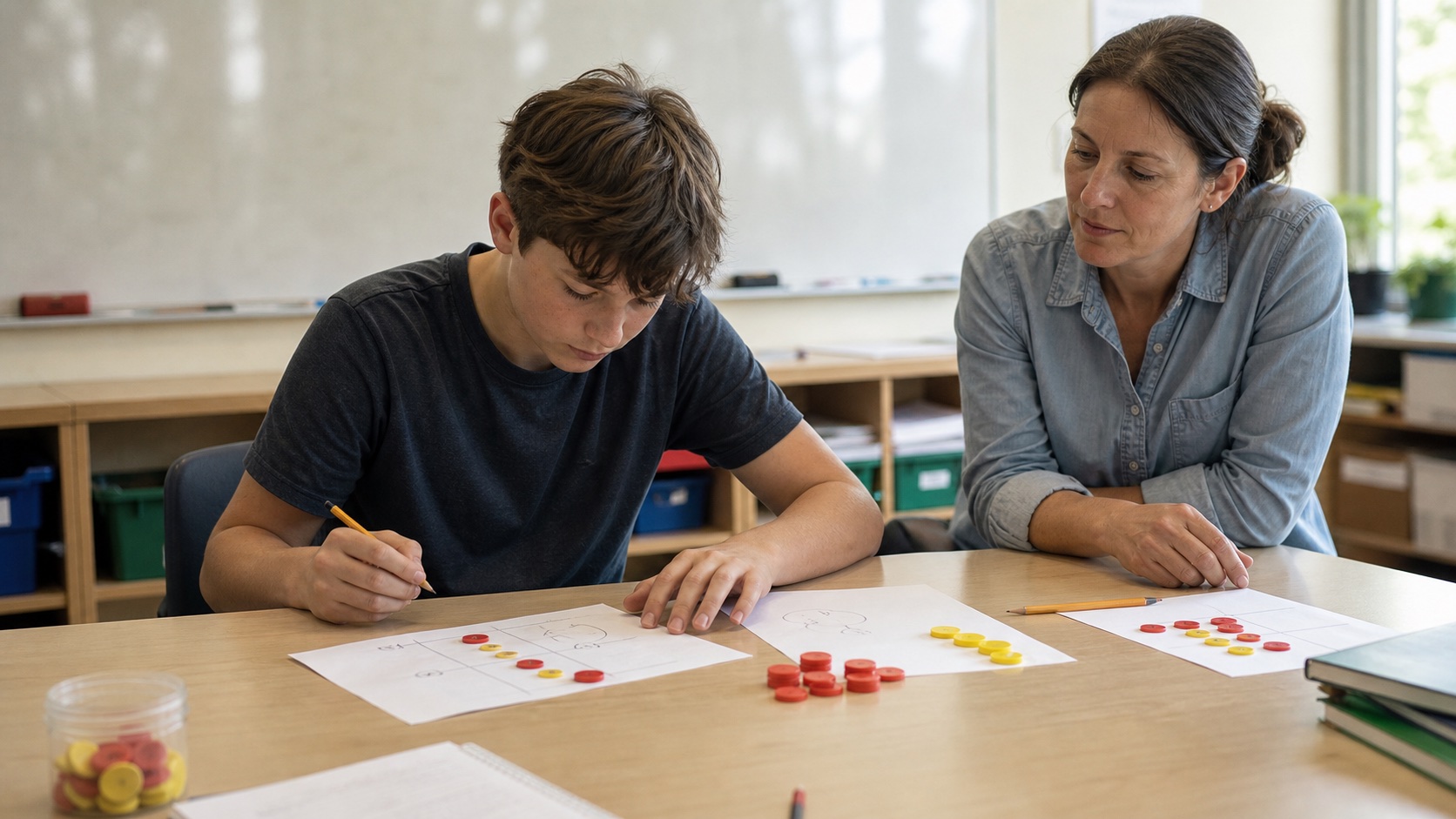
Difficulty is not automatically productive. A learner can spend twenty minutes comparing strategies and building a useful model—or spend twenty minutes repeating a misconception, guessing and absorbing the message that help will not arrive.
The boundary is not a stopwatch. Productive struggle has a reachable learning target, produces information, preserves enough regulation for strategy use and is followed by feedback or instruction that consolidates what the learner noticed. Watch the quality of activity, then choose among waiting, hinting, teaching and pausing.
Why “Let Them Struggle” Is Incomplete Advice
Effort can strengthen retrieval, expose contrasts and prepare learners to understand an explanation. It can also overload attention or stabilize the wrong procedure. The result depends on prior knowledge, task design, emotional safety, available strategies and what happens after the attempt.
Productive failure is one specific instructional sequence—not a general endorsement of abandonment. In two randomized studies of mathematics learning, students who solved before instruction developed stronger conceptual understanding and transfer while both sequences produced procedural knowledge. The author explicitly cautioned that failure itself is not required. A later meta-analysis of 53 studies and 166 comparisons examined when problem solving followed by instruction outperformed instruction first.
At home, the practical lesson is narrower: an initial attempt may prepare learning, but it needs a designed endpoint and consolidation.
Check the Five Conditions for Productive Struggle
Reachable target
The learner has enough prerequisite knowledge to represent the problem and make at least one relevant move.
Meaningful thinking
The task requires comparison, retrieval, explanation, modeling or strategy choice—not merely endurance or decoding confusing directions.
Information from attempts
Each attempt reveals a constraint, pattern, contradiction or next question instead of producing random guesses.
Regulation remains available
Emotion may be uncomfortable, but the learner can still listen, inspect evidence and change strategy.
Consolidation is coming
Feedback, discussion, comparison or explicit instruction will connect the attempt to a valid method.
If the target is unreachable or no consolidation will occur, longer struggle is unlikely to become productive by itself.
Read the Learner, Not Just the Clock
Five live signals
- Representation: Can the learner restate the problem, draw it, label quantities or name the claim?
- Strategy movement: Are attempts changing in response to evidence, or is the same move repeating?
- Error information: Can the learner say what the last attempt ruled out or revealed?
- Help response: Does a small cue restart thinking, or does it disappear into confusion?
- Regulation: Can the learner communicate and make decisions despite frustration?
Two minutes can be unproductive when a novice cannot enter the task; fifteen minutes can be useful when a student is comparing viable models. Set a check-in point, but make the decision from these signals.
Choose One of Four Adult Moves
Wait
Use when the learner has a representation, is changing strategies and can explain what each attempt shows. Say less and preserve ownership.
Hint
Use when thinking is relevant but stuck at one transition. Point attention to a feature, ask a comparison or supply one missing fact that is not the target.
Teach
Use when prerequisites are absent, a misconception repeats or the learner cannot interpret the task. Model explicitly, then require a parallel attempt.
Pause
Use when regulation is gone, fatigue dominates, safety or relationship is deteriorating, or continuing cannot meet the learning purpose.
These moves are not a hierarchy of virtue. Teaching a missing method is not “giving in,” and waiting is not automatically respectful. The best move leaves the learner with more independent capability afterward.
Design the Task Before Demanding Persistence
A good struggle task has an understandable goal, more than one plausible entry, visible relationships and a challenge located in the intended concept. Remove accidental barriers such as unreadable layouts, unknown vocabulary unrelated to the target or a volume that turns analysis into fatigue.
For novices, use worked examples and completion problems before expecting open problem solving. The Institute of Education Sciences recommends worked examples and visual representations as part of mathematics instruction; guidance can fade as schemas develop.
Do not infer that an advanced task is good because many students fail it. The failure should activate relevant prior knowledge and create contrasts that later instruction can resolve.
Give Hints That Preserve the Target
First name the learning target. If the target is choosing an operation, do not name the operation. If it is constructing an argument, do not supply the claim. If it is revising sentence structure, clarifying the factual topic may be harmless.
Move from lighter to stronger support:
- Ask the learner to state what is known and what must be found.
- Direct attention to one relevant feature or contradiction.
- Ask for a comparison with an earlier example.
- Provide a partial representation or parallel example.
- Model the method explicitly, then remove the model and test transfer.
A hint is successful only if it changes the learner's next independent action. Encouragement without information and answers disguised as questions both miss the purpose.
End With Consolidation, Not Relief
The important learning often occurs after the attempt. Compare two strategies, connect an error to the governing idea and name why the valid method works. Then give a changed problem soon enough to test transfer and again after a delay to test retention.
Ask three questions:
- What did your first attempt assume?
- What evidence changed your model?
- What feature would tell you to use this idea next time?
Do not end with “See, you knew it.” The student may have learned precisely because the attempt exposed what they did not yet know.
Distinguish Desirable Difficulty From Bad Friction
Retrieval, spacing, interleaving and generation can make practice feel harder while improving later learning. But a difficulty is desirable only relative to a learner and a goal. Illegible materials, inaccessible language, sleep deprivation, humiliation and unsupported prerequisite gaps are not desirable learning techniques.
Immediate fluency can also mislead. Rereading an example may feel successful while producing weak later retrieval; a harder closed-note attempt may feel worse while revealing and strengthening memory. Measure delayed independent performance, not comfort alone.
Students with disabilities may need access supports that remove irrelevant friction while preserving the target capability. Equity does not require identical obstacles.
Prevent AI From Erasing the Attempt Phase
AI can provide rapid explanations and finished solutions before a learner has generated a representation. That is efficient when the goal is obtaining information, but risky when the goal is learning to frame, select or reason.
Use a three-stage boundary:
- Attempt: the student records an initial representation, strategy or prediction.
- Bounded support: AI asks a question, identifies one inconsistency or gives a parallel example without completing the target.
- Ownership check: with AI closed, the student explains the method and solves a changed problem.
If the tool always enters before an attempt, neither the student nor adult can see the actual boundary between productive and unproductive struggle.
Stop When the Cost Exceeds the Learning Signal
Pause when the learner can no longer process language, every attempt is random, distress is escalating, the relationship is becoming unsafe or the task conflicts with agreed accommodations. Recovery may mean a short break, a smaller task, explicit instruction or communication with the teacher—not permanent removal of difficulty.
Persistent extreme reactions, panic, school refusal or patterns across settings deserve appropriate educational or health support. A home observation cannot identify a learning disability or mental-health condition.
The aim is neither maximum struggle nor maximum ease. It is the smallest difficulty that produces useful thinking, followed by the support that turns that thinking into independent knowledge.
Frequently Asked Questions
-
Use time only as a check-in cue. Help sooner when the child cannot represent the task, repeats random attempts or loses regulation; wait longer when strategies are changing and the child can explain what each attempt reveals.
-
No. Productive failure is a designed sequence in which problem solving precedes later instruction. Productive struggle is a broader description of effort that generates useful thinking and remains connected to feedback or teaching.
-
Not if the hint preserves the learning target and restarts the learner's thinking. A bounded cue can make struggle productive; a disguised answer transfers ownership away from the learner.
-
Pause and restore regulation. Later determine whether the task was inaccessible, threatening or simply poorly timed. Tears do not prove either that the child should quit permanently or that persistence should be forced.
-
Yes. Learners can generate interpretations, predictions, explanations, designs or drafts before feedback in many subjects. The same conditions apply: relevant prior knowledge, informative attempts, reachable challenge and consolidation.