Early Learning Product Guide

11 Best Number Learning Toys in 2026: Which Teach Real Counting

Which number toys actually teach preschoolers counting and number sense — and which just market the idea. Find the right match for age and learning style.

11 Best Number Learning Toys in 2026: Which Teach Real Counting editorial illustration

Many number toys claim a 12-month age floor and promise preschool math mastery, but the gap between the box and the hands-on experience shows up fast. Some sets snap together so stiffly that a 3-year-old can't connect them alone, while others limit play to numbers 1-10 when a parent wanted counting to 100.

The real question is fit, not quality. A self-correcting puzzle builds confidence for one child, a character-linked cube set keeps another engaged for half an hour. Matching the toy to your child's age, fine motor skill, and how they like to play matters more than the review count on the box.

The picks below group by what each toy actually does — not by what the packaging implies — so you can find the one that will be used more than once.

#1

Numberblocks Cubes 1-10

Numberblocks Cubes 1-10

Structured learning

Customer rating 4.8/5
Check Price

Worth Noting

  • Printed character stickers can peel with heavy play, so the faces may fade over time.
  • Some cube connections snap together stiffly, calling for grown-up help with the youngest hands.
Age Range
3-5
Tactile Build
Snap cubes
Numbers Taught
1-10, adding
Engagement Hook
Show characters
Read the full review

The Numberblocks Activity Set turns the show's 1-10 characters into counting cubes, pairing 30 guided activities with character pieces kids recognize from the screen. Kids build each Numberblock by snapping on faceplates and numberlings, then use the finished characters for counting, sums, and early subtraction. The show-linked engagement keeps preschoolers practicing long enough for the repetition to stick, and the activity cards walk them through each step. Build quality holds up to the grab-and-toss energy of a 4-year-old at play, and the included numberlings and character cards make each activity feel like a small mission rather than a worksheet.

This set suits Numberblocks fans and homeschoolers who want guided practice rather than free-form block play. The character theming adds little for families who haven't watched the show, and the printed stickers can peel with heavy play — durability rides on the plastic cubes themselves. Within the 3-5 band, though, it's the only option here pairing guided activities with characters kids already love, even if the stiffest connections call for a grown-up's help with the youngest hands.

Bottom line: The show-linked activities keep preschoolers practicing longer than free-form blocks — a worthwhile step up from plain cubes for families already invested in Numberblocks.
#2

MathLink Cubes 100pc

MathLink Cubes 100pc

Open-ended STEM

Customer rating 4.8/5
Check Price

Worth Noting

  • Some cubes meet young fingers with stiff connectors while others loosen with play
Age Range
5+
Tactile Build
Snap cubes
Numbers Taught
Count to 100
Engagement Hook
Open-ended building
Read the full review

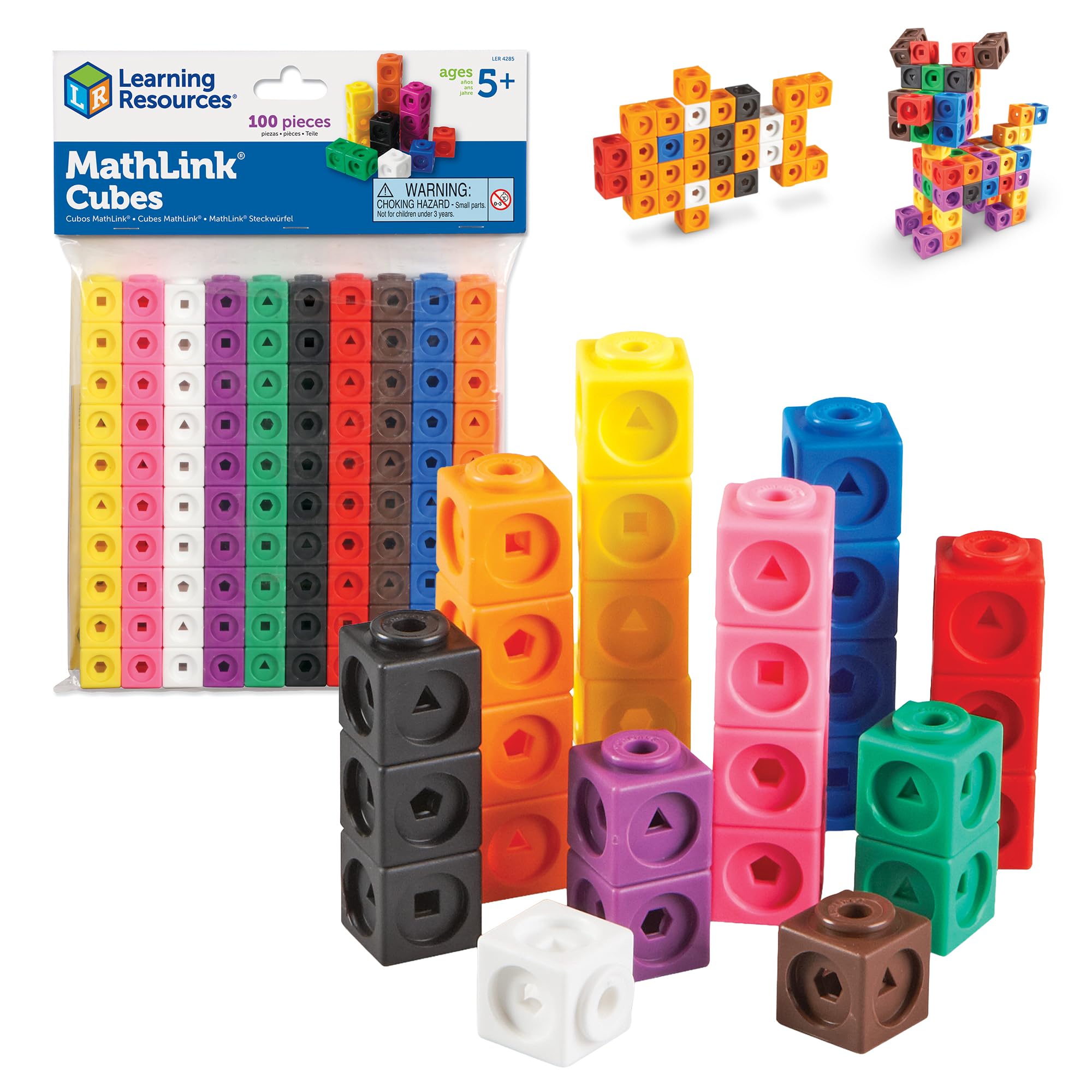
The unglamorous workhorse — cubes connect on all six sides, so counting, skip counting, and early addition become something a child can hold and rearrange. No character overlay here; the set is a blank canvas a homeschooler reuses from a first count into early arithmetic.

Best for homeschoolers and classrooms wanting one durable, reusable tool, and for visual learners who grasp equations through physical manipulation. This suits the 5+ end of preschool rather than the toddler years, and the plain unthemed plastic won't hold the attention of a child who craves a character story.

Start a child with the looser connectors and add the stiffer ones as grip strength builds.

Bottom line: Right for families who want one budget, open-ended math tool that grows from a child's first count into early arithmetic.

#3

Match It! Counting Puzzle

Match It! Counting Puzzle

Quiet puzzle play

Customer rating 4.8/5
Check Price

Worth Noting

  • Once a child masters the matching, the single puzzle loop holds less interest
Age Range
3-6
Tactile Build
Cardboard
Numbers Taught
Count to 20
Engagement Hook
Puzzle matching
Read the full review

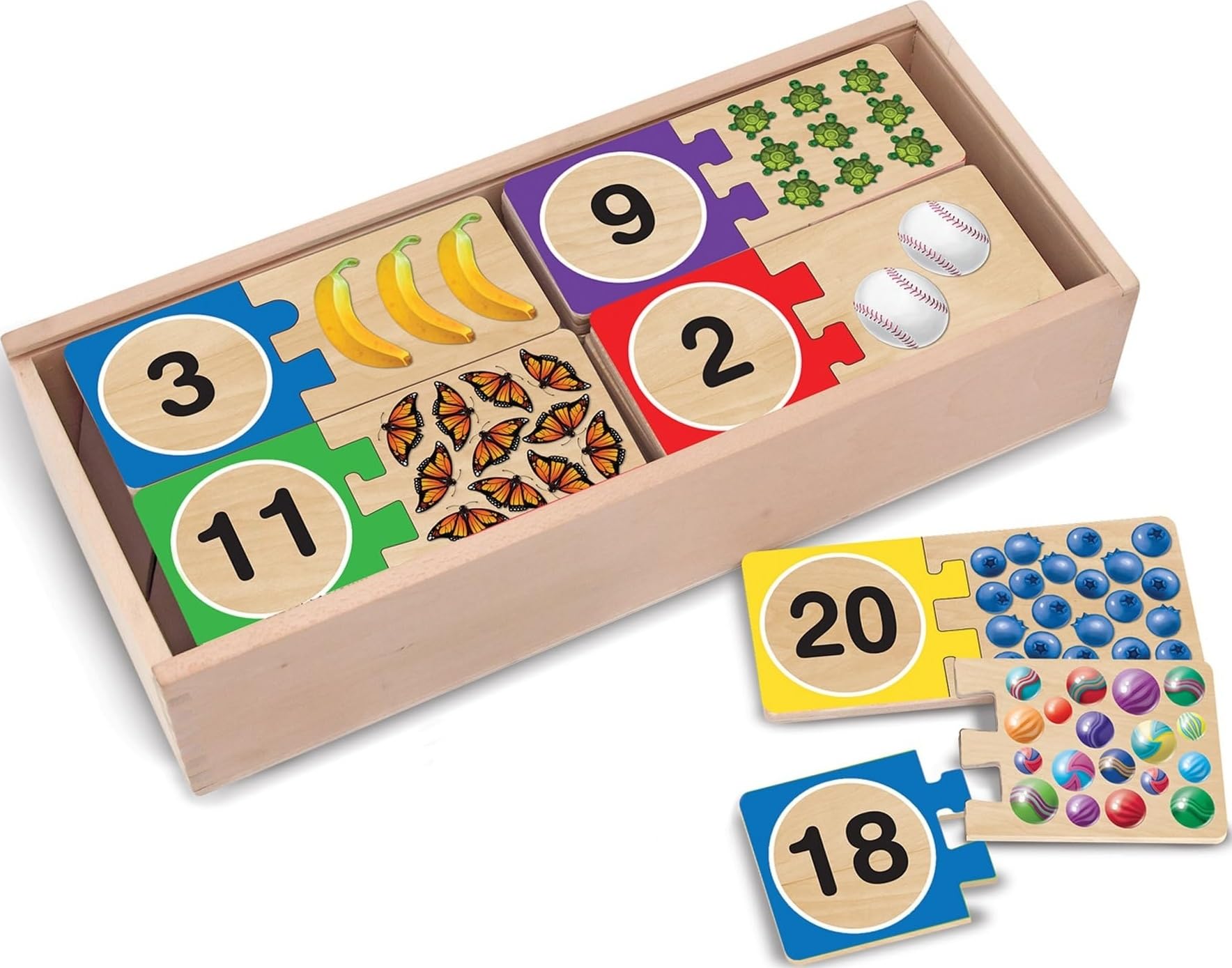
Thick, durable cardboard pairs click together with a self-correcting mechanism that lets 3-year-olds check their own matches — no characters or screens, just the satisfaction of finding the right fit independently. Counting 1 to 10, each pair teaches number recognition through hands-on matching.

The calm, tabletop format suits 3-4 year olds building number recognition and counting to 20 through focused practice. It's a budget-friendly gift for families who want a classic puzzle. Once a child masters the matching, repeat-play value tapers until counting grows with them.

Set it aside for a few weeks and return — fresh eyes on matched pairs keep the loop engaging.

Bottom line: Best for a 3-4 year old making their first counting attempts; once the pairs are memorized, kids ready for bigger numbers will want a set that scales further.

#4

Snap-n-Learn Counting Cows

Snap-n-Learn Counting Cows

Toddler first numbers

Customer rating 4.8/5
Check Price

Worth Noting

  • Some cows snap together stiffly, which the smallest hands can struggle to pull apart.
Age Range
2-4
Tactile Build
Snap-apart plastic
Numbers Taught
1-10, colors
Engagement Hook
Farm animal theme
Read the full review

Color-coded snap-together cows make number and color matching nearly effortless for 2-3 year olds. Each cow splits into a numbered front and a dotted back, so kids self-correct by matching color and numeral without adult help. Where the top pick guides 3-5 year olds through thirty structured activities, the cows keep the scope simple and younger.

Best for toddlers first pairing numbers with quantities, especially farm-animal lovers. The ceiling is counting to 10, so kids past that will outgrow it quickly — and the youngest fingers can need help snapping some cows apart.

Bottom line: A gentle on-ramp to counting — right for 2-4 year olds learning colors and numbers together, who will outgrow it once counting feels routine.

#5

Numberblocks Pattern Game

Numberblocks Pattern Game

Family game night

Customer rating 4.8/5
Check Price

Worth Noting

  • Setup instructions take an adult read-through; the rules are more involved than the 3+ label suggests
Age Range
3-12
Tactile Build
Cardboard board
Numbers Taught
Patterns, colors
Engagement Hook
Show characters
Read the full review

Race to Pattern Palace trades the guided solo building of the Numberblocks Activity Set for a shared board: kids take turns, pop the dice, and place bridge tiles by matching patterns toward the finish. It doubles as a first game night for Numberblocks-loving families, with three to four players and pattern cards that reinforce color and shape recognition between turns. Best for households ready to introduce turn-taking and rules to a young player.

Bottom line: The right choice for Numberblocks-loving families ready for a shared game night — pattern play that builds turn-taking and color recognition together.

#6

Frog Balance Math Game

Frog Balance Math Game

Equations play

Customer rating 4.7/5
Check Price

Worth Noting

  • Frog weights are small
Age Range
3+
Tactile Build
ABS scale
Numbers Taught
Add, subtract
Engagement Hook
Balance reveal
Read the full review

Correctly calibrated weights make addition and subtraction intuitive: a child sets three frog weights on one arm and watches them balance a 7 on the other. The scale self-corrects — if the math is off, the arm tips — so kids build their own answers without an adult prompting.

Best for 4-5 year olds starting addition and subtraction, STEM-leaning families, and Pre-K math centers where hands-on feedback keeps small groups engaged. It suits structured math time rather than open-ended play, and the small frog pieces mean waiting until a child is past the mouthing stage.

Bottom line: For a 4-5 year old past the mouthing stage, this balance gives math a physical anchor that flashcards cannot match.

#7

MOTREE Counting Board

MOTREE Counting Board

Montessori visual

Customer rating 4.7/5
Check Price

Worth Noting

  • When laid out on a bare table, the blocks and cards scatter
Age Range
3-5
Tactile Build
Wooden board
Numbers Taught
Sums within 10
Engagement Hook
Finger counting
Read the full review

The MOTREE Counting Board places number relationships under small fingers: thirteen basswood blocks move across a wooden finger board so a 3-5 year old sees addition and subtraction within 10 take shape, guided by eight double-sided cards. That hands-on, screen-free format holds a preschooler's attention where flat worksheets lose it.

This is the pick for homeschool and classroom settings where a Montessori-style visual aid beats show-linked characters. It works best when a small bin or tray stays close at hand, since the blocks and cards won't all rest on the stand, and kids far past counting to 10 will outgrow the board's ceiling.

Keep a small bin or tray beside the board — pieces and cards stay tidy without built-in storage.

Bottom line: The MOTREE board is what number correspondence looks like when it stays in a child's hands — right for homes and classrooms that keep a small tray in the rotation.

#8

Coogam ABC & Number Cards

Coogam ABC & Number Cards

ABC + 123 combo

Customer rating 4.7/5
Check Price

Worth Noting

  • A set can occasionally arrive short one block, which interrupts the matching game until replaced.
Age Range
3+
Tactile Build
Wood blocks
Numbers Taught
1-10, A-Z
Engagement Hook
Animal cards
Read the full review

The wooden letter and number blocks are genuinely sturdy, and the animal cards keep kids coming back to match them again. For a household where a 3-4 year old is working on both the alphabet and counting, this dual focus pulls double duty. But that same split is what keeps it from competing here: the number practice tops out at 10 and gets equal billing with letter recognition, so it doesn't deliver the depth of a dedicated counting toy.

Bottom line: Right for families who want one set covering letters and numbers together; less so if a pure counting curriculum is the goal.

#9

M&D Number Puzzle

M&D Number Puzzle

Traditional wooden

Customer rating 4.7/5
Check Price

Worth Noting

  • Wood quality varies between units
Age Range
4-7
Tactile Build
Wood pieces
Numbers Taught
Count to 20
Engagement Hook
Classic puzzle
Read the full review

This traditional slot-in puzzle teaches counting to 20 with a self-correcting mechanism and a storage box that keeps all 40 pieces together — budget-friendly and effective in classrooms and homes. Durability holds it back: wood quality varies between units, with occasional splintering or plywood splitting in some pieces, so this classic suits gentle, seated play.

Bottom line: Right for parents who want a traditional, screen-free wooden puzzle for seated, gentle play — give the pieces a quick once-over before gifting.

#10

Counting Animals Sorting Set

Counting Animals Sorting Set

Budget Montesorri

Customer rating 4.8/5
Check Price

Worth Noting

  • With children who still mouth toys, the small figurines warrant supervision
Age Range
3+
Tactile Build
Small plastic
Numbers Taught
Sort, count
Engagement Hook
Tweezer sorting
Read the full review

High-quality plastic that survives heavy use, with tweezers that build fine motor control while kids sort 36 animals by color. It teaches sorting, colors, and counting readily. But no numerals are printed, so it won't reinforce written numbers, and the small figurines call for supervision with children who still mouth items — best suited to engaged 4-5 year olds.

Bottom line: Strong budget entry for sorting, colors, and counting with engaged 4-5 year olds — pick a numbered set if written numerals are the goal.

#11

AILE Wooden Number Puzzle

AILE Wooden Number Puzzle

First puzzle intro

Customer rating 4.8/5
Check Price

Worth Noting

  • No self-correcting mechanism or activity cards, so independent answer-checking isn't part of the play.
Age Range
2-4
Tactile Build
Wood board
Numbers Taught
1-10
Engagement Hook
Simple puzzle
Read the full review

The AILE puzzle pairs good-quality wood with a painted peg design that holds a 2-year-old's attention screen-free. Ten chunky pieces fit a friendly board, building number recognition and hand-eye coordination. As a plain board, it can feel pricey next to sets that offer more, and there's little to grow into past the number 10.

Bottom line: Best as a 2-year-old's first number puzzle while counting 1 to 10 is still new; once numbers click, a set with self-correcting play offers more to grow into.

How to Choose

Age Range Fit

Many listings stretch age labels downward aggressively. A toy that officially starts at 5+ may frustrate a 3-year-old with stiff snap connections, while a toddler-focused set with small figurines can be a choking risk for a child still mouthing objects.

Look for the age floor that matches your child's fine motor stage. If they can easily snap duplo-style blocks, they'll handle most preschool sets. If they still struggle with that grip, a snap-apart or slot-in design is a safer bet.

Number Spectrum

The most common buyer mistake: picking a 1-10 set when they wanted counting to 100, or vice versa. If your child already counts to 10 confidently, a 1-10 toy will be outgrown fast.

Consider where your child is on the number line. Character-linked sets like Numberblocks teach the 1-10 relationship thoroughly, but an open-ended cube set with 100 pieces lets a child push toward higher numerals and place value when they're ready.

Self-Correcting Mechanism

Self-correcting toys let a child know they've got it right without an adult hovering. A puzzle where only the correct pair fits, or a balance scale that only levels with the right answer, gives instant feedback.

That feedback loop matters for independent play. Without it, a child may repeat the same mistake without noticing. The trade-off: self-correcting mechanisms can be more expensive and sometimes limit open-ended exploration.

Tactile Build

Fine motor skills at 2-3 years old are still developing. Snap-together cubes with stiff connectors can be impossible for small hands — reviewers report adults struggling with some pieces. Color-matched snap-apart designs or thicker puzzle pieces are gentler on young fingers.

But if your child has stronger grip, a snap-together set opens up more build possibilities. The trade-off is between ease of use and open-ended play. Feel the connectors yourself before buying if possible, or choose a set with varying tension.

Engagement Hook

The best number toy is one your child actually picks up. That means matching the theme to their interests: a Numberblocks fan will stay engaged through a structured activity set, while a play-kitchen kid might prefer cookies that teach counting.

Consider whether your child prefers guided activities or open-ended building. Some toys come with 30 structured tasks; others are blank slates. The right one depends on how much direction they need.

Frequently Asked Questions