Notebooks & Paper Product Guide

11 Best Music Manuscript Paper of 2026: Match Staves to Your Hand

Which music manuscript paper balances stave spacing, page size, and page count for your hand — without wasting money on cramped or oversized pads.

11 Best Music Manuscript Paper of 2026: Match Staves to Your Hand editorial illustration

Most manuscript notebooks boast about stave counts and page totals, yet those numbers rarely decide whether you'll enjoy writing on them. The real deciding factors are stave spacing, true page size, and whether the binding stays open on a music stand. A 12-stave page can feel cramped if the lines sit close together, while a 6-stave page gives large handwriting room to breathe.

Size matters more than listings suggest. Several popular notebooks run smaller than letter-size, which quietly shrinks the space available for notation and chord symbols. Budget coil spirals also show durability issues over time, so you want paper thick enough for double-sided writing and a binding that lies flat.

For students and teachers, the right match is about how you write, not what the packaging promises. This guide separates wide-staff layouts, page dimensions, and page counts so you can pick the book that fits your hand and your semester.

#1

Hal Leonard Standard Wirebound

Hal Leonard Standard Wirebound

Theory students

Customer rating 4.8/5
Check Price

Worth Noting

  • Printed stave lines can run small, making dense notation trickier to write.
  • Staves sit close together, leaving little room for lyrics or oversized handwriting.
Page Count
96
Binding Type
Wirebound spiral
Page Dimensions
8.5 x 11 in
Staves Per Page
12
Read the full review

This 96-page wirebound notebook fits 12 staves onto each letter-size sheet at a price that undercuts printing staff paper at home. A printed notation guide rides along for quick reference, and the paper accepts pencil smoothly, keeping note-taking clean even in a busy lecture. Twelve staves per page give composers and students a workable canvas for chord progressions and harmonic analysis without wasting paper, which is exactly what a daily working pad should do.

The 96-page count covers a full semester of theory work before the last sheet is filled. Teachers ordering a class set get a uniform notebook that stacks neatly, and the wirebound spine stays open on a music stand while hands are at the instrument. For everyday sketches, the notebook handles quick melodic ideas as easily as long homework assignments.

College theory students, teachers, and composers who work in standard notation are its natural audience. Writers who want wide staves for large handwriting, or generous lyric space, will find the wide-staff sibling in this set a better fit.

Working with a fine-point pencil keeps dense sketches within the close staves legible.

Bottom line: Students, teachers, and composers will find this the paper to keep stocked on the desk all year.

#2

Hal Leonard Wide Staff

Hal Leonard Wide Staff

Beginners, big handwriting

Customer rating 4.7/5
Check Price

Worth Noting

  • 32 pages fill up fast for anyone writing notation daily
Page Count
32
Binding Type
—
Page Dimensions
8.5 x 8.5 in
Staves Per Page
6
Read the full review

Six broad, clearly printed staves set this Hal Leonard book apart from the standard 12-stave pads — every note sits in generous space that reads cleanly, even from across a table. The compact 8.5 x 8.5 square format suits younger students, the red cover stands out in a stack, and a printed notation guide walks first-timers through the basics.

Best for beginning students, teachers introducing notation, and composers with large handwriting who want generous spacing above all. Daily multi-page composers will want a thicker book — this suits single-session and lesson writing best, and at a budget price it's easy to keep several on hand.

Bottom line: The clearest, most affordable introduction to standard notation for beginners and large-handed writers.

#3

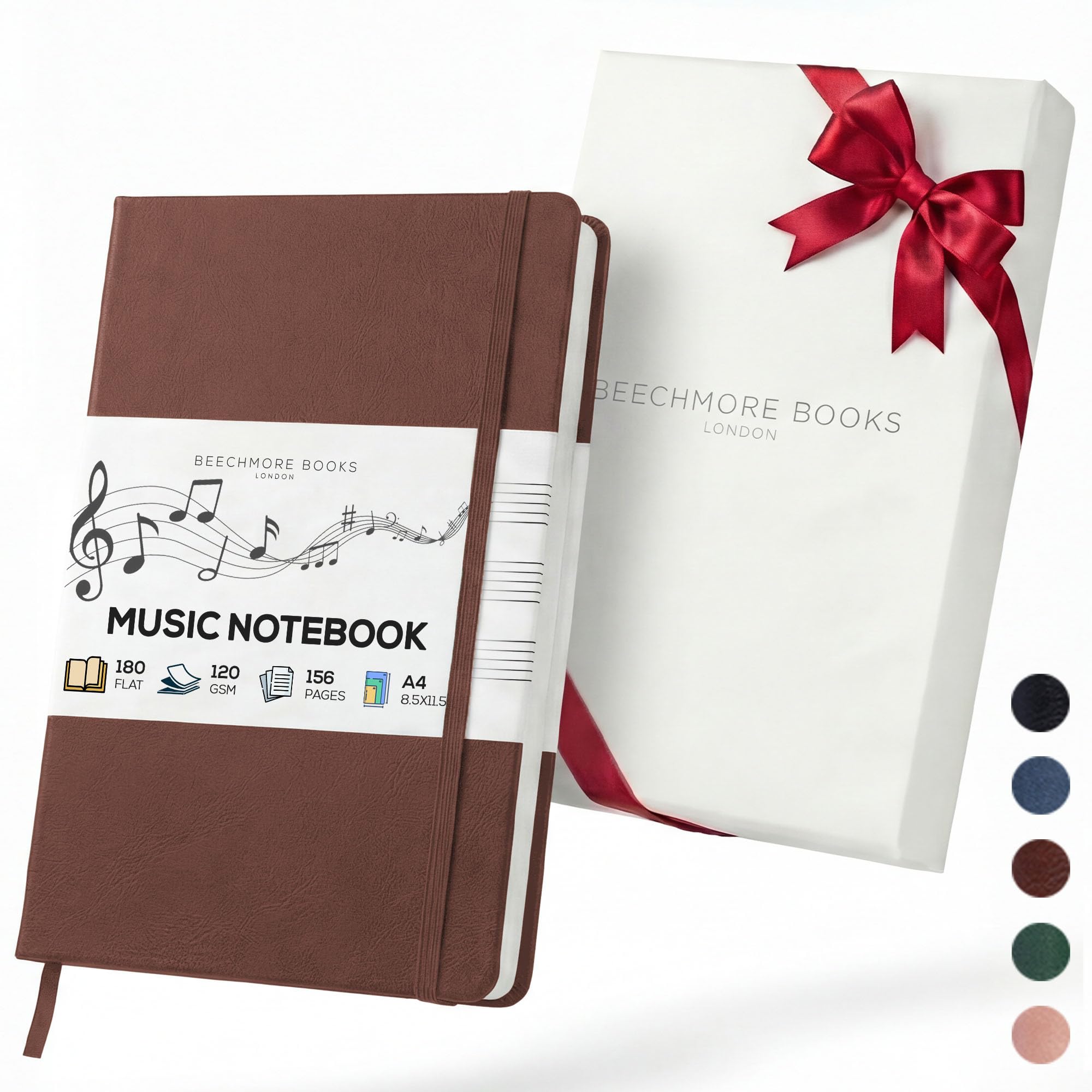
Beechmore A4 Hardcover

Beechmore A4 Hardcover

Gift composers

Customer rating 4.8/5
Check Price

Worth Noting

  • Dense polyphony on one A4 page can run into staves that print small; clean spaced notation fills the page comfortably
Page Count
156
Binding Type
Hardcover lay-flat
Page Dimensions
A4
Staves Per Page
10
Read the full review

The hardcover binding and 120gsm archival ivory paper hold up across semesters of theory and musicianship, where a thin budget coil would crease and bend. At 156 pages with a lay-flat seam, it reads like a composer's journal rather than a classroom pad, finished with an elastic closure and gift box.

This suits gift-givers and composers who want a durable, handsome book over the cheapest option. Composers who favor clean, spaced notation will find the ten staves per A4 page natural; heavy multi-voice passages belong on the wider-staff books in this set.

Draft choral and multi-voice passages in a scratch pad first, then transfer clean lines to keep the stave count readable.

Bottom line: The gift-worthy hardcover for composers who want their writing book to outlast the semester, trading tighter stave spacing for heavyweight durability.

#4

Peter Pauper Wide Staff

Peter Pauper Wide Staff

Students, teachers

Customer rating 4.8/5
Check Price

Worth Noting

  • Dense scores spread across more pages
Page Count
—
Binding Type
—
Page Dimensions
Large format
Staves Per Page
6
Read the full review

Six wide staves per page give notation room to breathe, and the perforated pages tear out cleanly for filing or handing to a student. The sturdy cover stays put on a stand rather than sliding, and the large page reads clearly with no squinting.

This suits students who want large, readable notation, violinists following parts as they play, and composers who file or share single sheets. Dense scores do spread across more pages than a 12-stave book — the cost of choosing generous spacing over packing more staves per page.

Keep note-dense compositions in a 12-stave book — this wide-staff format shines with one or two musical lines.

Bottom line: For notation visible at arm's length and pages you can actually remove and share, this wide-staff notebook keeps readability the denser books give up.

#5

MAXCURY 100-Page Coil

MAXCURY 100-Page Coil

Budget students

Customer rating 4.7/5
Check Price

Worth Noting

  • For note-dense scores, the sub-letter page and large staves crowd the writing area.
Page Count
100
Binding Type
Coil spiral
Page Dimensions
26 x 19 cm
Staves Per Page
—
Read the full review

The MAXCURY coil flips 180° flat, so a 100-page pad stays open while you copy piano music at the desk; beige double-sided paper takes ink cleanly without bleed-through, and the overall feel justifies its budget price. It suits budget students, parents buying a first notebook for a young musician, and casual composers who want a portable writing space — with the caveat that cover sturdiness can vary between units, so think of it as a desk-side pad rather than a rugged travel binder.

Bottom line: For a student on a budget or a parent buying a young musician's first notebook, this coil offers flat-opening pages without the top pick's price tag.

#6

Talented Minds Wide Staff

Talented Minds Wide Staff

Kids, piano teachers

Customer rating 4.7/5
Check Price

Worth Noting

  • Pages tear from the binding without perforation, so pulling a single sheet for a handout is awkward
Page Count
125
Binding Type
Bound, non-perforated
Page Dimensions
8 x 10 in
Staves Per Page
6
Read the full review

Wide staves deliver clear note visibility for young learners, and 125 pages at a budget price make it a practical buy for music teachers. The 8x10 inch page favors beginners' large handwriting over dense, note-heavy scores, setting it apart from the denser 12-stave pad.

Best for piano teachers working with young kids and parents of beginning students, where the generous spacing reduces visual strain. Adults with larger handwriting also fit comfortably. Those needing to remove or share sheets will find the non-perforated binding limiting — this notebook works best kept intact.

Bottom line: For early-notation teaching, the wide-staff layout supports young learners without the premium price — keep pages in place and it covers a full semester.

#7

MOREYES 100-Page Spiral

MOREYES 100-Page Spiral

Budget composers

Customer rating 4.7/5
Check Price

Worth Noting

  • Line darkness can vary between units
Page Count
100
Binding Type
Spiral
Page Dimensions
26 x 19 cm
Staves Per Page
—
Read the full review

A 100-page spiral at a student budget handles casual composing and theory work well, anchored by good paper thickness and a binding that keeps sheets together. Line darkness can vary between units, so some sheets print faint staves that are harder to read. Pages run short of letter dimensions — a fine match for quick sketches, less ideal for dense, note-heavy scores.

Bottom line: Fits budget-minded composers sketching quick ideas who can accept variable line quality — step up to a top-tier book when consistently readable staves matter most.

#8

MoHern 2-Pack Notebook

MoHern 2-Pack Notebook

Spare notebook

Customer rating 4.8/5
Check Price

Worth Noting

  • For note-dense composition, pages run smaller than standard manuscript and can crowd stave spacing.
Page Count
160
Binding Type
Double-coil lay-flat
Page Dimensions
—
Staves Per Page
10
Read the full review

Two hardcover journals with waterproof covers and double-coil binding lay flat for comfortable writing. The beige 10-staff pages and two-book bundle cover a home desk and a travel bag for the price of one premium book. Pages run smaller than standard manuscript, which can crowd dense scores — a casual sketching option rather than a serious composing tool.

Bottom line: Best for musicians who want a spare notebook for casual sketching, transcription, and theory work without needing full letter-size staves.

#9

Roaring Spring Loose Leaf

Roaring Spring Loose Leaf

Binder users

Customer rating 4.5/5
Check Price

Worth Noting

  • Only 20 sheets per pack
Page Count
20
Binding Type
Loose-leaf, 3-hole
Page Dimensions
8.5 x 11 in
Staves Per Page
12
Read the full review

Full-size 8.5x11 sheets with 12 staves and a clean 3-hole punch drop straight into a standard binder. Heavyweight 24# paper holds ink cleanly. At 20 sheets per pack, ordering several at once makes sense. Performance beyond the printed specs is unverified, so this suits teachers and students who stock their own binders.

Bottom line: Best for binder-centric students and teachers who distribute single sheets and don't mind ordering in multiples.

#10

Deluxe Wirebound Gold

Deluxe Wirebound Gold
Customer rating 4.8/5
Check Price

Worth Noting

  • For lyric-heavy scores or wide-stave needs, the 12-stave spacing can feel tighter than wide-staff books.
Read the full review

Twelve staves per page give comfortable writing space, and the wirebound gold cover reads as a step above basic spirals at a mid-range price. For composers who prefer wide staves or lyric-heavy pages, the denser 12-stave layout asks for compact notation. Sparse published specifications mean checking paper weight before purchase takes effort.

Bottom line: An everyday option when you want wirebound convenience with a more premium cover and comfortable 12-stave spacing, provided your notation stays compact rather than wide-staff.

#11

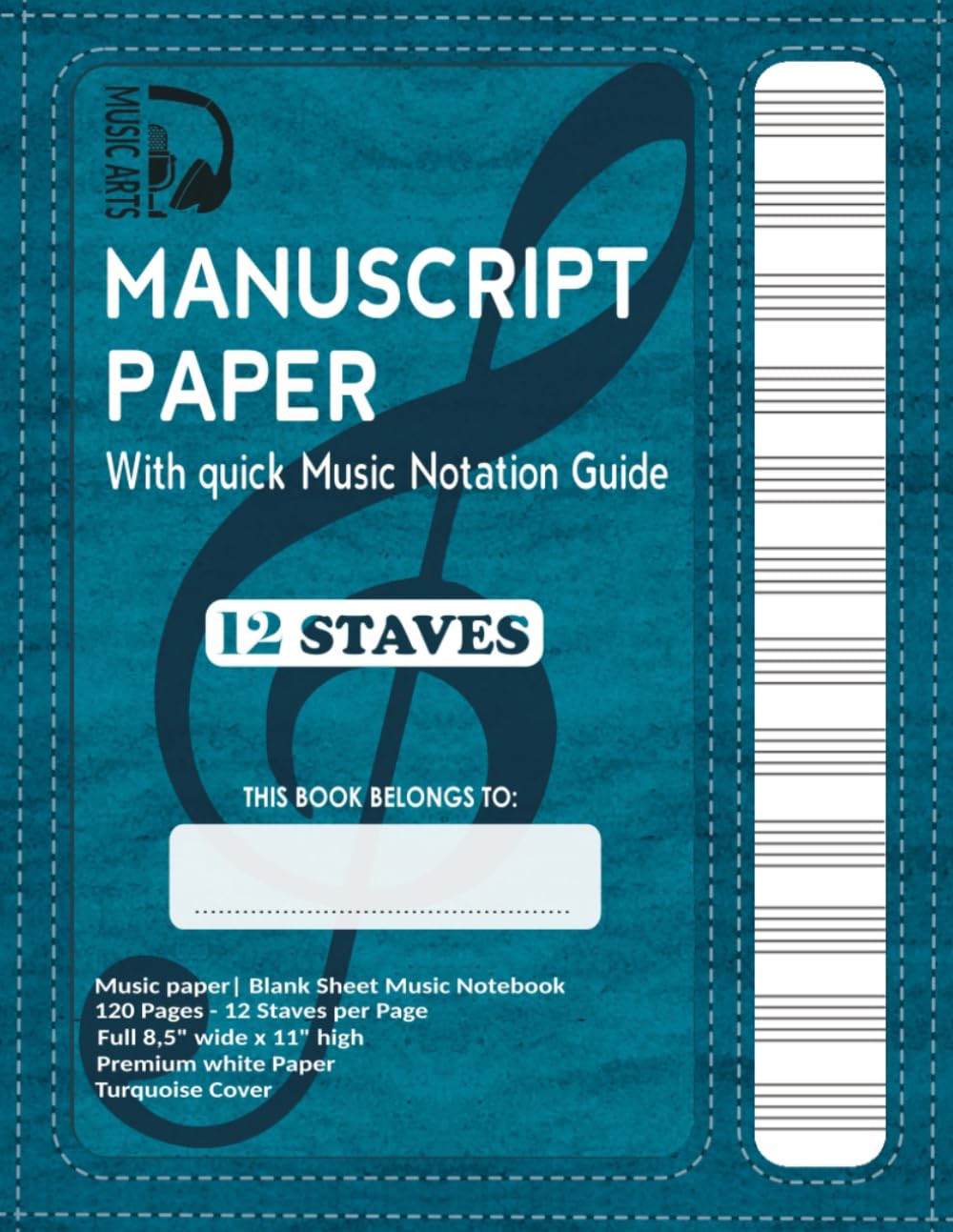
MusicArts 12-Stave

MusicArts 12-Stave

Full-size composers

Customer rating 4.7/5
Check Price

Worth Noting

  • Dense scores that pair lyrics with notation will feel the 12-stave spacing tight on a letter page.
Page Count
120
Binding Type
Soft cover
Page Dimensions
8.5 x 11 in
Staves Per Page
12
Read the full review

Full letter-size pages with 12 staves deliver exactly the drafting space a composer wants, and the turquoise cover keeps a clean classroom look. 120 pages cover a working semester. The catch is that on-paper quality hasn't been independently confirmed, so treat the written specs as provisional until you hold one.

Bottom line: A fit for composers who must draft on full-size pages — verify paper quality on first use before committing a term's worth of notes.

How to Choose

Staves per Page

A 12-stave page packs more measures onto a single sheet, which makes it efficient for sketches, theory worksheets, and piano reductions. A 6-stave page spreads each line out, giving you larger staff height and more vertical margin for annotations. The trade-off is simple: more staves means less room per line, and fewer staves means more pages per composition.

Think about how you actually write. If you're copying exercises verbatim, 12 staves maximize every page. If you're composing with chord symbols, lyrics, or performance notes, 6 staves let you fit those elements without crowding.

Stave Spacing

Stave spacing is distinct from stave count. Two notebooks with the same 12-stave layout can differ dramatically in the gap between lines, and that gap determines whether you can write lyrics, dynamics, and chord symbols between the staves. When the lines sit close together, notation written in the margins overlaps and becomes hard to parse.

Wide spacing also helps students who are still learning note positions: the taller staff gives their pencil enough room to form correct, legible noteheads. The catch is that wide spacing usually comes with fewer staves per page, so a composition will span more pages. Look for spacing described as 'wide' or check photos of the actual gap.

Page Dimensions

A true 8.5 x 11 inch page provides noticeably more writing area than the compact 26 x 19 cm pads that dominate budget listings. That extra width matters when you're drafting dense scores with multiple staff lines or adding chord symbols at the margin. Smaller pages are more portable, but they force noteheads closer together, which can make mistakes easier to write.

If you compose at a desk or studio, the full sheet is worth the slight handling cost. If you're sketching ideas during a class or on the go, a compact pad is easier to slip into a bag. Verify the dimensions before buying, because several popular 12-stave notebooks are smaller than letter-size without saying so clearly.

Page Count

Page counts range from 32 to 160+, but the number alone doesn't tell you how long a book lasts. A 32-page wide-staff notebook can vanish in a few weeks of daily theory homework, while a 96-page notebook with standard spacing covers a full semester. Also consider paper weight: high page counts printed on thin sheets may not withstand erasing and rewriting.

Estimate your weekly consumption: one page per composition plus practice notes adds up quickly. If your course runs a term, pick at least 96 pages to avoid buying a second notebook halfway through. For short courses or beginners, 32 to 64 pages is enough to test the format without waste.

Binding Type

Binding determines how comfortably a notebook stays open and whether you can remove pages. Wirebound and coil springs lie flat on a piano or music stand, but the rings can catch on backpack straps. Hardcover lay-flat binding offers durability and a premium feel but costs more and adds weight.

Loose-leaf sheets are ideal if you organize materials in a 3-ring binder, but you risk losing individual pages. Perforated pages are a middle ground — they tear out cleanly when you need to file or share a single sheet. Choose a binding that matches where you'll actually write: on a stand, at a desk, or in a binder.

Frequently Asked Questions