STEM Toys Product Guide

8 Best Microscope Accessories for Students 2026: Glass Over Plastic

Find the best microscope accessories for students that deliver clear glass views, safe edges, and reliable prep kits – without the blur of budget plastic.

8 Best Microscope Accessories for Students 2026: Glass Over Plastic editorial illustration

Many budget prepared-slide sets are made from plastic. They're shatterproof and inexpensive, but specimens can look thick, blurry, or show adhesive residue – a frustration that turns kids off microscopy. Glass slides cost only a few dollars more and deliver dramatically clearer images, making the difference well worth it for most students.

The right accessories also depend on how you plan to use them. Ready-to-view prepared slides are perfect for structured lessons, while blank slides and a prep kit let students mount their own specimens – a hands-on approach that often keeps curiosity alive longer. Finding the balance between the two is key to building a microscope kit that actually gets used.

For most students, a reliable glass starter set paired with blank slides and a prep kit covers both structured learning and hands-on exploration – the combination that keeps a microscope from collecting dust.

#1

AmScope PS25 25-Slide Set

AmScope PS25 25-Slide Set

Homeschool starter

Customer rating 4.6/5
Check Price

Worth Noting

  • Under low power a few sections show less detail than the rest
Slide Material
Glass
Slide Composition
25 prepared
Read the full review

The AmScope PS25 ships as 25 prepared glass slides seated in a fitted wooden case, each one labeled with its specimen and sealed under a coverslip in cedar wood oil. Glass, not plastic, is what separates this set from the cheap shatterproof collections: the onion skin, euglena, and insect leg sections stay crisp through months of handling instead of fogging behind adhesive residue. The selection crosses plant, animal, and insect kingdoms, so a first-time owner finds something new on nearly every slide rather than a stack of near-identical squares.

The set behaves like a teaching aid rather than a static box of samples. Parents and homeschool instructors report kids lingering over the slides unprompted — checking the printed identification, comparing one section to the next — while the wooden case doubles as a storage tray between lessons. Slides arrive fully prepared, removing the mounting step that sidelines other starter kits.

This set belongs on the bench of a first-time microscope owner of any age, a homeschool family, or a classroom teacher equipping a budget station. The honest scope is a starter count: 25 specimens is an introduction, not a collection, so buyers who need 40 or more sections in one box should size up to a larger glass set or a plastic 48-slide option. Buyers planning to prepare their own specimens should reach for a slide-making kit instead — the PS25 ships prepped, not blank.

Individual slides vary in clarity — a handful of specimens show less detail than the rest under low-power magnification. That variance is a boundary rather than a defect: the set's core job of delivering a young viewer's first clear look still lands, and the soft sections sharpen as you step to higher magnification. Classes observing at 400x will see past the fuzz; anyone capped at a single low-power lens may find a few sections underwhelming.

At a mid-range price, the pairing of glass viewing accuracy with a protective case carries real staying power — the construction holds up to being hauled between classrooms, and the labeled layout makes a missing slide obvious at a glance. That is where the PS25 steps ahead of the look-alike plastic listings that crowd the budget shelves.

Bottom line: For a mid-range price, the PS25 delivers the one thing the look-alike plastic sets cut — viewing clarity — inside a case that holds up to classroom handling. For a first-time owner or a homeschool bench, that covers the entire job.

#2

ZEEGOO 50 Blank Slides Kit

ZEEGOO 50 Blank Slides Kit

DIY specimen prep

Customer rating 4.8/5
Check Price

Worth Noting

  • The thin 0.15mm coverslips can be tricky for young hands to grip without slipping
  • No stains, tweezers, or mounting tools included
Slide Material
Glass
Slide Composition
50 blank
Read the full review

The ZEEGOO blank-slide kit is the right choice when you plan to prepare your own specimens rather than buy prepared slides. Pre-cleaned optical glass with ground safety edges delivers a clear, scratch-free surface to build on, and the 45-degree clipped corners keep young hands safe during handling.

This set suits homeschool STEM projects and classrooms that need dependable everyday slide stock at a budget price. If you want ready-to-view specimens, the prepared-slide starter set is the better fit — this kit is strictly for building your own. A coverslip can arrive cracked in transit despite protective foam padding, so a quick inspection before handing them to students is worthwhile.

Specimens hold focus well at the eyepiece because the glass stays clean and free of scratches straight out of the box, which is what separates a dependable blank from a frustrating one. The 100 thin coverslips cover the 50 slides twice over, so spills and slip-ups won't derail a lesson. For the modest price, this is the blank stock that keeps a homeschool science fair or an after-school club moving without fuss.

Lift coverslips by their edges with tweezers — the thin glass is easy to smudge or slide off-center.

Bottom line: For anyone mounting their own specimens, this is the blank stock to keep on hand — clean glass with safe edges at a price that won't slow a classroom project down.

#3

OOZSTAR 120 Specimen Slides

OOZSTAR 120 Specimen Slides

Serious students

Customer rating 4.7/5
Check Price

Worth Noting

  • Some slides can arrive cracked from transit packing, so a damaged unit is possible on delivery.
Slide Material
Glass
Slide Composition
120 prepared
Read the full review

The OOZSTAR set leads with scale in this lineup: 120 glass slides spanning plants, algae, insect parts, and mammalian tissue, each with polished rounded edges and housed in a fitted case. Where the top pick's 25 slides curate a handful of standout specimens, this collection banks on breadth — a full run of taxa in a single purchase that a smaller set cannot match, and the kind of variety that sustains a full term of study.

Slides arrive labeled and grouped by category, which keeps the volume workable in practice; a student can pull the onion root tip or the butterfly wing without digging through the entire case. The organized layout turns what could be an unwieldy stack into something a classroom can parcel out across a full term rather than sort through each lab session, and the wooden case keeps the collection tidy between uses.

The right buyer is a serious student, classroom lab, or homeschooler who wants glass clarity across many taxa without assembling three smaller kits. It is a premium-priced purchase intended for a committed learner, so tighter budgets are better served by the leaner option, and shipping on some orders can leave a slide cracked on arrival. Introducing a child to a first eyepiece calls for the smaller starter set instead.

Bottom line: For a classroom or serious young scientist, this is the broadest glass library in the lineup — a semester of biology held in one fitted case.

#4

DIY-SCIENCE 48 Prepared Slides

DIY-SCIENCE 48 Prepared Slides

Young beginners

Customer rating 4.6/5
Check Price

Worth Noting

  • Cardboard slide sleeves can tear when a child returns a slide, shortening the case's useful life.
  • Staining intensity can vary within the same set, so some slides look washed out next to others.
Slide Material
Plastic
Slide Composition
48 prepared
Read the full review

48 shatterproof plastic slides make this the safest choice for the youngest microscope users. Matching color-coded categories across plants, insects, animals, and flowers let a child find a specimen without hunting through labels. For a first-time viewer, the variety keeps a child hunting for the next specimen, which matters more at this stage than the fine detail glass provides. The lack of sharp edges and the budget price make it a defensible pick where a glass set would feel fragile.

Built for beginners ages 8 to 14, this set suits a homeschool shelf or a classroom drawer where shatterproof safety comes first. That safety carries a clarity cost: plastic mounts can make a specimen look thick, and individual slides may show adhesive residue, so this is not a tool for serious high-magnification study. Parents focused on a child's first look at a mite or a flower petal will find the experience worth the lower fidelity of plastic.

The 48-slide count sits above entry-level plastic sets at a similar price, and the colored labels double as a sorting exercise while a child views each mount. The set works well with a basic student microscope, keeping the first slide-viewing sessions light and encouraging.

Bottom line: For a young beginner who will handle a set roughly, the shatterproof build and slide variety make this the sensible first purchase.

#5

AmScope SP-14 Slide Prep Kit

AmScope SP-14 Slide Prep Kit

Slide prep kit

Customer rating 4.6/5
Check Price

Worth Noting

  • Stains arrive as dry powders requiring water mixing before the first mount is ready.
  • Just five blank slides and coverslips are included, so steady slide makers will want fresh stock.
Slide Material
Glass
Slide Composition
5 prepared, 5 blank
Read the full review

The SP-14 is the only slide-preparation toolkit in this lineup, pairing two powdered stains with tweezers, a swab, blank slides, and coverslips so students build mounts start to finish. Where the top-pick set offers ready-to-view specimens in a wooden case, this kit hands the entire workflow to the user — collect, mount, stain, and label. That hands-on build is where specimen details actually sink in.

Staining Eosin Red onto cytoplasm and Methylene Blue onto nuclei produces two-tone contrast that reads clearly under a school microscope. Both dyes arrive as dry powders the student mixes with water, a format that stores better than premixed liquids and supports small fresh batches per session. The 22-piece box keeps every tool — tweezers, swab, and labels — in one place for a tidy workstation.

Pair this kit with a blank-slide pack and it anchors a homeschool cell-biology unit where students gather pond water, leaf sections, or cheek swabs. The five prepared specimens included give first-day viewing while a student's own collection develops, and buying extra blank slides keeps mounting momentum across sessions. For learners who want to make their own biology rather than just observe it, this is the hands-on route.

Bottom line: The complete DIY toolchain for students who want to collect, stain, and label their own specimens — paired with blank-slide stock it becomes the hands-on prep route here.

#6

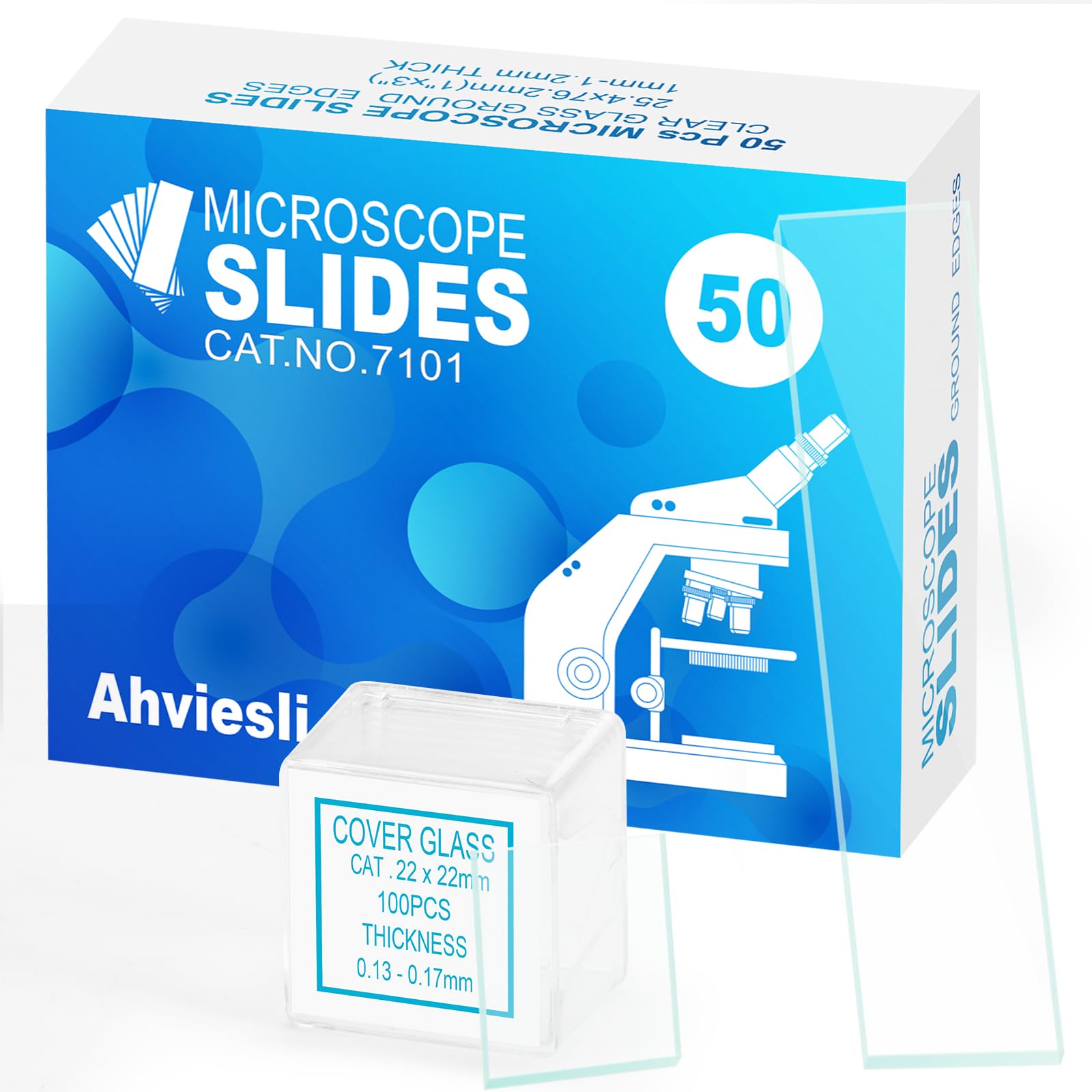
Ahviesli 100 Blank Slides

Ahviesli 100 Blank Slides

Bulk classrooms

Customer rating 4.6/5
Check Price

Worth Noting

  • The 100-slide bulk pack ships without a fitted case, so a classroom supplies its own organizer for labeling.
Slide Material
Glass
Slide Composition
100 blank
Read the full review

This bulk blank-slide kit delivers 300 total pieces of pre-cleaned optical glass at the best per-slide economy in its category. Polished sides with 45-degree clipped corners keep handling safe for younger users, and the 100-slide volume suits classrooms that work through glass quickly.

The tradeoff is format — no prepared specimens, no curated content, and no fitted storage case, so quantity comes ahead of per-slide clarity assurance. For a co-op teacher or frequent DIY preparer who mounts samples weekly, the per-slide price is the deciding factor. Buyers wanting a smaller alternative may prefer the slimmer option in this lineup; this one owns the bulk lane.

Bottom line: Best for a busy classroom or co-op that mounts specimens weekly and can supply its own storage — at this per-slide cost, loose glass is worth it.

#7

USCAMEL 100 Prepared Slides

USCAMEL 100 Prepared Slides

Advanced students

Customer rating 4.6/5
Check Price

Worth Noting

  • Individual slides can arrive with cracked coverslips or unsealed specimens
  • Premium pricing sits above budget sets that cover the same everyday specimens for less.
Slide Material
Glass
Slide Composition
100 prepared
Read the full review

This 100-slide glass collection spans bacterium, fungus, human tissue, and mitosis — specimens smaller budget sets rarely include. A catalog guide helps students locate each sample, and observing cells across plant, animal, and microbial groups keeps lessons engaging.

Students tackling biology or botany projects who need broad specimen variety will find this set genuinely engaging. It suits buyers who give each slide a quick look before class; anyone wanting every slide ready without inspection should consider a smaller glass collection.

Bottom line: Best for biology students who want broad specimen variety including mitosis and human tissue in a single set and will inspect slides before class. Those wanting every slide ready without checking should pick a smaller, more uniform glass collection.

#8

Bysameyee 48 Prepared Slides

Bysameyee 48 Prepared Slides

Budget basics

Customer rating 4.6/5
Check Price

Worth Noting

  • A few specimens arrive folded or only partly mounted, which makes the sample harder to view.
  • Tape-mounted specimens can trap air bubbles that blur the view at higher magnification.
Slide Material
Plastic
Slide Composition
48 prepared
Read the full review

Forty-eight shatterproof plastic slides give young beginners a safe, affordable introduction to animals, insects, plants, and flowers. Rounded edges protect small hands, and color-coded labels with specimen names keep identification simple during first explorations.

It's the near-identical sibling of the DIY-SCIENCE 48-set for less money, so buyers choose between the two on price alone rather than content. As with all plastic sets, clarity and mounting sit below glass — fine for low-magnification first viewing, less useful once a student needs crisp high-power detail.

Bottom line: For a young child's first microscope, this budget set offers shatterproof safety and enough variety to spark interest — a starter bundle, not a tool for high-magnification detail.

How to Choose

Slide Material

Plastic slides are shatterproof and safe for young kids, but the specimens often appear thick and blurry because the mounting medium and plastic itself interfere with light. The hidden trade-off is that the shatterproof construction is exactly what reduces image clarity, making fine details hard to see.

Glass slides transmit light far better, revealing crisp details of cell walls and membrane structures. The risk is breakage, so ground edges and careful storage become important. For most students, the clarity gain outweighs the slight handling caution.

Prepared or Blank

Prepared slides are convenient because they're ready to view, but even the best sets have inconsistent individual slides. The hidden trade-off is that you can't control the quality of specimens you haven't mounted yourself. Blank slides require an investment of time and a prep kit, but they let students mount their own specimens, which often produces cleaner, more engaging slides.

Staining Quality

On budget prepared sets, staining and mounting vary widely – some slides are excellent, others barely usable. This inconsistency is rarely visible in product photos, so it's a risk you take with any budget set. Buying from a brand with a large, verified review base reduces the chance of a disappointing batch.

Storage Case

A fitted case is not a frill. Cardboard holders rip easily and offer no crush protection, leading to cracked or lost slides. A wooden or sturdy plastic case with individual slots keeps glass slides safe and organized, making it a practical part of the kit.

Edge Safety

Ground edges and clipped corners prevent cuts when young hands load and unload slides. Plastic slides are naturally safe but sacrifice clarity, while glass slides with polished edges offer the best of both. Check for ground edges if kids will handle the slides directly.

Frequently Asked Questions