Desk & Study Product Guide

8 Best Drafting Tables for Architecture Students 2026: Real Height

Which drafting tables for architecture students deliver height adjustment that actually works — and which lock you into a single strain-prone position.

8 Best Drafting Tables for Architecture Students 2026: Real Height editorial illustration

Drafting tables get marketed on the word 'adjustable,' but that promise comes apart in different ways once the box is open. On some models the height crank binds on one side; on others it never moved to begin with, leaving you locked into a single seated position that wears on the neck and lower back a few weeks into studio.

That fixed-height trap is the compromise architecture students most often regret — not surface size, not tilt. A table you cannot raise still holds paper fine, but a full day of drafting hunched over it turns into chronic strain. Glass-top desks photograph well, yet their mounting hardware is the part most likely to give out, a risk wood and steel surfaces do not carry.

The features that actually earn their keep are narrow: a top that fits a 24-by-36-inch sheet flat, a tilt past roughly 40 degrees for angled work, and height adjustment you can operate single-handed.

#1

Yaheetech Drafting Table + Stool

Yaheetech Drafting Table + Stool

Overall value

Customer rating 4.5/5
Check Price

Worth Noting

  • Particle-board construction won't read as furniture-grade to buyers expecting solid wood
  • Assembly can stretch into a multi-hour build, with some units arriving missing pieces or misaligned holes; a second person helps
Extras
Stool
Storage
2 drawers, laptop shelf
Tilt Range
0°–60°
Height Range
27.5″–36.5″
Read the full review

The 47.5-inch sit-stand surface is the largest in this budget group, pairing a 0-60-degree tilt with two drawers, a retractable laptop shelf, and an included stool. Height adjusts from 27.5 to 36.5 inches, so drafters can alternate between seated and standing positions through a long session, and full-size blueprints sit flat across the 23.6-inch depth. The retractable auxiliary shelf is the standout for hybrid CAD-plus-paper workflows — a laptop or tablet rests at drafting height, keeping reference material off the main surface. The black finish blends into a studio or dorm room without standing out.

Architecture students who need one surface for CAD, perspective sketches, and full-size paper drawings get the most complete feature-per-dollar deal in this set. The height range and tilt support the seated-and-standing hybrid workload most studios expect, and the included stool removes a separate purchase. The honest tradeoff is assembly — budget a free afternoon and a second pair of hands, since some units arrive with misaligned hardware that needs patience to overcome.

Bottom line: For architecture students juggling CAD and hand drafting on a student budget, this is the most complete single-purchase drafting station in the set — the most adjustability and storage per dollar, with the stool included.
#2

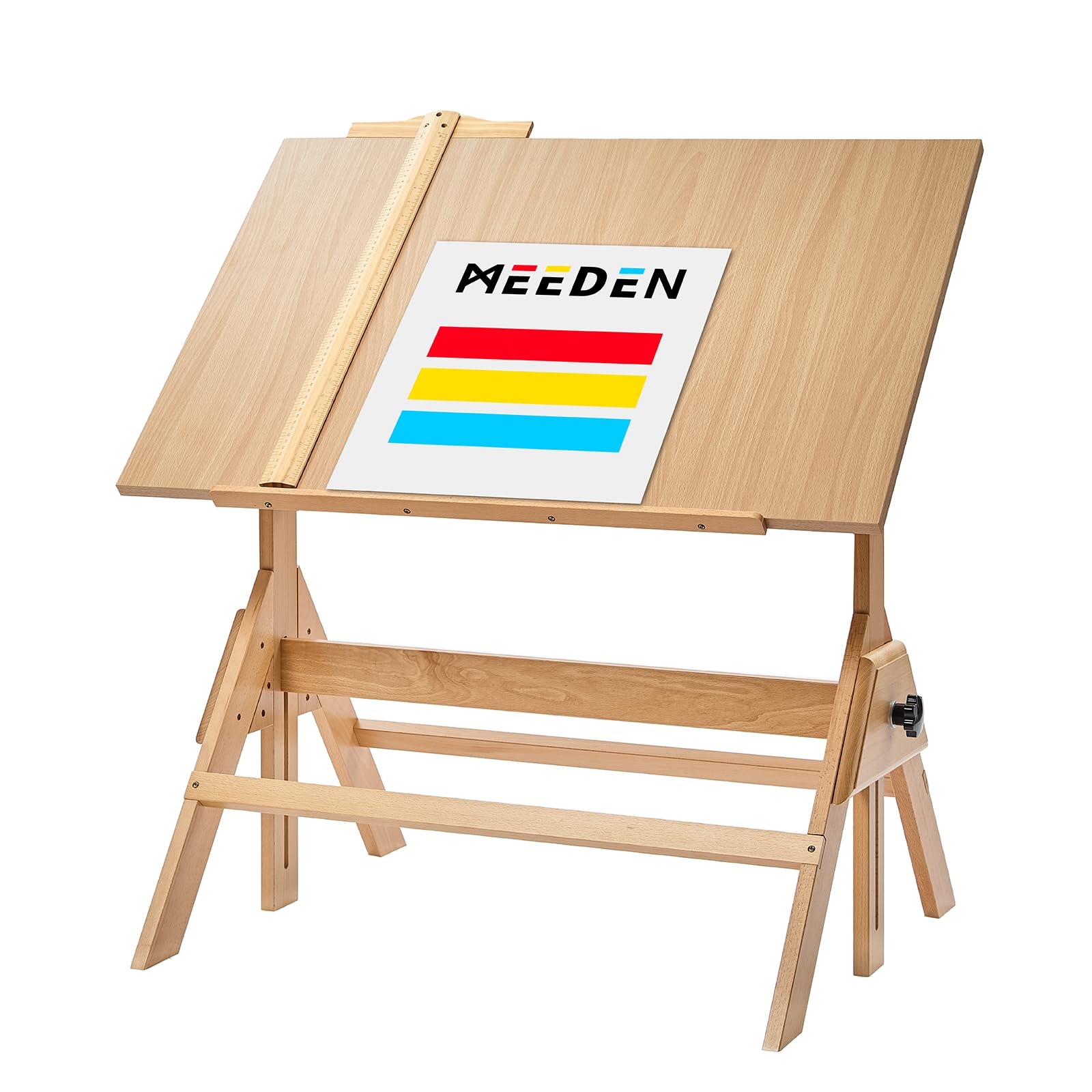
MEEDEN Wood Drafting Table

MEEDEN Wood Drafting Table

Wood construction

Customer rating 4.6/5
Check Price

Worth Noting

  • The 23.5-inch depth leaves the far edge of a full 24-inch blueprint marginally supported
  • Height and tilt changes require two hands and real effort, making mid-session re-positioning a slow move
Extras
24″ T-square
Storage
—
Tilt Range
Up to 60°
Height Range
29.7″–38.4″
Read the full review

Solid beechwood construction and a bundled 24-inch T-square — called out unprompted by architecture reviewers — give the MEEDEN a furniture-grade presence that photographs far above its price. The 35.5-by-23.5-inch top and up-to-60-degree tilt cover standard blueprint work and angled drafting.

This is the pick for architecture and design students who want a real-wood studio piece with a ready drafting tool rather than maximum surface. The honest tradeoff: height and tilt adjustments are stiff and two-handed, so the table suits a set-once workflow, and the 23.5-inch depth leaves the far edge of a full 24-inch blueprint thinly supported.

Set height and tilt once at the start of a session — the two-handed mechanism suits occasional repositioning best.

Bottom line: Buy it for the studio-heirloom feel and the bundled T-square — this desk ages better than its flat-pack rivals for design coursework that spans years.

#3

Stand Up Desk Store Drafting Table

Stand Up Desk Store Drafting Table

Serious drafters

Customer rating 4.6/5
Check Price

Worth Noting

  • Height changes are slow, so a shared drafting desk means re-tooling for each session.
  • On a tilted top, plans can slide unless clipped
Extras
Lifetime warranty, BIFMA
Storage
Full-length pencil tray
Tilt Range
11 positions, 45° max
Height Range
26.5″–38.5″
Read the full review

The certified precision instrument of the set: six height positions in two-inch steps, eleven tilt angles, and a BIFMA-tested frame backed by the only limited lifetime warranty among its flat-pack rivals. The adjustment mechanism holds the 40-by-26-inch surface steady at any angle.

Best for the architecture student who drafts daily for years and wants furniture-grade longevity over a budget price. Angled work calls for anchoring plans, the full-length pencil tray sits at an angle that can drop supplies, and height changes are slow — a shared desk means re-tooling each session.

Keep plans clipped when working at an angle — the tilt positions are this desk's main asset.

Bottom line: The premium buys certified, wobble-free construction and the only lifetime warranty in the set — a sound long-term choice for the daily drafter.

#4

Studio Designs Vintage Drafting Table

Studio Designs Vintage Drafting Table

Traditional style

Customer rating 4.5/5
Check Price

Worth Noting

  • Height is fixed, leaving taller students and standing drafters underserved
Extras
Pencil groove
Storage
24″ pencil ledge
Tilt Range
Up to 90° vertical
Height Range
Fixed, no adjustment
Read the full review

The warm poplar build and the 90-degree vertical tilt set this table apart from the rest of the set — large drawings stand fully upright for review in a position no other option here offers, and the vintage finish reads far above its mid-range price. Once assembled, the solid-wood frame holds stable.

This suits architecture students who draft on paper at a consistent seated height and want a lasting warm-wood studio piece. Taller students and anyone who hopes to stand while working feel the fixed height as a limit, and the softer poplar surface can dent under heavy-handed sketching — a cutting mat covers dense work.

Bottom line: Students committed to seated paper drafting get the set's only upright vertical tilt in a warm-wood table that looks far costlier than its price.

#5

Yaheetech Height-Adjustable Table

Yaheetech Height-Adjustable Table

Budget small spaces

Customer rating 4.7/5
Check Price

Worth Noting

  • Tilt tops out at 30 degrees across five positions
Extras
Casters
Storage
—
Tilt Range
5 positions, 30° max
Height Range
30″–41″
Read the full review

Real 30-to-41-inch height adjustability with casters lands at the budget end of this set, and architecture students name this Yaheetech specifically for compact studio work. It switches between seated drawing and a standing position without effort, and the three height settings hold firm through daily drafting and note-taking.

This suits the tight-budget student mixing tablet work, digital drafting, and flat sketching in a dorm or small apartment. The 30-degree tilt ceiling is the honest tradeoff — comfortable for a tablet or flat paper, shallow for steep angled drafting, where the overall pick in this set goes further.

Bottom line: For architecture students who want real height adjustability and casters without stretching a budget — and who sketch flat or on a tablet — this is the value pick of the set. Keep paper drafting shallow and the tilt limitation stays out of the way.

#6

JupiterForce Drafting Table

JupiterForce Drafting Table

Most mobile

Customer rating 4.6/5
Check Price

Worth Noting

  • Under daily tilt use, the glass-mount hardware can detach and disable the tilt.
Extras
4 lockable casters
Storage
2 drawers, 4 trays
Tilt Range
0°–60°
Height Range
31.5″–49.5″
Read the full review

Four lockable casters and the widest 31.5-to-49.5-inch height range in the budget set make this an easy station to roll between dorm desks. The easy-wipe glass top keeps draft supplies tidy. The glass-mount hardware can detach and disable the tilt, so inspect the unit on arrival.

Bottom line: Best for budget students who need a movable, height-adjustable station and don't depend on the tilt daily — inspect the glass mounts on delivery.

#7

VECELO Drafting Table + Stool

VECELO Drafting Table + Stool

Compact storage

Customer rating 4.4/5
Check Price

Worth Noting

  • Misaligned pre-drilled holes and stubborn screws can slow the build, needing a drill to seat properly.
Extras
Stool
Storage
2 drawers, shelf
Tilt Range
0°–65°
Height Range
Fixed 29.5″
Read the full review

VECELO packs a 65-degree tilt, two drawers, and an under-table shelf into a compact 40.2-inch footprint at a fair price. The tilt eases neck strain through long drafting sessions, and the top takes 24-inch blueprints. The fixed 29.5-inch height suits consistent seated drafting - stand-up work and taller drafters fall outside its reach.

Bottom line: Suits younger students who draft seated at one height - the tilt and storage earn their keep, while standing work calls for a height-adjustable table.

#8

Tribesigns Drafting Table + Storage

Tribesigns Drafting Table + Storage

Steep angles

Customer rating 4.4/5
Check Price

Worth Noting

  • Assembly can be time-consuming, and occasional misaligned hardware may require adjustment.
Extras
—
Storage
Drawer, 2 shelves
Tilt Range
12 positions, 80° max
Height Range
Fixed 29.5″
Read the full review

The 80-degree tilt across 12 positions is the widest in this set, letting you draft near-vertical without neck strain, while the 47.2-inch top with drawer and shelf storage handles large blueprints and tools. But the fixed 29.5-inch height and particle-board top read as less premium, so this suits seated steep-angle drafting more than ergonomic flexibility.

Bottom line: Steep-angle seated drafters who want a wide tilt and storage will find this a capable budget pick; skip it if you need height adjustability or a solid-wood top.

How to Choose

Height Adjustability

Most budget tables advertise a sit-stand range, but the mechanism behind it is where corners get cut. A pinned or friction bracket binds as one side wears faster, which is why owners report adjustments that stick or need two hands.

You only need to change height occasionally, but it must move smoothly when you do. A counterbalanced mechanism holds its position; a stiff one gets abandoned in a single setting — the exact trap you were trying to avoid.

Tilt Angle

Tilt spares your neck, but steeper angles add gravity: above roughly 40 degrees, pencils roll and loose sheets slide unless the top has a working edge stop. A 30-degree cap handles digital and flat sketching but is thin for angled paper drafting.

Check how the tilt holds. Fixed-position ratchet stops beat a single friction knob, which can drift under pencil pressure. If you draw near-vertical, confirm the bottom lip actually catches the sheet.

Surface Size

A standard architecture sheet is 24 by 36 inches and a drafting top must fit it flat. Width matters most — around 40 inches minimum — but depth is the subtle part. Boards that stop at 23.5 inches leave a 24-inch-deep sheet unsupported at the far edge, flexing under your hand.

A 26-inch-deep surface carries the whole sheet cleanly, which matters when you are pressing a ruling edge along the far side of a blueprint.

Storage and Auxiliary Surfaces

Architecture coursework is hybrid — CAD on a monitor, hand drafting on the board — so a side surface for a laptop or tablet earns its keep. Retractable shelves and wide auxiliary counters let you switch between software and pencil without clearing the table.

Drawer space stores tools, but a real drafting chair matters more than the stool most tables ship with.

Assembly and Included Tools

Budget drafting tables arrive as flat packs and buyers underestimate the build. Plan one to three hours, a helper for the first steps, and the chance that a hole is misaligned or a part missing. Picture-only instructions worsen this, so favor written steps and check hardware before starting.

Treat any bundled stool or T-square as a bonus, not the reason to buy.

Frequently Asked Questions