Writing Supplies Product Guide

9 Best Cursive Practice Workbooks of 2026: Accurate Letterforms

The best cursive practice workbooks for kids, teens, and adults that teach correct letterforms instead of modern or misprinted styles.

9 Best Cursive Practice Workbooks of 2026: Accurate Letterforms editorial illustration

Teaching cursive at home usually means matching the letterforms you learned in school. But popular workbooks differ sharply on that point — some teach modern, non-traditional shapes, a few contain outright misprints, and several are pure practice sheets with no instruction at all. This guide sorts workbooks by letter-formation accuracy, stroke-order guidance, and practice depth.

The right workbook depends on who is learning. Young beginners need tracing-heavy step-by-step progression with clear stroke arrows. Teens and adults want age-appropriate content that skips childish illustrations. The picks below account for those differences rather than treating cursive as a one-size-fits-all drill.

Page count decides whether a book is a quick intro or a real curriculum — a 32-page bestseller runs out fast for a child practicing weekly. Weighing that trade-off matters as much as letter style when you teach at home.

#1

Brighter Child Cursive 2-5

Brighter Child Cursive 2-5

Grades 2-5 kids

Customer rating 4.7/5
Check Price

Worth Noting

  • Blank freehand space runs short for families who want extra words beyond the printed exercises.
Page Count
80 pages
Progression
Letters, words, sentences
Letter Style
Traditional
Reading Level
Grades 2-5
Read the full review

The Grades 2-5 workbook from Brighter Child attaches numbered arrow strokes to every letter, walking a child through each start point, bend, and lift in the correct sequence. That explicit formation guidance is the book's core value — it turns penmanship into something a grade-schooler can follow on their own rather than guess at. Sight words, full sentences, and letter tracing run across 80 pages, mixing isolated shape drills with real word use so each letter is reinforced in context, and the numbered strokes remove the guesswork that stalls beginner attempts.

The same care shows in the letterforms themselves, which stay standard and traceable. Other titles in this category print non-traditional or plainly misprinted characters — one popular book ships an uppercase K that reads as lowercase — so a parent who follows a workbook's strokes can wind up passing on an error the workbook introduced. Brighter Child's cue sets hold to conventional cursive, which means the hands-off setup is also an accurate one.

It produces results quickly. Young readers pick the motion up after a few sessions, and the structure lands especially well with 3rd and 4th graders, who read well enough to follow the short instructions without supervision. The arrows answer the 'where do I start?' question before it gets asked, shortening the friction on each page. The targeting stays deliberately narrow — this is elementary content, not a teen or adult refresher, and pointing a high-schooler at it would undersell them.

The right household is an elementary writer in grades 2-5, whether that is a homeschool parent assigning daily pages or a caregiver who wants accurate, self-directed practice that does not re-teach bad habits. The single tradeoff sits in free practice: blank space for extra words runs short, so the child works inside the printed exercises rather than improvising long passages. Families wanting generous open-ended freehand pages will reach that limit; those who want a guided, accurate foundation will not. Buyers after the cheapest possible taste of cursive can step down to the 32-page budget starter instead.

Mid-range pricing lands this a step above the throwaway budget pads and a step below the dedicated adult volumes, and the return is a book a child can finish and actually write from afterward. For a parent who wants penmanship taught right the first time and is willing to supervise rather than hand-correct every stroke, this is the strongest single purchase in the lineup.

Bottom line: The clearest way to teach grades 2-5 cursive at home — accurate formations a child completes alone, with no errors to un-teach later.

#2

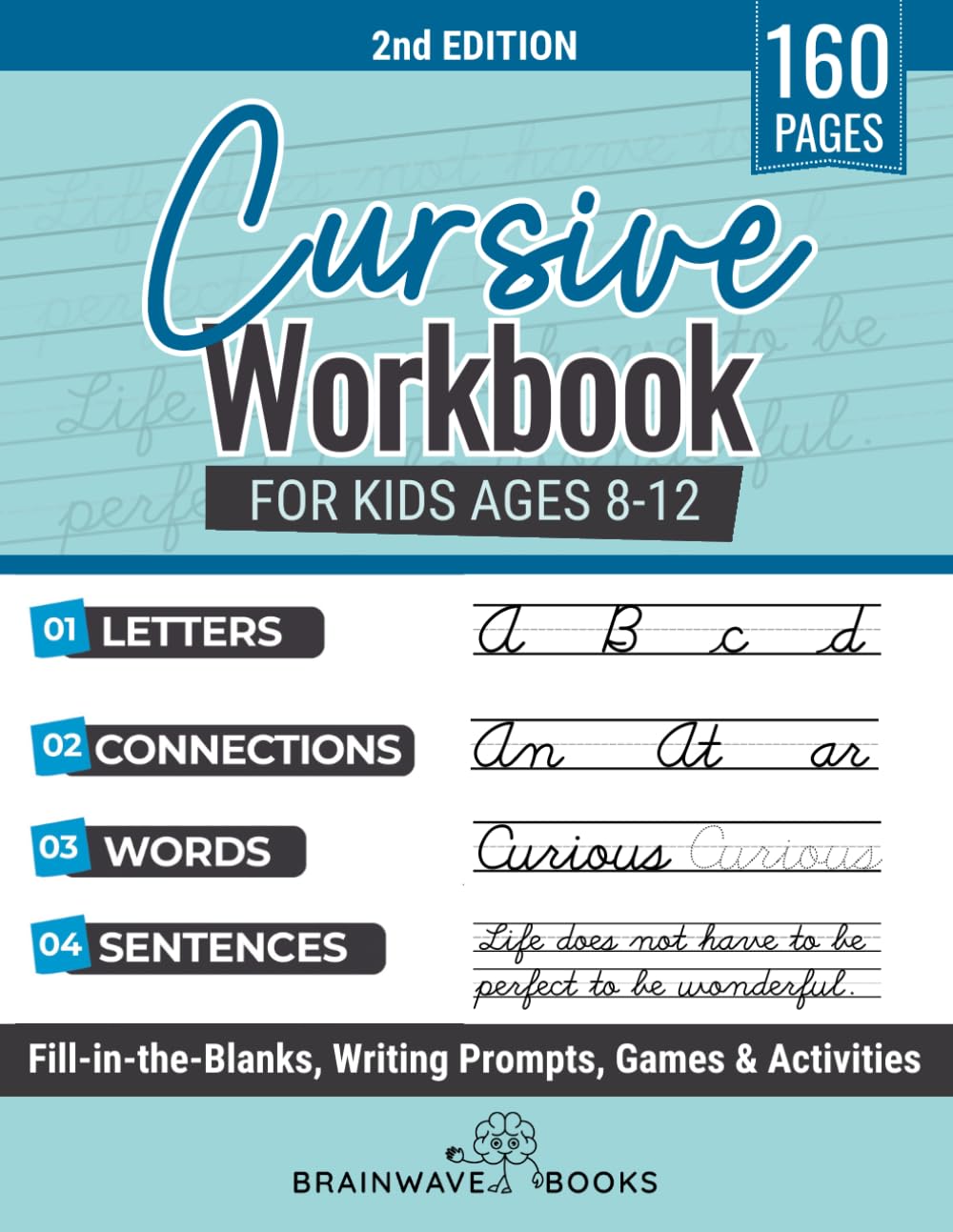
Cursive Workbook for Kids

Cursive Workbook for Kids

Age 7+ beginners

Customer rating 4.7/5
Check Price

Worth Noting

  • Ornate, fussy capitals take extra effort for young hands and read as decorative rather than classroom-style.
  • Some letterforms are formed differently from standard school cursive, so a child can absorb a shape that differs from classroom teaching.
Page Count
108 pages
Progression
Letters, words, sentences
Letter Style
Non-standard, ornate
Reading Level
Age 7+
Read the full review

This is the most-purchased beginner workbook in the set, and the step-by-step structure explains its reach. Each letter opens as a large numbered tracing example, narrows through guided rows into freehand lines, and only then does the book combine letters into words and sentences.

The progression reads like a classroom primer rather than a workbook that skips ahead. Young writers repeat each form until the shape sticks, then move from short words into full sentences, building muscle memory without the rush that leaves beginners behind. The tone stays kid-appropriate throughout, with no affirmations or motivational filler.

Best for parents of a first cursive writer age 7 and up who want a self-directed, budget-priced book that does the teaching without adult correction on every stroke. Families who insist on strictly traditional school letterforms should weigh the ornate capitals and the page-spacing quirk that can mislead tracing — this workbook serves practical beginners better than penmanship purists.

The 8.5 x 11-inch layout and 108 pages cover a full first-semester cursive program at a budget price, and the straightforward design lets parents hand it to a child without prepping each lesson ahead of time.

Have your child trace one dotted guide line at a time rather than following the letter-row rhythm, since the page spacing can pull the eye toward a row's edge.

Bottom line: For families who want a budget-priced, self-directed first book, this is the one to hand a new writer — provided the ornate capitals don't clash with the school style they aim to teach.

#3

Sujatha Teen Cursive

Sujatha Teen Cursive

Teens 13-18

Customer rating 4.7/5
Check Price

Worth Noting

  • Print darkness can vary between pages
Page Count
108 pages
Progression
Letters, words, sentences
Letter Style
—
Reading Level
Ages 13-18
Read the full review

Motivational quotes and affirmations set this workbook apart, and the approach delivers — daily practice produces measurable handwriting gains within days. Across 108 pages the structure moves from letters to words to sentences, a self-guided path teens can follow without adult supervision. Where the top pick wins on letter-formation accuracy, this book wins on engagement, with content written for a teen's sensibility rather than a younger child's.

This suits teens 13 to 18 learning or refreshing cursive on their own, plus homeschool families who want quote-rich practice that motivates rather than drills. Print darkness can vary between pages — an occasional sheet may run faint enough to complicate tracing, minor in normal lighting but more noticeable in very bright rooms. The content is clearly aimed at teens, so it won't serve small children still working on basic letter shapes.

Budget-friendly and effective, the workbook fits into a few weeks of short daily sessions, providing enough repetition to build muscle memory rather than simple exposure. Affirmations woven throughout keep the practice feeling personal, supporting the independent study teens favor.

Bottom line: For teens who want to improve without sitting through classroom-style drills, this is the engagement-first answer in the set — budget-friendly, effective, and easy to pace on their own.

#4

Cursive Mastery Kids 8-12

Cursive Mastery Kids 8-12

Kids 8-12

Customer rating 4.8/5
Check Price

Worth Noting

  • Occasional tight spacing on the densest practice pages can feel crowded for younger writers
Page Count
164 pages
Progression
Letters, words, paragraphs
Letter Style
—
Reading Level
Ages 8-11
Read the full review

This 164-page program is the deepest kid-focused option in the lineup, marching children step by step from individual letters through words to full sentences and paragraphs in a single guided sequence. The structured progression keeps kids advancing with minimal adult correction, and the move from isolated strokes to real composition is more complete here than in any other book in this set. Where slimmer workbooks stop at the alphabet, this one pushes on into extended, varied practice that builds steady fluency rather than one-off recognition.

Best for families willing to treat cursive as a semester-long project, this is a thick, desk-bound workbook rather than a portable intro book — it asks for sustained weekly sessions to finish. Content targets kids 8-12 with a reading age of 8-11, so teens and adults wanting a quick refresher should look elsewhere. For households seeking a comprehensive, self-guided curriculum for a child new to cursive, the depth here is exactly what's wanted.

The volume of practice means some pages are packed with exercises, and spacing can feel tight on a few of the denser sheets for younger or impatient writers. Once kids settle into the rhythm, this tends to recede — the program's completeness is what stands out.

Bottom line: For families ready to invest in a full program of guided practice, this is the deepest kid-focused workbook here — one book that carries a child from first letters to finished paragraphs.

#5

Cursive Workbook for Adults

Cursive Workbook for Adults

Daily-use adults

Customer rating 4.6/5
Check Price

Worth Noting

  • Moving to checked-size paper, the oversized practice letters need adjustment before everyday script settles to normal scale
Page Count
110 pages
Progression
Letters, words, quotes
Letter Style
Oversized practice
Reading Level
Adults
Read the full review

Clear four-part progression from the alphabet through words, sentences, and quotes, laid out so each stage builds on the last and learners always know what comes next. At 110 pages the Scholdeners workbook stays digestible next to the 205-page adult option in this set, covering the same arc without the bulk.

The exercises skew practical rather than decorative — short, usable drills that carry over to everyday writing rather than idle tracing. The tone stays age-appropriate throughout, so adults can work the pages without the childish styling found in grade-school books, and the pacing suits the short sessions a busy schedule allows. Improvement tends to show within a few weeks of steady practice.

Built for adults relearning cursive for daily use — signing, note-taking, correspondence — this is not a children's title, and the mid-range price buys a focused 110-page program that reaches the full four-part finish without the commitment of the longer competitor. The tradeoff to accept is the letter scale: practice letters run larger than normal handwriting, so everyday script can look loose at first before the size transfers with continued drilling.

After each oversized line, rewrite the same letters at your everyday writing size — the scale transfer settles in noticeably faster.

Bottom line: For adults relearning cursive, this is the pragmatic mid-range refresher — a complete four-part arc with practical drills at a fair price.

#6

Carson Dellosa Beginning Cursive

Carson Dellosa Beginning Cursive

Budget beginners

Customer rating 4.7/5
Check Price

Worth Noting

  • Only 32 pages
Page Count
32 pages
Progression
Letter tracing
Letter Style
Traditional school
Reading Level
Grades 2-5
Read the full review

At budget pricing this slim primer offers a low-stakes way to test whether cursive clicks. Letter progression stays smooth, the content teaches the basics, and the simple school-style layout reads as fun rather than homework. It works as a quick introduction or a refresher for kids who already had some exposure.

The tradeoff is thickness — just 32 pages, so it runs out quickly for sustained weekly practice. That caps long-term value: this fits a first taste or a brush-up, not a months-long program. Families wanting deeper practice should look at the arrow-guided option with explicit stroke guidance instead.

Bottom line: Choose it when you want to gauge a child's interest in cursive cheaply. Families planning months of practice would be better served by the thicker arrow-guided option.

#7

Cursive for Adults (200+ pages)

Cursive for Adults (200+ pages)

Extended adult practice

Customer rating 4.6/5
Check Price

Worth Noting

  • Tight binding keeps inner pages from lying flat, so writing near the spine can feel cramped.
Page Count
205 pages
Progression
Letters, words, sentences
Letter Style
—
Reading Level
Adults
Read the full review

At 205 pages, this is the fullest adult workbook of the set, with letters, words, and sentences arranged for long-form daily practice. Its four-part letter-word-sentence structure works well for self-teaching, and the page count makes it a buy-once resource for dedicated relearners. The physical tradeoff is real: tight binding keeps inner pages from lying flat, so writing near the spine can feel cramped. That suits a desk-based workbook you work through steadily rather than one you flip open anywhere. Committed adult re-learners get more value than the premium price suggests, while a quick-refresh buyer will find more book than they need.

Practice near the outer edge of each page first; once the spine relaxes, writing across full-width lines becomes comfortable.

Bottom line: Reserved for the adult re-learner who practices daily at a desk — the page count and self-teaching structure justify the premium price, and the binding becomes manageable once the spine relaxes.

#8

Modern Kid Press Teen

Modern Kid Press Teen

Casual teen learners

Customer rating 4.7/5
Check Price

Worth Noting

  • Letterforms deviate from classic cursive — a 3-hump 'm' and 2-hump 'n'
Page Count
79 pages
Progression
Letters, words, sentences
Letter Style
Non-traditional style
Reading Level
Ages 13-18
Read the full review

Teens who dread drill-style practice found this one approachable — the uplifting tone and age-appropriate activities held engagement, and the structured progression produced noticeably cleaner handwriting. The 79-page layout is easy to follow with real practice space.

The tradeoff sits in the letterforms themselves: a 3-hump 'm' and 2-hump 'n' deviate from classic cursive, so characters learned here won't line up with traditional school penmanship. For style purists that is a genuine mismatch — this better suits older learners brushing up without academic pressure.

Bottom line: Right for teens who want an approachable, pressure-free refresher they'll actually finish — style purists should preview the sample pages before committing.

#9

Cursive Workbook for Kids 8-12

Cursive Workbook for Kids 8-12

Ages 8-10 kids

Customer rating 4.7/5
Check Price

Worth Noting

  • Pen-direction arrows can be unclear, so kids first learning stroke order may need a parent to demonstrate a few letters.
  • Some letterforms deviate from classic cursive, which matters to parents wanting exact traditional shapes taught.
Page Count
112 pages
Progression
Letters, words, sentences
Letter Style
Non-classic forms
Reading Level
Ages 8-10
Read the full review

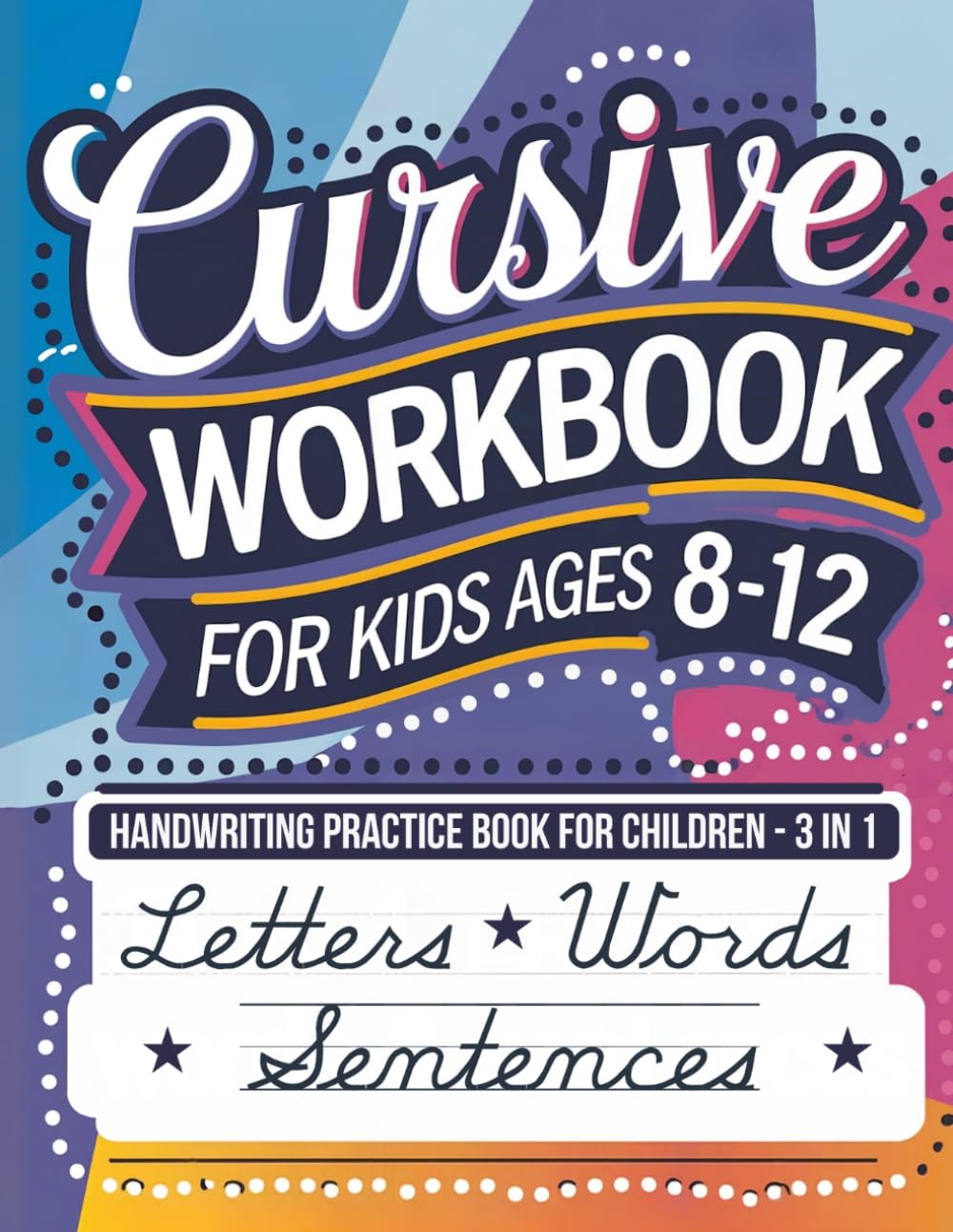
The 3-in-1 letters-words-sentences structure with shaded, colorable letters holds the attention of 8-10 year-olds and is easy enough for them to follow with minimal help; a near-4.7 rating backs that. Stroke-order arrows are lighter than in the category's top pick, so first-time writers may need a parent to demonstrate pen direction on a few letters rather than trusting the arrows alone. Kids who already know basic letter shapes will breeze through the repetition, though parents wanting exact classic letterforms will notice some shapes sit outside traditional cursive.

Show kids the pen direction for a couple of tricky letters up front — shading teaches shapes, but the arrows aren't always clear.

Bottom line: Best for homeschoolers whose kids already know letter shapes and want an engaging letters-to-words-and-sentences workbook; parents needing precise arrow guidance for absolute beginners should look at the top pick instead.

How to Choose

Page Count and Practice Volume

Page counts range from 32 to over 200 pages. A 32-page book works for a quick intro but runs out fast for a child practicing weekly — most families finish it in under a month. Look for 100+ pages for sustained learning so repetition can make letterforms automatic.

Practice volume builds muscle memory. Cursive requires connecting strokes in a fluid motion, which only becomes automatic with repeated tracing-to-freehand work. A thin book strands a learner right at the words-and-sentences stage.

Letter Style and Accuracy

Letter style causes the most buyer regret. Several popular workbooks use modern, non-traditional letterforms, and a few contain outright misprints. If you are teaching a child what you learned in school, an ornate or non-standard 'm' is confusing to correct.

Traditional cursive has a specific look — rounded 'a' and 'o', a two-stroke 'm', consistent slant. Once a child internalizes the wrong form, unlearning it takes far longer than learning it right the first time. Check sample pages if matching your own letterforms matters.

Age and Reading Level

Reading level decides whether a child works independently and whether content holds attention.

A 7-year-old struggles with sentences written for a 15-year-old, while an adult loses patience with grade-school exercises. Match the stated age range to reading ability, not just age.

Progression Structure

All effective workbooks move from letters to words to sentences, but sequence matters. The best books isolate tricky letter joins — like connecting 'b' to 'o' — before pushing into full sentences.

Books that skip letters and jump to words leave gaps that surface as illegible handwriting.

Stroke-Order Guidance

Stroke order is the hidden feature separating instructional workbooks from pure practice sheets. A child who develops the wrong stroke order produces slow, awkward handwriting for years.

Not every 'workbook' teaches — several bestsellers are practice-only with no arrows showing where a stroke begins. Look for clear stroke-order markers, especially for a true beginner.

Frequently Asked Questions