Art Supplies Product Guide

11 Best Brayer for Printmaking in 2026: Match Rubber to Ink

Not every brayer for printmaking lays even ink. Compare soft vs hard rubber rollers and find which steel-frame picks survive classroom duty.

11 Best Brayer for Printmaking in 2026: Match Rubber to Ink editorial illustration

A brayer's job sounds simple: roll ink evenly across a block. But many inexpensive rollers marketed for printmaking earn their high ratings from Cricut and vinyl users, not from even inking on linoleum. The mismatch shows up fast in streaks, black rubber marks on paper, and axles that loosen under pressure.

The fix comes down to two specs most listings barely mention: rubber hardness and frame steel. Soft rubber flexes to lay an even ink film; hard rubber presses glue, decals and carving lines without flexing. A steel frame keeps the roller true so it rolls flat instead of squeaking across the plate.

For classrooms and new printmakers, this distinction decides whether a purchase lasts the term or falls apart after a week. Choose the right durometer and frame for the job, and a modest roller outperforms a pricier one used the wrong way.

#1

Speedball Deluxe 6"

Speedball Deluxe 6"

Even ink coverage

Customer rating 4.8/5
Check Price

Worth Noting

  • For printmakers building thick, textured layers, the thinner ink film reads lighter than firmer rubber.
  • After years of heavy daily studio use, the soft rubber surface can split.
Roller Width
6 in
Frame Material
steel
Ease Of Cleaning
wipes clean with water
Read the full review

The 40/42-durometer soft rubber conforms to the surface beneath it, laying smooth, streak-free ink across gel plates, linoleum and wood blocks. A full steel frame with a rust-resistant axle holds the roll true under pressure, and the wide 6-inch face clears most blocks in a single pass. Cleaning takes seconds — a wipe with baby wipes or water between colors keeps the drum fresh.

This is a finishing tool for dedicated printmakers — linocut and woodcut artists, gel plate and mixed media users working fine line detail. The tradeoff sits at the edges: soft rubber lays a thinner ink film than firmer rollers, and after years of heavy daily studio use the surface can split. Glue-heavy craft and thick relief layers belong to the harder rubber in this same line.

Bottom line: For printmakers who prize clean, fine-grained ink coverage, this is the roller that earns its premium. Those building thick textured layers should shop the firmer rubber model.

#2

AKIRO 2-Pack Brayers

AKIRO 2-Pack Brayers

Budget classroom sets

Customer rating 4.7/5
Check Price

Worth Noting

  • Roll can vary between units; bearings occasionally need reseating to stay true.
  • Rubber may shed black marks that stain paper during printing.
Roller Width
4 + 2.2 in
Frame Material
plastic/metal
Ease Of Cleaning
cleans with water
Read the full review

Two widths cover the range crafters actually reach for: the 4-inch rolls standard blocks while the 2.2-inch squeezes into tight corners and small stamps. At a near-entry price the pair makes outfitting a classroom or starter bench realistic, and the soft rubber cleans up fast with water-soluble ink.

For Cricut vinyl, collage, and gluing, the smooth rubber delivers a comfortable roll for the money. In printmaking the rubber can shed black powder that stains paper and the roll can vary between units, so the set suits budget crafters and classrooms over fine-art precision.

If the roll starts to wander, reseat the bearings after taking the roller apart.

Bottom line: Best value for budget crafters and classrooms where even, streak-free ink is a bonus rather than the job — not for fine-art printmaking.

#3

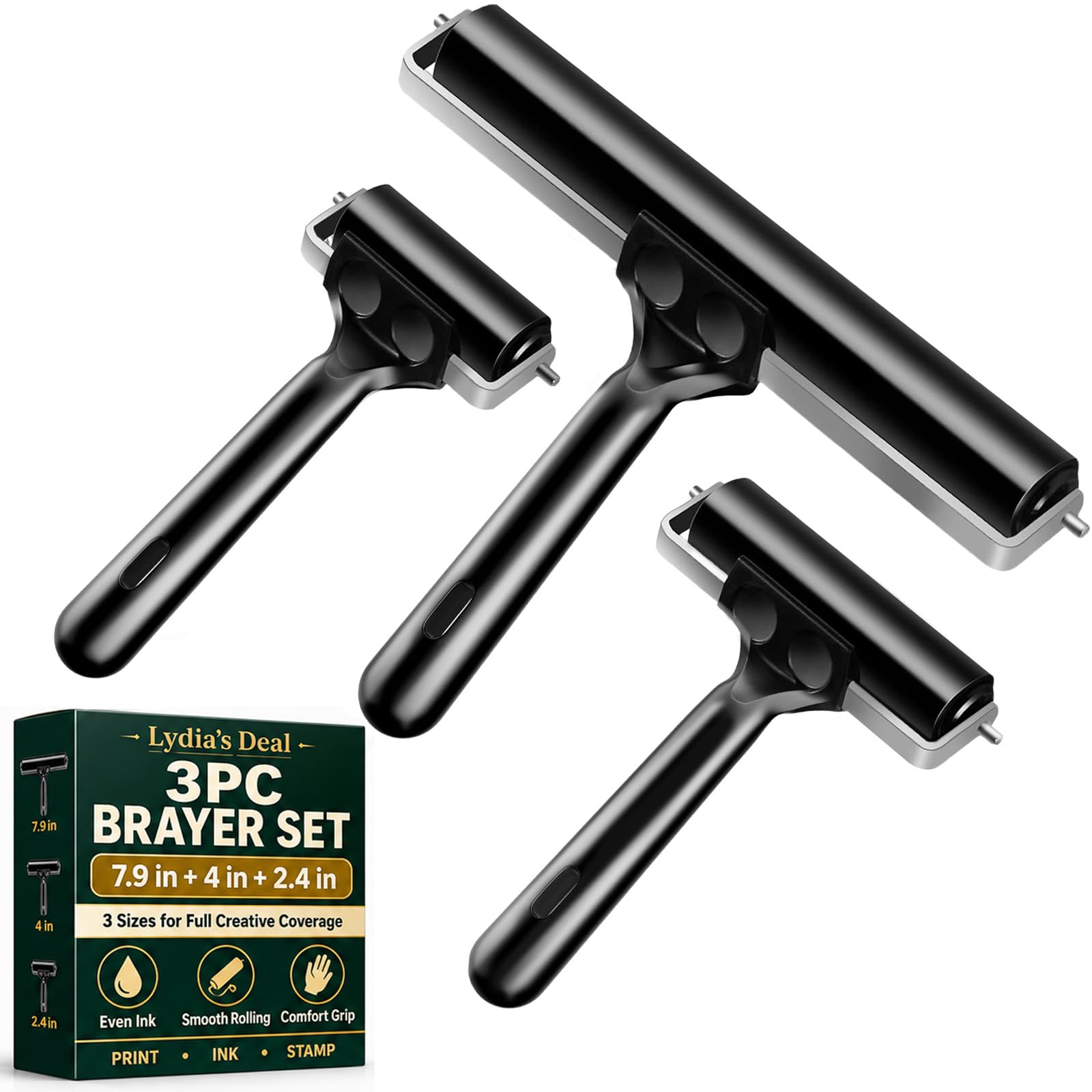
Lydia's 3-Pack

Lydia's 3-Pack

Mixed-scale printing

Customer rating 4.7/5
Check Price

Worth Noting

  • At full-sheet sizes the widest roller may yield less even coverage than on smaller blocks
Roller Width
2.4, 4, 7.9 in
Frame Material
stainless steel
Ease Of Cleaning
easy cleanup
Read the full review

Three stainless-steel rollers — 2.4, 4, and 7.9 inches — span fine details to full sheets in one box, where a single-width brayer covers only one size. The spread is the point: narrow for stamps, middle for standard blocks, wide for larger plates, all with a comfortable non-slip grip.

For mixed-scale printmakers and classrooms that switch between stamp-size and full-page pieces, this set replaces a drawer of separate brayers. Rolling runs smooth for lino, vinyl and decoupage. Coverage holds even on small and medium projects; at very large sheet sizes the widest roller can thin out.

Use the widest roller at medium scale for the smoothest inking passes.

Bottom line: For mixed-scale printmakers and classrooms, three usable widths beat juggling separate brayers at a mid-range price.

#4

Speedball Hard 4"

Speedball Hard 4"

Glue and decals

Customer rating 4.5/5
Check Price

Worth Noting

  • In a quiet studio, the axle can squeak and roll stiffly until it gets a light oiling.
Roller Width
4 in
Frame Material
wire frame
Ease Of Cleaning
wipes clean
Read the full review

Firm 80-durometer rubber on a USA-built wire frame presses glue, decals and transfer tape into a thin, even film without flexing, and wipes clean between jobs. That stiff roll is exactly why woodworkers and laminate installers reach for it over the soft-rubber top pick, which compresses and loses pressure under heavy use. The hard surface also handles light carving, and the frame keeps its shape under repeated pressure.

Printmakers who want silent, buttery inking on soft plates should pick the soft-rubber model; this roller is built for pressure, not delicate ink films.

A drop of light machine oil on the axle settles the squeak and restores a smooth roll.

Bottom line: Woodworkers and laminate installers who spread glue and decals daily get a firmer, longer-lasting roller than the inking-focused top pick — the premium buys pressure, not ink film.

#5

Falling in Art 2"

Falling in Art 2"

Small block detail

Customer rating 4.7/5
Check Price

Worth Noting

Roller Width
2 in
Frame Material
stainless steel
Ease Of Cleaning
wipes clean
Read the full review

The 2-inch width gives this firm-rubber roller agility on stamps and small blocks, with a heavy-duty stainless frame that keeps the roll true. It costs far less than premium rubber, and the curved non-slip handle with thumb indentation sits comfortably in hand.

For classroom and detail work, the firm rubber presses ink onto linoleum, stamps and mini blocks without flexing. It is built for small pieces - the multi-width set handles full sheets - and keeping the roller level matters, since edges can leave tracking lines on the print if the angle drifts.

Bottom line: Budget workhorse for stamp and mini-block detail - reach for it when a full-size roller is overkill.

#6

Lydia's Deal 4"

Lydia's Deal 4"

Budget first-timers

Customer rating 4.7/5
Check Price

Worth Noting

  • Single 4-inch width confines it to small-to-medium work; large sheets need a wider roller
Roller Width
4 in
Frame Material
stainless steel
Ease Of Cleaning
easy cleanup
Read the full review

Sturdy stainless frame and smooth rolling at a budget price handle lino, vinyl and decoupage comfortably for first-time printmakers on small-to-medium pieces. The trade-off is width: the single 4-inch roller covers neither large sheets nor fine detail, so bigger projects need the three-width set for a modest price jump.

Bottom line: Right for budget printmakers who stick to small blocks and standard sheets; projects spanning larger surfaces will outgrow the single width.

#7

AKIRO 4" Rubber Brayer

AKIRO 4" Rubber Brayer

Ultra-budget crafting

Customer rating 4.7/5
Check Price

Worth Noting

  • Rubber can shed black marks that stain paper during inking.
Roller Width
4 in
Frame Material
plastic/metal
Ease Of Cleaning
cleans with water
Read the full review

Its 4-inch head handles Cricut adhesion, collage and gluing at a rock-bottom price, with a smooth rubber surface that washes clean in water. Rolling can vary between units, so fine printmakers needing even ink should look to the Speedball line. It wins on minimum spend, though the two-size kit adds a 2.2-inch roller for slightly more.

Bottom line: For budget crafters and Cricut users after the cheapest possible 4-inch roller, this brayer fits — just not for fine printmaking where even ink matters.

#8

Ortnuzk 2-Pack

Ortnuzk 2-Pack

Budget gel prints

Customer rating 4.5/5
Check Price

Worth Noting

  • On plates wider than four inches, expect several passes to cover the surface.
Roller Width
4 + 2.4 in
Frame Material
solid frame
Ease Of Cleaning
—
Read the full review

Two usable widths with smooth-rolling bearings and soft rubber that inks smaller plates and blocks evenly. Budget pricing fits casual gel-printing and stamping well, though this is matched to small-to-medium craft work rather than large-format printing or professional-grade inking.

Bottom line: Pick this up for budget gel-printing and stamping jobs where two sizes in one set beat the need for a wider roller.

#9

TOOYIMR 4" Brayer

TOOYIMR 4" Brayer

Occasional light craft

Customer rating 4.6/5
Check Price

Worth Noting

  • The handle can wear out within a few months of light use.
Roller Width
4 in
Frame Material
—
Ease Of Cleaning
—
Read the full review

Rolls cling stamps and general craft smoothing well, with solid build quality for the price. Value is the draw here, and it fits occasional, light project work best. That makes it a sensible entry point for trying printmaking without a big outlay.

Bottom line: Right for very budget-conscious buyers doing occasional light crafting, where the low price is the whole point.

#10

EastyGold 4" Roller

EastyGold 4" Roller

Craft smoothing tasks

Customer rating 4.6/5
Check Price

Worth Noting

  • Diamond-patterned rubber and squeaky roll leave uneven ink
Roller Width
4 in
Frame Material
plastic
Ease Of Cleaning
—
Read the full review

The EastyGold is well-made and sturdy, with a comfortable weight for extended smoothing sessions. But the diamond-patterned rubber and squeaky roll answer best to diamond painting and craft flattening — for printmaking, even ink coverage is a stretch, and one metal bar was noted breaking after months.

Bottom line: Choose this for diamond painting and craft flattening on a budget — just not when even ink coverage matters.

#11

Gel Press 4" Brayer

Gel Press 4" Brayer

Gel plate printing

Customer rating 4.5/5
Check Price

Worth Noting

  • In some cases a raised lip at each end streaks ink, so an even pass depends on the unit arriving flat.
Roller Width
4 in
Frame Material
ABS plastic
Ease Of Cleaning
—
Read the full review

This hard, latex-free roller from the gel-press brand suits gel plates and monoprinting, and working units spread paint smoothly and evenly. Flatness is the tradeoff: some rollers carry a raised lip at each end that streaks ink across the block, so an even pass relies on checking your unit's edge before inking.

Bottom line: Fits flat gel plate and monoprint sessions at a budget price — worth it only if you confirm the roller's edges are flush before inking.

How to Choose

Pick the Right Roller Width

Roller width sets how much surface you cover per pass, and 4 inches is the versatile default — wide enough for standard linocut and woodcut blocks, narrow enough to stay controllable in new hands.

A 2-inch brayer suits stamps and small cuts but needs many passes on larger work. A wider roller such as 7.9 inches covers full sheets fast, but the wider the roller, the harder it is to keep perfectly level, so uneven edges show up as tracking lines.

Soft vs. Hard Rubber

Durometer measures rubber firmness and decides what a brayer can do. A soft 40-to-42-durometer roller flexes as it rolls, conforming to the low spots on linoleum, wood or a gel plate and depositing a thin, even ink film — the behavior printmaking actually needs.

A hard roller around 80 durometer does not flex, so it presses glue, decals and transfer tape into a thin, even layer and handles light carving without bouncing. The trade-off is that hard rubber rolls noisily and inks differently, making it a workshop tool more than a fine-print brayer.

Frame Material Predicts Lifespan

The frame is the best predictor of how long a brayer survives regular use. A steel frame holds the roller true against the downward force of inking, so the axle stays straight and the roller keeps rolling flat pass after pass.

Plastic frames flex under that same pressure. Over a term in a classroom, the flex loosens the end caps, the roller starts to wobble, and even inking turns into a streak problem — the most common failure in budget brayers.

Axle and Bearing Quality

The axle and bearings decide how smoothly and quietly the roller spins. Well-seated bearings roll freely with a light touch and glide across the ink plate without skipping.

Poor bearings drag, squeak and catch, which pushes you to press harder. That extra pressure misaligns the roller and leaves uneven ink, and a squeaky brayer is often the first sign the roller is not perfectly flat.

Cleaning and Ink Build-up

A roller that cleans up fast keeps your ink colors from muddying. Water-soluble inks wipe off soft rubber in seconds, which is why removable rollers are a real plus — you can wash the roller thoroughly without soaking the frame.

Hardened ink left on the roller surface forms tiny ridges that transfer onto the next print. Rollers that trap ink in seams or patterned rubber are harder to clear and can contaminate light-colored inks.

Frequently Asked Questions