Outdoor & Active Play Product Guide

11 Best Binoculars for Kids in 2026: Which Real Optics Fit Their Age

Best binoculars for kids that match real optics to your child's age, so young explorers see clearly instead of wrestling with a toy.

11 Best Binoculars for Kids in 2026: Which Real Optics Fit Their Age editorial illustration

Many kids' binoculars fall into two camps: cheap toys with weak plastic lenses that frustrate, and adult binoculars scaled down without regard for small faces. The difference between them shows up the first time a child tries to focus a distant bird.

The real decision isn't about magnification numbers — it's about whether the pair matches your child's age and physical ability. A 3-year-old who can't turn a focus wheel gets more from a fixed 2x model than from an adjustable 8x that feels like homework. A 9-year-old birdwatcher outgrows toys fast and needs genuine optics that hold focus.

This guide separates real binoculars from toys and tells you which magnification, focus style, and build suit each age range — so you buy a tool your child will actually use, not a shelf decoration.

#1

OBUBY 8x21 Binoculars

OBUBY 8x21 Binoculars

First real pair

Customer rating 4.5/5
Check Price

Worth Noting

  • On some units the image starts soft until the center focus wheel is dialed in for each eye.
Build
Shockproof, drop-resistant
Extras
Case, strap, cloth
Best Age
5-12
Focus Type
Center focus
Read the full review

Genuine 8x21 glass optics give kids clear views of distant birds and sideline action, and the shockproof rubber shell absorbs the drops that end plastic toys. This is a working instrument rather than a costume piece, holding the middle ground between disposable toys and premium optics — the clarity keeps a 6-year-old looking instead of losing interest, and the center-focus dial is simple enough for small hands to manage, with the included case protecting it between trips.

In family hands the pair endures toppled falls on picnic tables and careless strap swings. The 8x view brings distant treetops into reach, exactly what holds a young birder's attention on a trail walk, and kids reach for it repeatedly — the kind of gear that migrates into a backpack rather than the toy box. The included neck strap keeps it close at hand, and the cleaning cloth handles the inevitable fingerprint smudges.

Best for families with kids 5 to 12 who want honest magnification for birding, hiking, or the ballpark at a mid-range price. The compact 21mm objective favors daytime skies over twilight viewing, and a quick focus-wheel check on arrival is the one setup step worth doing before that first walk.

Bottom line: Real 8x magnification, a shockproof build, and a mid-range price make this the genuine binocular for kids who would otherwise wear out plastic toys in a season.

#2

GeoSafari Kidnoculars

GeoSafari Kidnoculars

Toddler first pair

Customer rating 4.6/5
Check Price

Worth Noting

  • Image sharpness can look soft until eyepieces sit flush against a small face.
  • The neck strap can separate with rough tugging during play.
Build
Sturdy for daily play
Extras
Neck strap
Best Age
3-5
Focus Type
Fixed focus
Read the full review

The fixed-focus design removes the single biggest toddler failure point — no lens-twisting, so a 3-year-old sees instantly through jumbo eyepieces sized for small faces. That makes it the least frustrating first pair a parent can hand over, with a lightweight body that survives active play.

At 2x magnification this is a close-range nature tool for the leaves and insects right in front of a child — not for spotting distant birds. Parents of 3-5 year olds get a safe, simple entry into backyard observation, while older kids wanting real reach should step up to the 8x top pick instead.

Bottom line: For toddlers who only need to inspect what's right in front of them, this is the simplest, safest first pair — no focusing battles.

#3

LeapFrog Magic Adventures

LeapFrog Magic Adventures

Screen learning fun

Customer rating 4.6/5
Check Price

Worth Noting

  • Occasional screens can carry clarity defects, so inspect the display on arrival.
  • Stiff magnification knob may need extra hand strength, slowing independent use.
Build
Durable for drops
Extras
340+ BBC videos
Best Age
4-8
Focus Type
Manual
Read the full review

A 2.4-inch video screen loaded with 340+ BBC nature clips and 10x optical zoom turns an ordinary walk into a live nature documentary for kids aged four and up. The light and capture button let a young explorer snap and save what they spot, and the rubber body survives repeated drops.

This suits families who want a screen-first learning tool more than a traditional optical pair. A tech-loving child will reach for it daily, but at this premium price the focus knob can run stiff for small hands, and parents after real magnification will get more from the investment-grade optics in this set.

Set the focus before handing over — small hands may struggle with the stiff knob mid-walk.

Bottom line: For families who want walks to double as screen-based nature lessons, this delivers daily engagement — but parents chasing real optics or a budget price should look elsewhere.

#4

Vortex Bantam HD

Vortex Bantam HD

Serious young birders

Customer rating 4.7/5
Check Price

Worth Noting

  • Premium price suits families committed to the hobby, not casual or occasional use.
Build
Waterproof, rugged
Extras
Lifetime warranty
Best Age
8-12
Focus Type
Center focus
Read the full review

HD 6.5x32 glass and a fully waterproof body place this a step above the 8x21 middle ground, and the lifetime warranty is something no other kids' pair can match. The 32mm objective pulls in noticeably brighter light at dawn and dusk, when feeder birds and early-morning wildlife are most active.

Built for the 8-to-12 set who treat binoculars as gear rather than toys, this suits dedicated young birders and hunters more than the casual backyard crowd. The premium price is overkill for occasional play — a buy for families ready to invest in a hobby, not test one.

Bottom line: For the young birder or hunter whose hobby is already locked in, this is the pair that outlasts every stage of growth — the warranty alone covers a decade of rough handling.

#5

Little Experimenter Night

Little Experimenter Night

Nighttime toddler play

Customer rating 4.6/5
Check Price

Worth Noting

  • 2x magnification keeps distant birds and scenery out of view
Build
Durable toddler build
Extras
Green night light
Best Age
3-6
Focus Type
Fixed focus
Read the full review

The green 'night vision' light turns dusk and indoor play into pretend night missions, and the fixed 2x focus means a 3-year-old sees instantly with no focusing skill required. The chunky grip fits small hands and the sturdy build takes the occasional toddler drop in stride.

Understand that 'night vision' here is a green light, not true infrared — it won't brighten real darkness. For 3-6 year olds exploring the living room or backyard at dusk, that spark of imagination is plenty; older kids who need actual magnification will want real optics instead.

Bottom line: A memorable first gadget for the 3-6 year old who turns dusk and the living room into imaginary night adventure.

#6

Think Peak Green Binoculars

Think Peak Green Binoculars

Premium real upgrade

Customer rating 4.6/5
Check Price

Worth Noting

  • Premium price buys optical polish kids won't notice
Build
Rugged, waterproof
Extras
—
Best Age
6-12
Focus Type
Center focus
Read the full review

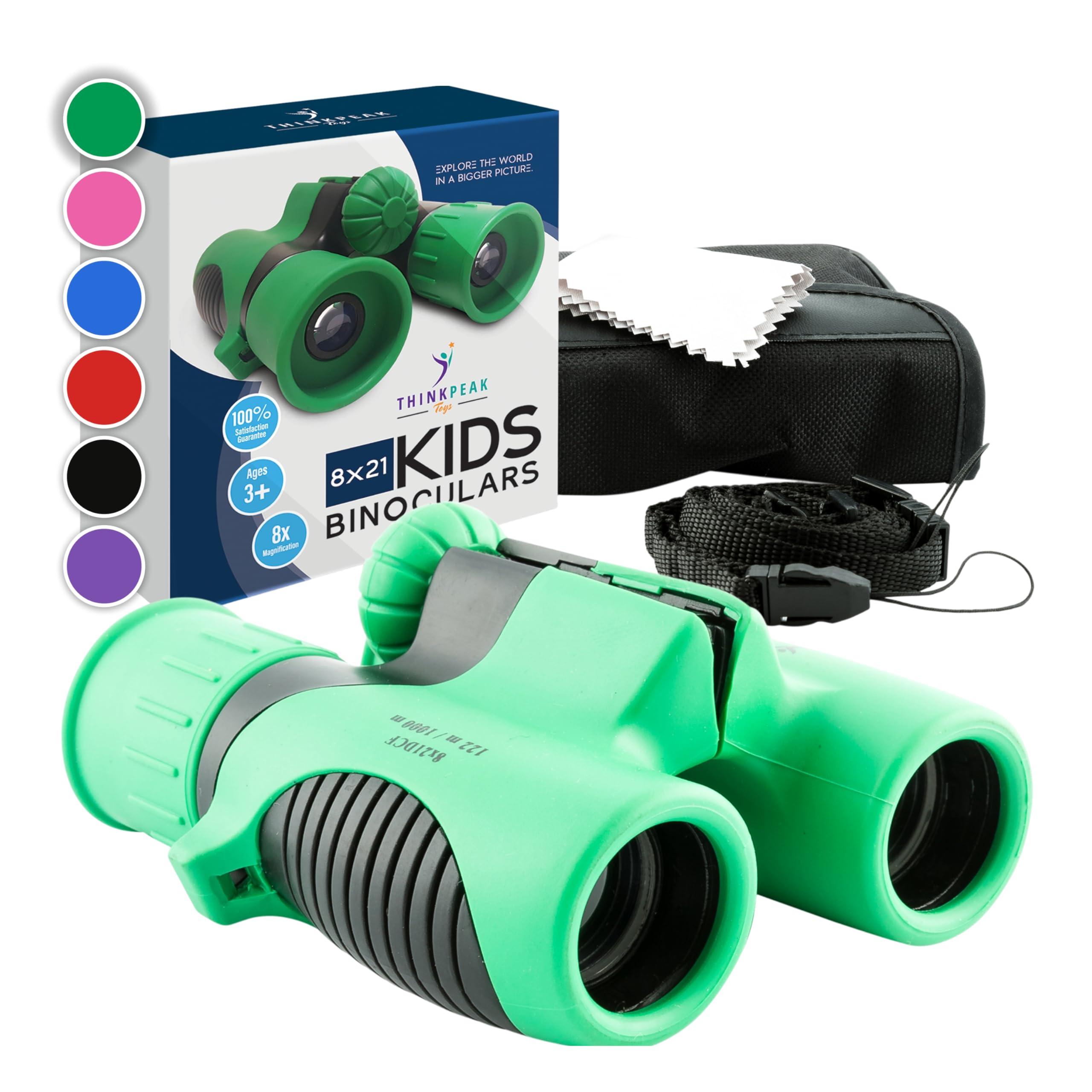
The Think Peak delivers genuine 8x21 glass optics with BAK4 prisms and a waterproof body, giving crisp, clear views and a rugged build that survives active use. Small hands manage the center focus easily. The catch: at a premium price, the optical gain over the lower-priced top pick is barely perceptible for kids' casual viewing.

Bottom line: Best for parents who want premium optical polish and a young birdwatcher who will actually use the extra clarity. For casual backyard play, the lower-priced top pick delivers the same real-world experience.

#7

Noptix Real Kids Binoculars

Noptix Real Kids Binoculars

Learning with optics

Customer rating 4.6/5
Check Price

Worth Noting

  • The bird sticker book is a modest extra - a pleasant intro to species, not a substantial learning tool
Build
Shockproof
Extras
Bird sticker book
Best Age
4-10
Focus Type
Manual
Read the full review

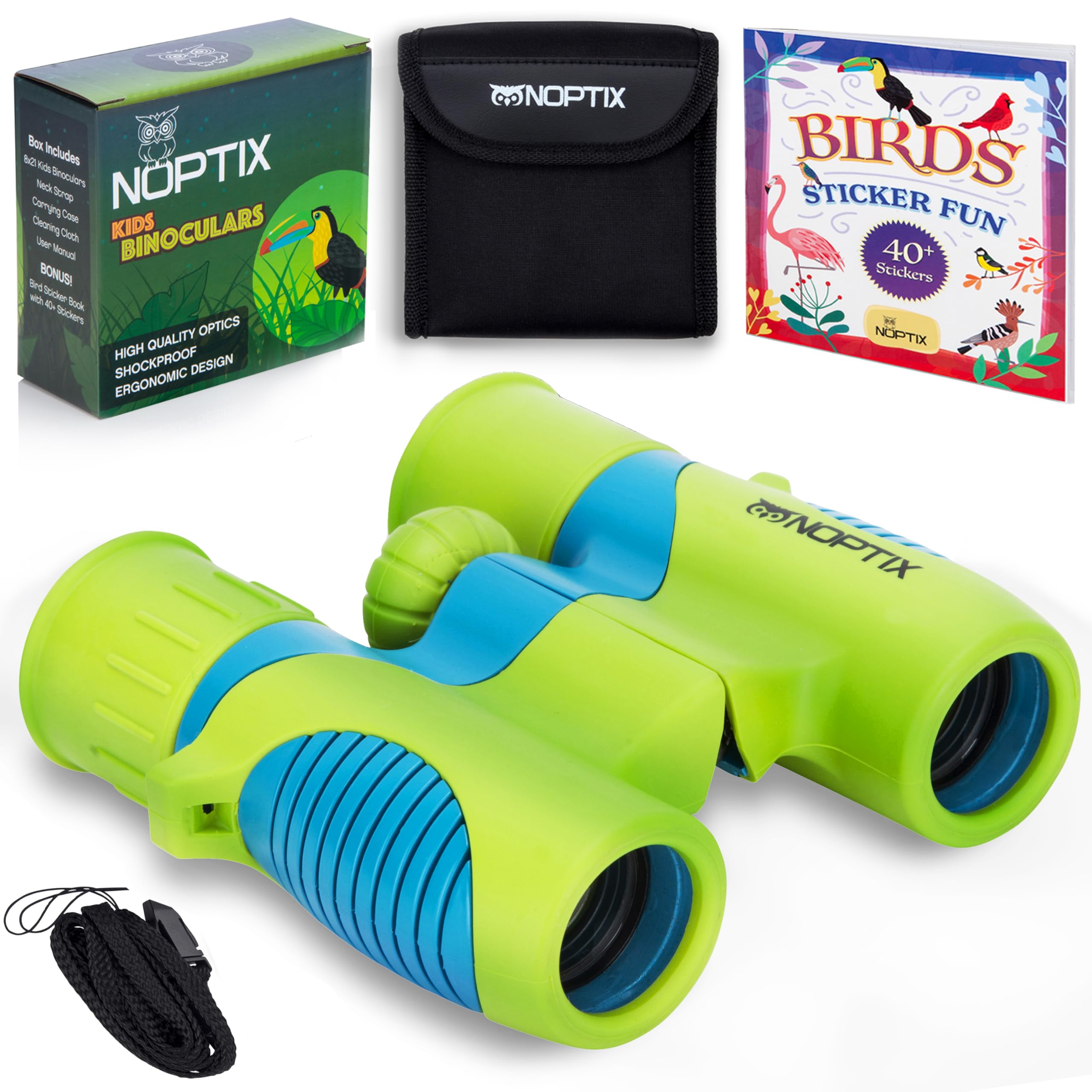
Clear 8x21 glass optics deliver genuinely usable magnification that small hands can steady, and the shockproof rubber body shrugs off everyday drops. The bird sticker book adds a light educational hook - lovely for introducing species, though it won't substitute for a real field guide. Long-term durability across heavy play is less settled than the top pick's.

Bottom line: Pick it when a 6- to 9-year-old will actually use the bird guide on real outings; the educational hook justifies the mid-range price over cheaper kits.

#8

Melissa & Doug Explore Set

Melissa & Doug Explore Set

Pretend role play

Customer rating 4.6/5
Check Price

Worth Noting

  • View is blurry by design
Build
Sturdy play build
Extras
Compass, field guide
Best Age
2-4
Focus Type
Manual
Read the full review

Toddlers respond to the full kit — binoculars, compass, and field guide form a ready-made exploration story that holds a 3-year-old's attention longer than a single optic. Drops survive thanks to a sturdy play build. The tradeoff by design: the image is blurry, so this is imagination fuel rather than a window on the outdoors.

Bottom line: Best for ages 2-4 who want to dress up and play explorer — not for any child who expects to see objects clearly.

#9

Promora 8x21 with Extras

Promora 8x21 with Extras

Explorer adventure bundle

Customer rating 4.5/5
Check Price

Worth Noting

  • Strap attachment can give way, letting the binoculars fall during play.
Build
Solid build
Extras
Compass, magnifier
Best Age
5-10
Focus Type
Center focus
Read the full review

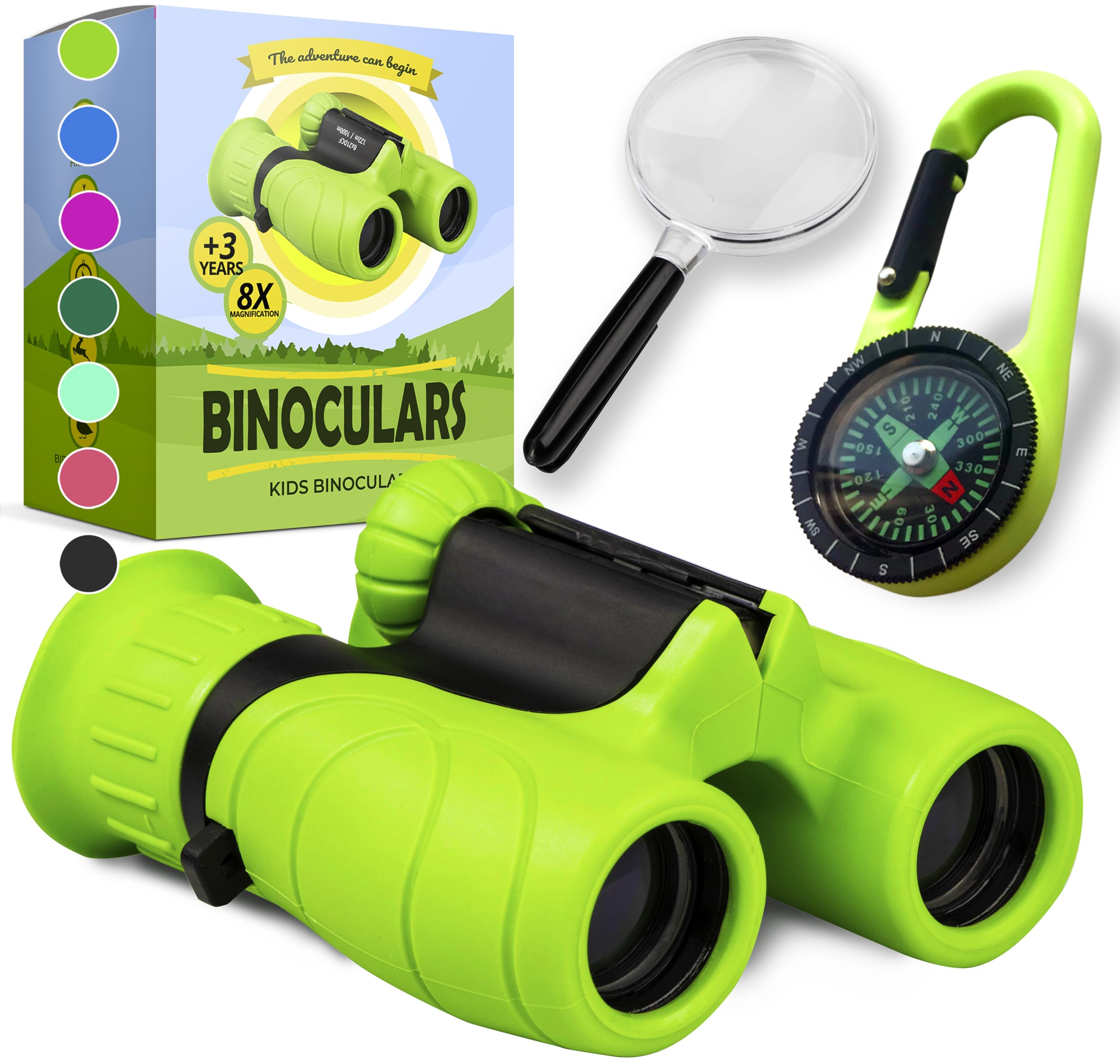
Genuine 8x binoculars deliver real magnification kids can use, sized for small hands with a focus wheel children master quickly. The bundled compass and magnifier are cheap extras that may be non-functional. The strap attachment can give way early. For a child who loves explorer play, the optics carry the value at a mid-range price.

Bottom line: Best for a 5-10 year old who loves explorer play and will treat the accessories as a novelty — the binoculars themselves deliver solid value at a mid-range price.

#10

ARTOMIDE with Compass

ARTOMIDE with Compass

Budget gadget explorer

Customer rating 4.5/5
Check Price

Worth Noting

  • For a child hoping to spot birds or objects across a yard, distant details stay blurry at 5x.
Build
Waterproof
Extras
Compass, whistle
Best Age
3-12
Focus Type
Center focus
Read the full review

At this set's lowest price, the ARTOMIDE puts a whistle, compass, and binoculars in a young gadget-lover's hands, and kids enjoy the extras. It's light enough for small hands to carry on short walks. Build quality can vary between units — parts may arrive loose — so this suits gentle backyard play, not rough handling.

Bottom line: For the young gadget-lover who wants a pocket kit of their own, this delivers the full explorer set at the lowest price in the lineup — best suited to short, casual outings.

#11

LET'S GO! Kids Binoculars

LET'S GO! Kids Binoculars

Budget starter pair

Customer rating 4.5/5
Check Price

Worth Noting

  • Distant birds look small at 4x
Build
—
Extras
Bird manual, bag
Best Age
3-7
Focus Type
—
Read the full review

Budget-friendly 4x optics with a bird-watching manual make it easy to gauge a preschooler's interest in nature. The simple focus and carrying bag suit 3-6 year olds on backyard walks. But build quality is a gamble — this is a disposable starter for gentle, occasional use, not a long-term binocular.

Bottom line: Worth the small outlay when you're testing whether a preschooler will stick with birding — move up to stronger optics once that interest is clear.

How to Choose

Magnification vs. Real Viewing

Higher magnification magnifies blur and hand shake right along with the subject. A 4x toy with plastic lenses enlarges a fuzzy image, while a 2x pair with glass optics stays sharp up close — which is why low-power real optics beat high-power toys for young children.

Past roughly 8x, steadiness becomes the limiting factor. Small hands shake enough that a distant bird turns into a jittery blur, so higher power only helps older kids who can hold the barrels still.

Fixed vs. Adjustable Focus

Fixed-focus lenses are set so everything beyond a few feet is sharp — a toddler just lifts and looks with no skill required. Adjustable center focus demands fine-motor control: the child must turn a wheel while keeping the barrels steady against their face.

Most kids under five haven't built that coordination yet. When focusing feels like a chore, frustration wins and the binoculars get abandoned, so choosing fixed focus for the younger set is usually the difference between daily use and a shelf ornament.

Build Quality and Drop Strength

Rubber armor absorbs impact so the internal lens alignment stays intact when the pair hits the ground. Cheap plastic bodies and hinge joints crack instead, which is why lenses 'pop out' and bodies split on budget models after a few drops.

A breakaway neck strap matters more than it seems. It snaps open under force, protecting a child from getting caught or dragged, and it's often the first component to give out on cheap pairs — check the anchor point before you trust it.

Eyepiece Fit and Weight

The distance between the eyepieces (interpupillary distance) must match your child's face for the image to merge into a single circle. Many budget kids' models fix this spacing, and when it's wrong the child sees black crescents or double vision no matter how the focus is set.

Weight determines whether a child will actually carry them. A heavy pair tires small arms within minutes and gets left behind on hikes, so the lightest build that still offers real optics suits the youngest explorers best.

Extras That Earn Their Keep

Extras only add value if they work and match a real interest. A compass that spins but doesn't point, or a whistle that won't sound, frustrates more than it delights — cheap accessories are often afterthoughts bolted onto the box.

The strongest learning add-ons tie content to what kids can actually see: a bird sticker book, a field guide, or a screen with real footage turns 'look at that' into 'what is that,' which is the whole point of binoculars for an education-minded family.

Frequently Asked Questions