Math Learning Product Guide

9 Best Base Ten Blocks of 2026: Teach Through Thousands

Find base ten block sets that properly teach place value through the thousands place — and identify materials that survive years of use.

9 Best Base Ten Blocks of 2026: Teach Through Thousands editorial illustration

Most base ten block listings lead with 'teacher-designed' and 'colorful,' but the sets that actually teach place value are those with complete piece counts. Budget-friendly options often look identical in the photos yet stop at 999 because they skip the thousands cube. That limitation only surfaces halfway through the school year, when a child needs to build a four-digit number.

Material matters just as much. Foam sets are quieter and easier for small hands, but they bend and bite off under rough use; plastic sets cost a little more and hold up for years of daily handling. The right trade-off depends on how many children will use the blocks and for how many grades you plan to teach.

This guide separates sets that support true place-value instruction through the thousands place from those that only cover hundreds, and it flags which storage and magnetic extras are worth buying — so you can choose a set that won't leave you shopping again next year.

#1

Simply Magic 131 pc Set

Simply Magic 131 pc Set

Homeschool & small groups

Customer rating 4.8/5
Check Price

Worth Noting

  • No storage container ships with the set, so loose pieces need a bin you already own.
Pieces
131 pc, 1 cube
Material
Plastic
Read the full review

The Simply Magic 131-piece set covers the entire place-value range in a single box — 100 ones, 20 rods, 10 flats, and a thousands cube — so a student can build, compare, and regroup numbers up to four digits. The plastic construction holds its shape and keeps printed unit markings legible through months of sorting, which matters when blocks pass between students across a school year. Pieces are sized for small hands, and the set carries a lesson from single units to the thousands place without a missing link.

Place value turns hands-on rather than abstract here: a child physically trades ten ones for a rod while regrouping, and comparing 34 with 340 becomes a visual exercise instead of a memorized rule. Twenty rods and ten flats support the repeated regrouping that second-grade addition and subtraction require, so a lesson does not stall for lack of pieces. Four or five students can work the same problem at one table with the full kit spread out, which makes it a small-group tool rather than a solo desk prop.

This is the set for a homeschool parent, a small-group classroom teacher, or a self-learner who wants one complete kit instead of three partial sets. The tradeoff sits with organization: no storage container ships with the set, so the pieces need a bin you already own between lessons — a minor step for a kit that otherwise stands alone. Those needing magnetic display blocks for a whiteboard, or an entry-level price, will find a better fit in another tier.

Value holds up against the premium name in this category, which pairs its blocks with an activity book and a storage box at a notably higher price. Skip those extras when your lesson plans already exist — this kit returns the same core manipulative work at a lower cost while matching piece completeness through the thousands place. Sturdy plastic and a direct learning payoff carry real teaching weight at a mid-range price.

The plastic resists the bending and warping that foam alternatives show during normal handling, keeping the grid lines on each flat crisp so students read them accurately. Because the set includes a solid thousands cube rather than a hollow shell, older students extend the same place-value logic to four digits without a gap in the materials.

Bottom line: For teaching place value to one child or a small group, this single kit replaces three partial sets and holds up through years of use — complete, sturdy, and priced for everyday teaching.

#2

Torlam Magnetic Set

Torlam Magnetic Set

Classroom display

Customer rating 4.6/5
Check Price

Worth Noting

  • Repeated mounting and demounting on a whiteboard can gradually soften the magnets' grip.
  • The EVA foam body creases and dents more readily than plastic under regular handling.
Pieces
131 pc, 1 cube
Material
EVA foam + magnet
Read the full review

Oversized magnet-backed pieces hold firmly to a steel whiteboard, keeping a regrouped ten or hundred legible from the back of the classroom. During a whole-group lesson a teacher assembles units into rods and rods into flats directly on the board, and students watch the place-value exchange happen in view rather than in hand. The scale is the whole point — these pieces read clearly to a room of learners, while handheld sets demand a closer look.

The 131-piece set covers units, rods, ten flats, and a thousands cube, giving one board room to represent numbers up to 1,000 for regrouping practice. Out of the box the magnets hold pieces securely, and the large white faces keep each value easy to point out even when numbers are stacked into sums in a single lesson. That completeness is what lets a class move from counting ones to trading ten rods for a flat without swapping materials.

This is a whiteboard display set first — best for classroom teachers and homeschool parents demonstrating regrouping to a group at the board, not for students who need to hold and manipulate pieces. The foam-and-magnet build is lighter and less durable than the plastic sets, a tradeoff that barely registers when the whole lesson happens in front of the class.

Slide pieces off the board rather than prying them, which keeps the magnet grip strong across the school year.

Bottom line: A classroom teacher demonstrating regrouping at a whiteboard gets full 1,000-place coverage with pieces that read from across the room. Keep it at the board — students who need to handle pieces are better served by a plastic set.

#3

Simply Magic Foam 131

Simply Magic Foam 131

Quiet learning

Customer rating 4.7/5
Check Price

Worth Noting

  • No storage container, so the 131 pieces need a separate bin or bag to stay together.
  • Soft foam bends under a firm squeeze, giving it a shorter lifespan than plastic blocks.
  • A toddler who mouths objects can bite pieces off, a choking concern that needs supervision.
Pieces
131 pc, 1 cube
Material
Foam
Read the full review

The Simply Magic foam set keeps the full 131-piece line-up — units, rods, flats, and a thousands cube — while trading plastic heft for a material that lands silently. Where the sturdier plastic top pick clatters across a desk, these foam blocks settle without a sound, which suits a quiet homework table or a home where background noise matters.

First graders pick up place value quickly with these blocks, and parents highlight how clearly the pieces demonstrate regrouping. The foam texture reads as friendly and the blocks stay put instead of sliding, so a child can arrange flats and rods without losing count. Because the set reaches the thousands place, one tool covers both expanded form and borrowing from the hundreds column.

This set fits a parent after one child's at-home practice who wants a lightweight, quiet manipulative that doesn't intimidate an early learner — including supervised sessions with a toddler who mouths objects. The material demands honesty: foam bends under a tight squeeze, and a determined young child can bite pieces off, so rough handling by several kids or a busy classroom points to the durable plastic set instead.

Supervise toddler sessions closely so bites and hard squeezes stay out of the picture — gentle hands keep the foam intact.

Bottom line: For a parent coaching one child through place value at a quiet table, the foam build is the point: light, silent, and complete to the thousands place.

#4

Learning Resources Smart Pack

Learning Resources Smart Pack

Budget single-child

Customer rating 4.8/5
Check Price

Worth Noting

  • No thousands cube, so place-value instruction caps at numbers under 1,000
  • Small unit pieces can pose a choking risk for children under 4 during use
Pieces
121 pc, no cube
Material
Plastic
Read the full review

This Smart Pack is the most affordable 121-piece plastic set in this roundup, and it covers every piece needed for place-value work below 1,000: units, tens rods, and hundreds flats. The plastic is sturdy enough for repeated handling, and the compact size slips into a backpack for tutoring across homes.

This is the right fit for a homeschool parent guiding one child or a tutor who moves between houses. The absence of a thousands cube caps content at numbers under 1,000, which suits early place value but not multi-digit regrouping. The unit pieces are small, so supervision for children under 4 is worth planning around.

Compared with the pricier starter set that bundles extra rods and an activity book, this pack strips away add-ons to land at a lower price — a fair trade for buyers who bring their own exercises to the table.

Sturdier than foam alternatives, this set holds up to daily use without the bend or dent foam blocks develop. For demonstrations to a whole classroom, the small pieces read poorly from a distance — this set is built for close, one-on-one work rather than group display.

Keep the unit pieces in a sealed container between lessons to keep them out of reach of younger children.

Bottom line: For a parent or tutor guiding one child through place value below 1,000, this is the budget pick — pair it with supervision for younger kids and accept the 999 ceiling.

#5

Learning Resources Starter

Learning Resources Starter

Long-term instruction

Customer rating 4.8/5
Check Price

Worth Noting

  • The thousands cube is hollow and lightweight, feeling less substantial than the rest of the set.
  • Occasional missing-piece issues have been noted; worth verifying contents on arrival.
  • Premium price places it above simpler sets that cover the same core grades.
Pieces
141 pc, 1 cube
Material
Plastic
Read the full review

This set includes 30 tens rods plus an activity book and a sturdy plastic storage box, which is more component depth than any other option in this comparison. The extra rods matter for lessons that move beyond basic place value into repeated regrouping and multiplication, where one or two spare rods often run short in leaner sets.

Plastic construction holds up to steady classroom use, and the set covers units through the thousands place. The included thousands cube is a boon for introducing the next place value, though it is hollow and noticeably light — it sits fine on a desk but lacks the heft some buyers expect for demonstrating the relative size of a thousand.

This suits teachers and homeschoolers planning several years of place value work with grades 1 and up, where the activity book and extra rods carry real teaching weight. The premium price and the hollow cube are the tradeoffs: budget-focused buyers or those who only need occasional support under 1,000 will get the same core function for less from the budget plastic option in this set.

Unbox and count each piece against the included list before the first lesson — verifying contents early avoids a mid-activity surprise.

Bottom line: For a classroom or homeschool that will teach place value across multiple grade levels, the extra rods, activity book, and storage box make the higher cost worthwhile. Buyers needing only occasional practice under 1,000 can get by with a leaner, cheaper set.

#6

stochastic box 143

stochastic box 143

Activity-based learning

Customer rating 4.7/5
Check Price

Worth Noting

  • Blocks are hollow and lighter than solid plastic, which lessens the tactile heft some learners expect.
  • The storage container can crack if knocked; it suits a fixed shelf spot rather than a packed bag.
Pieces
143 pc, 1 cube
Material
Plastic
Read the full review

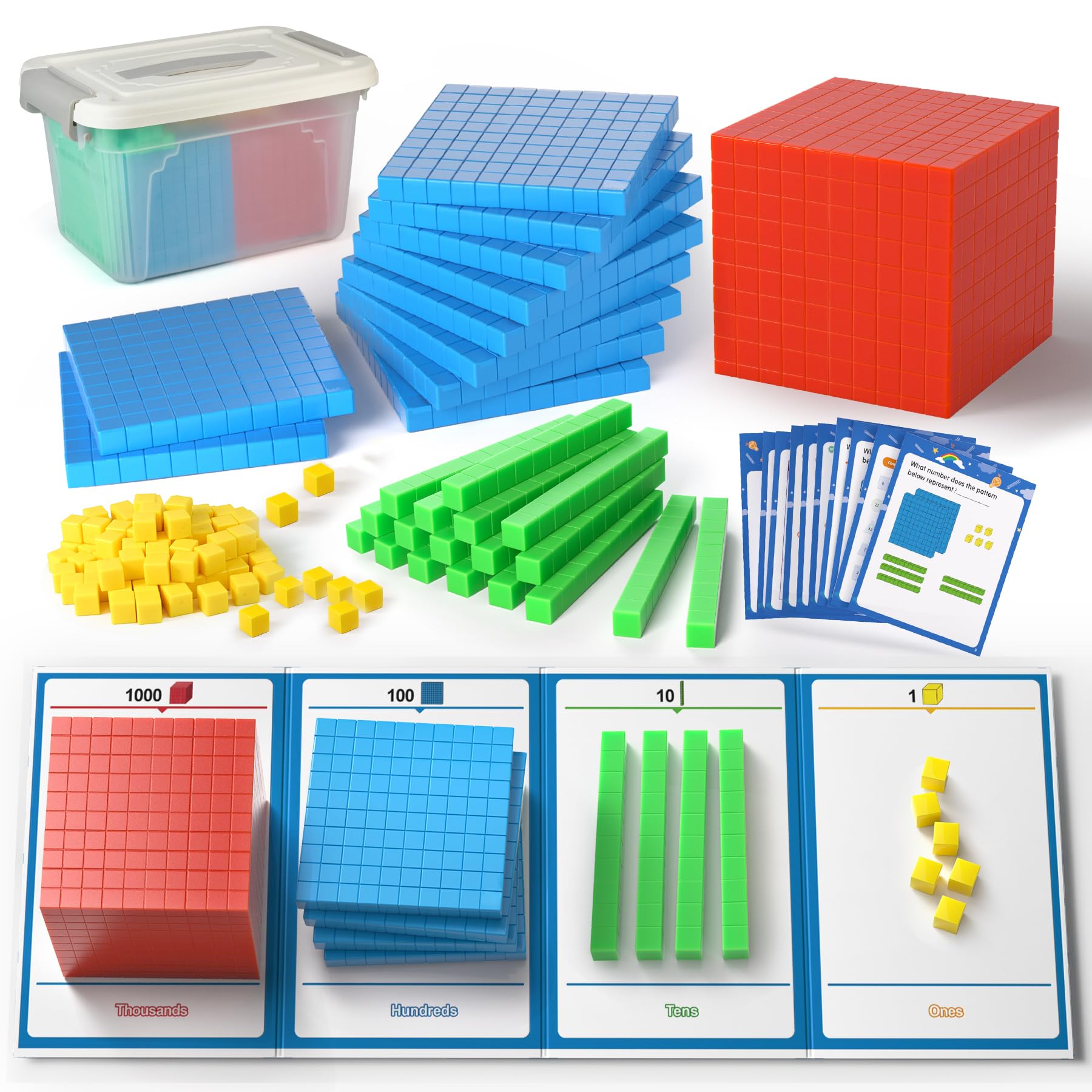
A fold-out place-value chart and 11 dry-erase cards set this apart from the flat plastic set that leads this guide, turning practice into a visible record. A unit moved from ones to tens updates the written spot as the child handles the block — a pairing most base-ten kits leave to improvisation. That structure favors guided lessons over open-ended play, which is exactly what a first-grade homework session needs.

The full 143 pieces include ones, rods, 10 flats, and a thousands cube, so numbers through 1,000 sit in one box. Plastic pieces have held up through repeated lessons in owner reports, and the visual-plus-kinesthetic approach earns consistent praise for the learning payoff — regrouping and borrowing register clearly when a child both sees and touches the exchange.

Best fit is a homeschooler or a parent guiding one child at a table, where the chart and cards give each lesson a clear shape. The blocks are hollow and light rather than solid-heavy — adequate for place-value grouping, though they lack the heft some prefer — and the storage box is best left on a shelf, since it can crack if dropped or packed tight into a bag.

Bottom line: A structured, activity-rich pick for a parent guiding a first-grader at home, where the chart and cards carry the lesson. Hollow blocks and a fragile box are acceptable while the set stays on a shelf.

#7

Torlam 131 pc Plastic Set

Torlam 131 pc Plastic Set

Guided practice

Customer rating 4.8/5
Check Price

Worth Noting

  • No storage tub included, so the set needs its own bin to keep pieces tidy between lessons.
  • Dry-erase mat can leave residue needing rubbing alcohol to remove, and markers may be missing on arrival.
Pieces
131 pc, 1 cube
Material
Plastic
Read the full review

The dry-erase mat is the standout — it gives children a dedicated space to build and regroup numbers, and the 131 plastic pieces include a thousands cube for work into the 1000s place. Blocks are sturdy and wipe clean, which suits visual and tactile learners through early elementary grades.

It runs slightly pricier than the top pick in this roundup, and the mat carries a real tradeoff: it can leave a residue that needs rubbing alcohol to clean, and markers may be missing on arrival. That makes it a strong guided-practice option for parents and homeschoolers rather than the best value for budget shoppers.

Bottom line: Best for parents and homeschoolers who want a guided practice mat built into their set — provided they are willing to wipe the mat clean between lessons. Budget-first shoppers will get the same piece count for less elsewhere in this roundup.

#8

Doloowee 121pc Set

Doloowee 121pc Set

Storage convenience

Customer rating 4.7/5
Check Price

Worth Noting

  • Ships with no activity cards or guided lesson materials
  • Mid-range pricing offers no cost edge over fuller sets that bundle teaching extras.
Pieces
121 pc, 1 cube
Material
Plastic
Read the full review

The 121-piece plastic set covers units, rods, flats, and a thousands cube, so place-value work through four-digit numbers lives in one box. The included storage tub keeps every block gathered between lessons and cuts down on lost pieces.

The tub can arrive cracked and wear down under regular handling, and that fragility is what keeps this set from ranking higher. The plastic blocks themselves hold up well to day-to-day use, so for one child's homework the set works where tough storage matters less.

Bottom line: Best for a homeschool parent guiding one child through early place-value work who wants the whole number range kept in a single box — light, single-family use is its natural setting.

#9

TOMMYHOME with Chart

TOMMYHOME with Chart

Kindergarten teachers

Customer rating 4.8/5
Check Price

Worth Noting

  • Activity cards can be missing from the box, leaving guided activities incomplete.
Pieces
131 pc, 1 cube
Material
Plastic
Read the full review

This 131-piece plastic set brings place value down to eye level for kindergarteners, and the write-and-wipe chart and storage box make it a tidy classroom pick. For tactile learners, the hands-on grouping of units into rods and flats makes abstract concepts tangible. The tradeoff: the activity cards advertised alongside the set can be missing from the box in some units, which matters more if you plan to follow the guided activities rather than build your own lessons. The brand is newer and less established, so if you prefer a longer track record, the top pick offers that assurance at a slightly higher price.

Bottom line: Best for kindergarten teachers and parents of 5-7 year-olds who want a hands-on place value set with a chart and storage, provided you don't rely on the included activity cards.

How to Choose

Piece Count

A set with only 121 pieces typically includes 100 ones, 20 rods, and one flat. That's enough to represent 100, but not to build a number like 1,234 because you'd need ten flats and a thousands cube.

Buying a set with 131+ pieces ensures you have 10 flats and a cube. Without them, children develop a shaky understanding of four-digit numbers and regrouping, and finding replacement cubes later is expensive.

Material Choice

Plastic pieces resist bending, chipping, and water damage, but they clatter on hard surfaces and can have sharper edges. Foam is quieter and softer for small hands, yet it compresses and tears after repeated squeezing.

Choose plastic if the set will be used daily for several grades or by more than one child. Choose foam for a quiet, supervised early-elementary environment where durability takes a back seat to safety.

Storage Realities

The cheapest way to lose pieces is to rely on the flimsy bags or cracked containers some kits ship with. A sturdy, compartmentalized box keeps rods, flats, and cubes separate and makes cleanup part of the lesson.

If the set has no storage bin, plan on buying a small plastic organizer before the blocks arrive. Loose pieces scatter quickly, and replacing a single missing cube is harder than buying a whole new set.

Magnetic Needs

Magnetic base ten blocks use a magnet layer glued to foam, so they work on whiteboards but are meant for display, not handheld manipulation. Strong magnets are essential; weak ones will slide or fall mid-lesson.

If you teach a whole class, prioritize large pieces that are readable from the back of the room. If you only tutor one child, a non-magnetic plastic set is more practical and cost-effective.

Activity Extras

Activity mats, dry-erase cards, and charts extend a set's usefulness, but quality varies. A well-made mat guides a child through building numbers step-by-step, while a flimsy one leaves marker residue and quickly becomes clutter.

Look for sets where the extras match how you teach. A single homeschooler may benefit from structured cards, but a busy classroom teacher often gets more value from a durable set with a storage box.

Frequently Asked Questions