Sensory & Accessibility Product Guide

7 Best Adaptive Scissors for Kids in 2026: That Cut and Last

Adaptive scissors for kids that genuinely cut and last, matched to hand strength, hand orientation, and classroom needs.

7 Best Adaptive Scissors for Kids in 2026: That Cut and Last editorial illustration

Scissors labeled adaptive often miss the one job that matters: cutting paper. Some spring levers snap off after a few uses, while other 'safety' blades never cut at all. The real difference between frustration and progress comes down to the assistive mechanism, blade material, and whether the pair matches the child's dominant hand.

For a classroom or home working with new cutters or children who have fine motor delays, these details decide whether a child builds cutting confidence or gives up. A loop handle with automatic spring reopening supports weak hand muscles, while a spring lever suits kids who can grip but need help opening the blades.

This guide sorts adaptive scissors by what they actually deliver — budget spring-assist for right-handed beginners, loop-handled sets for mixed hand use, and specialized tabletop designs for children who cannot form a grip.

#1

Special Supplies 6-Pack

Special Supplies 6-Pack

Special needs classes

Customer rating 4.6/5
Check Price

Worth Noting

  • Six pairs surpass what a single household's craft drawer needs
  • Auto-reopen does the squeeze motion for the child, so kids progressing to independent cutting get less practice in it
Pack Size
6 pairs
Blade Material
Carbon steel
Assist Mechanism
Loop, spring reopen
Hand Orientation
Ambidextrous
Read the full review

Most adaptive scissors still demand a squeeze-and-reopen cycle, but these cut with a two-finger press while the automatic spring reopens the blades after every stroke — kids with low hand strength keep cutting instead of tiring out. High carbon steel blades slice through paper cleanly enough that students in special-needs and preschool settings work through circles and more complex shapes without help. Because a single loop fits either hand, one set covers a classroom regardless of how each student grips.

The natural home is a special-needs or early-education classroom where many children share pairs, or a household with one child whose low muscle tone makes standard scissors tiring — the ambidextrous loops remove any left/right matching. Durability across a full school year of daily cutting is the aspect least confirmed by user experience, so classrooms planning constant heavy use should weigh that against the universal fit.

The reopen action turns each cut into a gentle press-and-release, which compounds into fine motor practice; educators note the confidence carries over after the craft table is cleared.

Bottom line: The only pick here that pairs ambidextrous loop handles with automatic spring reopening in a classroom-sized pack — built for kids whose grip runs out before the craft project does.

#2

Maped Koopy 5in

Maped Koopy 5in

Right-handed beginners

Customer rating 4.7/5
Check Price

Worth Noting

  • A few units lose spring tension after a few weeks, leaving a plain pair without the assist.
  • Right-handed orientation leaves no left-hand version.
Pack Size
1 pair
Blade Material
Stainless steel
Assist Mechanism
Spring, on/off
Hand Orientation
Right-handed
Read the full review

The Koopy's spring reopens the blades after each cut, with an on/off switch that lets a preschooler learn the cutting motion with help, then flip the assist off for solo practice. Blunt stainless blades slice through paper and thin cardboard without snagging, while the spring shoulders the opening work for small hands. At a budget single-pair price, it suits a right-handed child just starting out.

For a right-handed preschooler or an all-right-handed classroom, this is a practical first pair while an adult keeps the assist on until the motion clicks. Left-handed children have no version of this pair, and a few units lose spring tension after a few weeks, so treat it as a step-up tool rather than a long-term pair.

Start with the spring engaged, then flip it off once your child's cutting motion becomes routine.

Bottom line: For a right-handed beginner, the Koopy's on/off spring is a budget way to learn the motion, with the assist present only while it's needed.

#3

Fiskars Training 3-Pack

Fiskars Training 3-Pack

Early learners

Customer rating 4.7/5
Check Price

Worth Noting

  • In a group where a child cannot grip a standard handle, the spring lever offers no grip support
Pack Size
3 pairs
Blade Material
Metal, plastic
Assist Mechanism
Spring lever
Hand Orientation
Ambidextrous
Read the full review

The spring lever snaps each blade back open after every cut, and the blunt tips still sliced craft paper cleanly at the end of a full school year of classroom use — all three pairs sharing the same spring-lever assist instead of the loop handles of the top pick.

This is the right fit for parents and early-childhood classrooms with kids who can grip a standard handle but benefit from help reopening the blades. No loop handle or safety shield comes in the box — children who need a full-hand grip or finger protection are better matched to the loop-handled pairs.

Bottom line: The budget choice for kids who can grip a handle but want spring help reopening blades — three durable pairs that last through the year.

#4

HARAC Adapted

HARAC Adapted

Cannot form grip

Customer rating 4.6/5
Check Price

Worth Noting

  • Sharper than typical training scissors
  • Premium price for a single pair, versus the top pick's 6-pack at a similar cost.
Pack Size
1 pair
Blade Material
Japanese stainless steel
Assist Mechanism
Spring, press
Hand Orientation
Ambidextrous
Read the full review

The castanet-style handle cuts with a pressing motion, bypassing grip strength entirely — a child who can push down but not squeeze can still make clean cuts. Built from Japanese stainless steel and recommended by occupational therapists, this is a purpose-built tool for therapy settings, not a general preschool scissor.

This suits children with very limited hand strength or motor control, such as those with cerebral palsy, where the top pick's loop handles still require some grip. The blades run sharper than typical training scissors, so close adult supervision is essential during use.

Store this pair away from general craft supplies so the sharper blades stay supervised between sessions.

Bottom line: The right call for occupational therapy or a child with severe grip limitations; for everyday classroom cutting, the 6-pack goes further.

#5

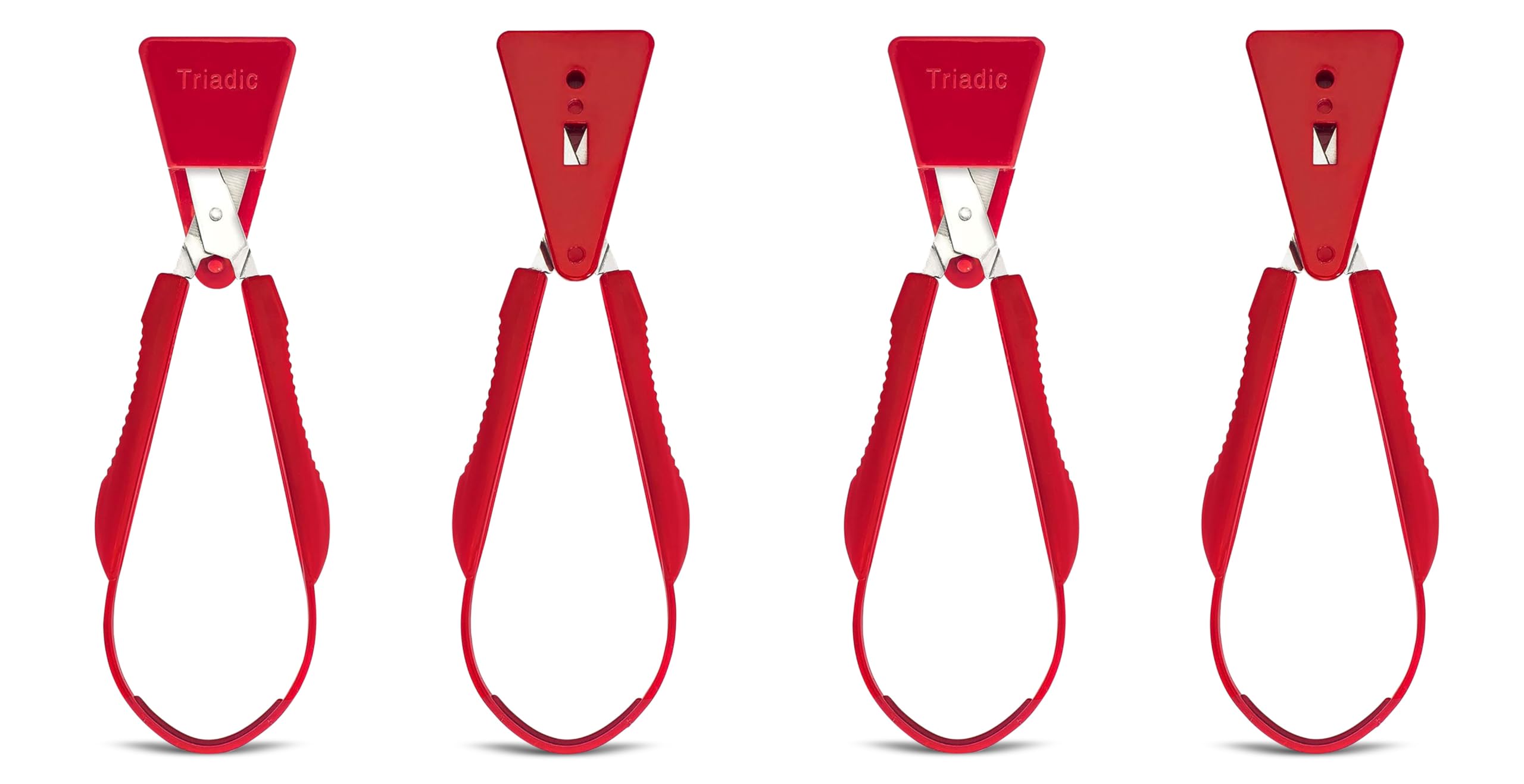
Triadic Loop 4-Pack

Triadic Loop 4-Pack

Classroom sets

Customer rating 4.6/5
Check Price

Worth Noting

  • Children with weaker hands may need extra effort to close the shielded handles.
Pack Size
4 pairs
Blade Material
—
Assist Mechanism
Loop, spring
Hand Orientation
Ambidextrous
Read the full review

The hard safety shield is this 4-pack's reason to exist: a rigid guard sits between fingertips and blade, so a single adult can supervise several children without hovering over each pair. Loop handles and spring reopening keep the cutting motion beginner-friendly while the shield handles the watching.

Classroom craft tables and special-needs programs get four shielded pairs at a mid-range price. The guarded handles ask for a firmer squeeze than plain loops, and an occasional pair arrives with a duller edge — boundaries to weigh if a child needs very light handles.

Swap a dull pair out of rotation — edge life varies across the set, so a quick check before each session keeps craft time moving.

Bottom line: For a supervised craft table or special-needs group, the 4-pack pairs a hard shield with classroom-scale quantity.

#6

Telooco Loop 3-Pack

Telooco Loop 3-Pack

Left-handed kids

Customer rating 4.5/5
Check Price

Worth Noting

  • Blade sharpness varies between units
Pack Size
3 pairs
Blade Material
Stainless steel
Assist Mechanism
Self-open spring
Hand Orientation
Left-handed
Read the full review

Self-opening loop handles that reopen after each cut and fit the left hand — a pairing the universal 6-pack doesn't offer. The stainless steel blades handle paper and card cleanly for toddler and special-needs learners, and the easy squeeze action suits small hands as they build cutting coordination.

Best for left-handed kids and special-education settings where budget matters, the 3-pack spreads multiple pairs across a craft table for less than a single premium pair. It won't suit right-handed children, and blade sharpness varies between units — some pairs cut less cleanly than others, so test the edge before handing them over.

Test each pair's edge on scrap paper before handing them to kids — sharpness varies by unit.

Bottom line: For left-handed learners on a budget, this 3-pack is the pick — self-opening loops deliver enough pairs for a craft table at a fraction of premium single-pair pricing.

#7

Triadic Loop 2-Pack

Triadic Loop 2-Pack

Small groups

Customer rating 4.6/5
Check Price

Worth Noting

  • For children with very low hand strength, squeezing the shielded handles shut can feel heavy
Pack Size
2 pairs
Blade Material
—
Assist Mechanism
Loop, spring
Hand Orientation
Ambidextrous
Read the full review

The 2-pack carries the same safety shield, loop handles, and spring reopening as the classroom 4-pack, sized for one or two children. Its cuts come out clean for young beginners. Per pair it costs more than the 4-pack, so full classrooms get better value from the larger set — this pair suits small-group home use instead.

Bottom line: Grab this 2-pack for one or two children who need finger protection at home; choose the 4-pack when outfitting a whole classroom.

How to Choose

Assistive Mechanism

Loop handles keep the hand in one opening and spread force across the palm, suiting children with low muscle tone. Spring levers reopen blades automatically after each cut, so a child only squeezes closed — for kids who can grip but struggle to reopen.

The spring is the weakest part. On budget pairs, the lever snaps within weeks. Look for a mechanism that survives weekly use and keep a spare pair on hand.

Hand Orientation

Right-handed blades meet the paper at the angle a right hand needs. A left-handed child using them twists the wrist and tilts the page to see the cut line. Ambidextrous loop handles sidestep the issue.

For classrooms with mixed hand use, pick ambidextrous pairs so no child fights an awkward grip. Dedicated left-handed models narrow the audience — fine at home, wasteful for a shared bin.

Blade Material and Edge

Stainless steel holds an edge and cuts paper and thin cardboard cleanly, which builds confidence. Plastic blades often cannot bite into paper, so a child practices the motion without ever producing a cut — a loop that teaches nothing.

The trade-off is supervision. Steel blades that cut well are sharp enough to need adult oversight, especially for the youngest users. Rounded tips lower the risk but adult attention stays essential.

Pack Size

A single pair lets a parent confirm grip and cutting ability before committing. Multi-packs cut the cost per pair and guarantee a backup when one spring gives way, which is why classrooms buy in bulk.

Match quantity to setting. A 6-pack suits a small special-needs group; a 4-pack with shields covers a craft table. Oversized packs for one child mean unused units.

Safety Shields

A blade guard keeps fingers back from the cutting edge during group craft time when an adult cannot watch every hand. The shield adds thickness and weight, and some children find it harder to squeeze shut.

Weigh supervision against hand strength. A child with weak hands may struggle with a shield's extra resistance. For one-on-one sessions, unshielded blunt-tip steel suits a stronger young cutter.

Frequently Asked Questions