Math Learning Product Guide

11 Best Abacus for Kids in 2026: 100-Bead Frames That Last

Which 100-bead abacus frames hold up to daily counting for preschool and early elementary math, and which add-on kits actually help.

11 Best Abacus for Kids in 2026: 100-Bead Frames That Last editorial illustration

Nearly every kids' abacus listing promises rock-solid wood construction. That claim is where the category's biggest quality gap sits — budget frames separate at the joints within days or wobble on a desk, while better-built versions survive years of counting. The difference usually comes down to metal rods and a solid wood base, not marketing copy.

The other common surprise is size. Many 100-bead frames measure just 9 to 11 inches tall, far smaller than product photos suggest. That footprint works fine on a small desk or in a lap, but knowing the real dimensions before you buy prevents a frequent disappointment.

The upgrade worth weighing is the card slot — a holder that keeps a written equation above the beads so a child sees the problem while sliding counters. Kits that bundle this with practice cards turn a toy into a structured daily routine, which is what makes guided math practice stick.

#1

Melissa & Doug Classic 100-Bead
Melissa & Doug Classic 100-Bead

Preschool counting

Customer rating 4.8/5
Check Price

Worth Noting

  • After years of heavy daily use, some units loosen at the joints
Age Range
3+ years
Card Slot
No
Bead Count
100 (10x10)
Accessories
None included
Read the full review

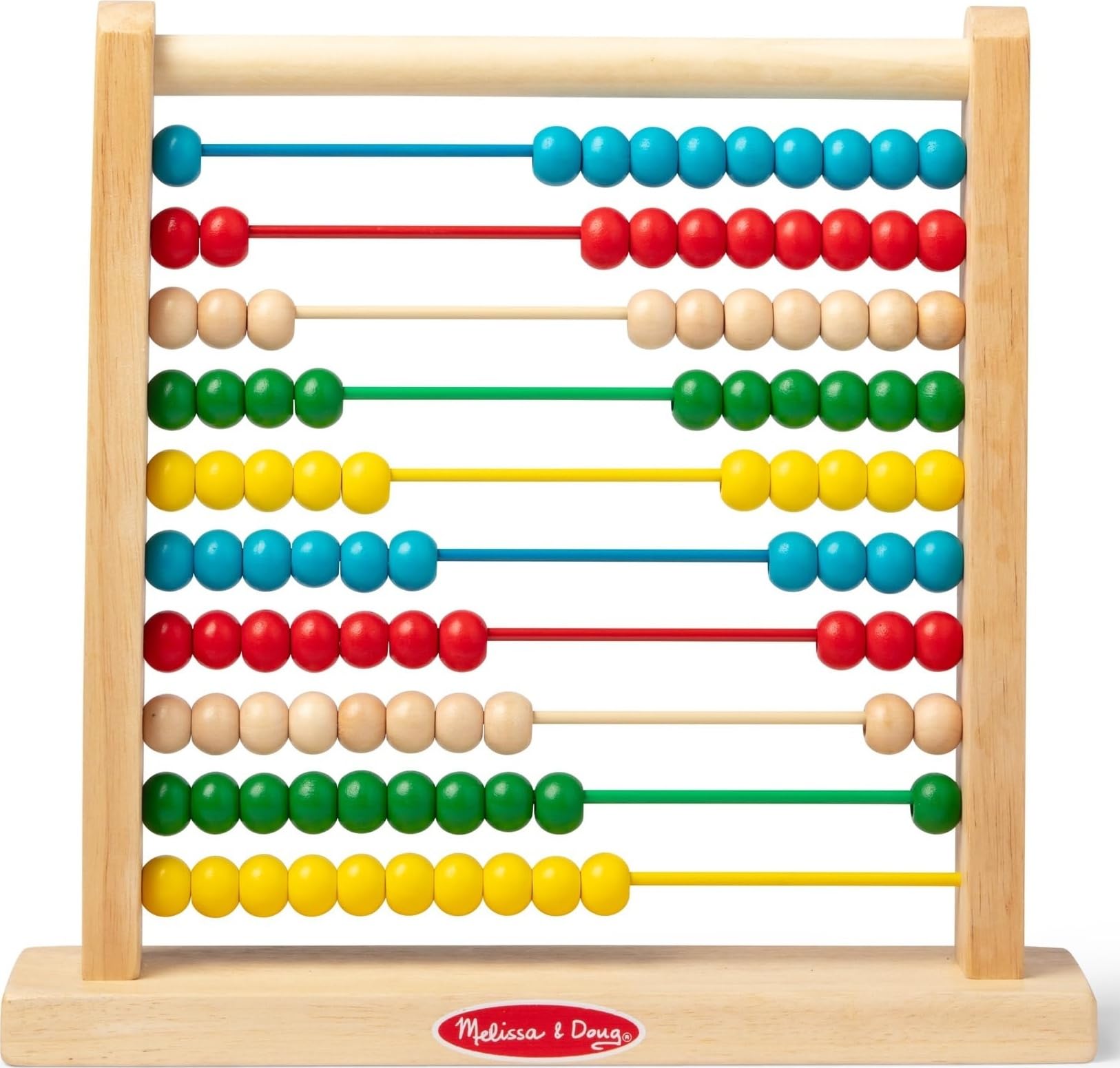
Our top pick rests on an unglamorous detail: the frame is screwed together rather than glued, which is why it survives years of daily play where cheaper wooden frames come apart within weeks. The 10-by-10 grid of one hundred beads teaches counting to 100, basic addition and subtraction, and color recognition in a single object. Children genuinely enjoy sliding the smooth wooden beads, so it doubles as quiet sensory play while they learn. Homeschool families and classroom teachers return to this design because it takes real use without wobble or flexing, and at a mid-range price it undercuts most competitors.

The ten rows are color-coded, so a child counting to ten sees each row as a distinct block before moving to the next — a small feature that makes place value visible. Before formal counting begins, the same colors support sorting and matching games. Families describe it as the toy children pull out unprompted for homework and free play alike, the honest test of whether a teaching tool actually gets used. At under a kilogram it's light enough for small hands to carry from table to rug, and rounded corners keep it comfortable for young fingers.

This frame suits the preschool counting stage — roughly ages 3 to 5 — and it's the go-to screen-free manipulative for homeschool families, classroom math centers, and anyone buying a safe first abacus as a gift. It is a pure counting frame: no practice cards, counting sticks, or add/subtract boards, so parents who want guided equation practice will supply their own materials alongside it. For that buyer, the simplicity is a strength; the frame does one job completely.

Bottom line: Sets the reference standard for a 100-bead classroom frame — buy it once for a preschooler who needs a screen-free counting tool that actually gets used.

#2

Cltoyvers Abacus + Sticks

Cltoyvers Abacus + Sticks

Structured practice

Customer rating 4.7/5
Check Price

Worth Noting

  • Compact footprint reads smaller than photos suggest
  • Frame can wobble on uneven surfaces in some units, so a level desk matters
Age Range
3-6 years
Card Slot
Yes, top slot
Bead Count
100 (10x10)
Accessories
110 cards, sticks
Read the full review

The Cltoyvers clips 110 equation cards into a slot above a classic 100-bead frame, pairing each written problem with an active count. Where the top pick is a pure counting frame, this set adds 100 counting sticks and card prompts that turn daily practice into repeatable, structured lessons. Beads slide along metal rods and hold their position well during counting.

This suits homeschool families running steady daily math practice and first- and second-grade kids who benefit from seeing the problem while they slide beads. Because the frame can wobble on uneven surfaces, it belongs on a flat desk rather than in a lap — a minor adjustment for the guided practice it enables.

Bottom line: For families who want card-guided lessons without buying extras, this set delivers the most complete practice kit in the mid-range at a fair price.

#3

Ranqibo 217-Piece Set

Ranqibo 217-Piece Set

Full math kit

Customer rating 4.7/5
Check Price

Worth Noting

  • The full 217-piece kit takes a drawer or shelf slot between sessions, so storage space is worth planning around.
  • Laying out the cards and sticks before each lesson makes this a planned session, not a quick pick-up frame.
Age Range
3+ years
Card Slot
No
Bead Count
100 (10 rows)
Accessories
217 pieces total
Read the full review

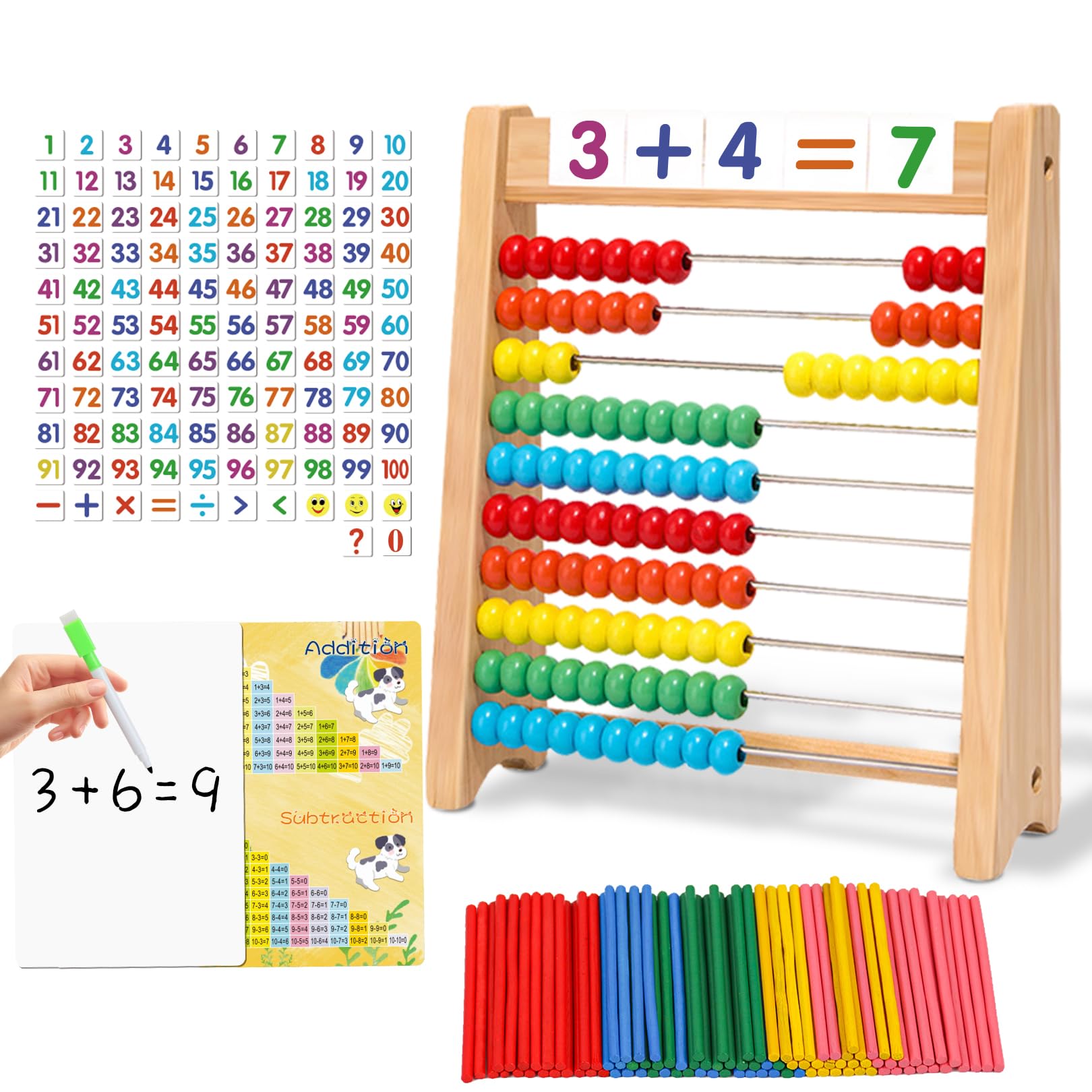
Ranqibo packs the classic 100-bead wooden frame with 100 number cards, 100 counting sticks, seven math symbols, and two operation tables, so a full lesson comes in one mid-range box. The frame rides on metal rods, and the beads slide smoothly at a size that suits small fingers, keeping the counting experience as tactile as the bare top-pick frame.

Children reach for the full set during free time rather than waiting to be asked, and swapping a card turns the same beads into a fresh lesson each session.

Best for homeschool families and 2nd-3rd graders pairing written equations with hands-on counting. Because the kit leans on loose cards and sticks, a parent manages the pieces during a session to keep them from scattering — light for guided practice, a real burden when kids work alone.

Bottom line: The fullest counting kit here — cards, sticks, and symbols around a smooth 100-bead frame — suited to a parent who runs the session rather than a child working alone.

#4

Flzoaveus Abacus + Clock

Flzoaveus Abacus + Clock

Math and time

Customer rating 4.7/5
Check Price

Worth Noting

  • The 8.3 x 9.5-inch footprint reads smaller in person than photos suggest, surprising buyers expecting a large frame.
Age Range
3-8 years
Card Slot
—
Bead Count
100 (10 rows)
Accessories
110 cards, clock, sticks
Read the full review

The included wooden teaching clock sets this apart from the plain 100-bead frames in this set, so one purchase covers both math and time-telling for a mid-range price. The 110 math cards and 100 counting sticks ride along as well, putting guided daily practice at hand without extra shopping trips.

This suits homeschool families easing a 3-6 year old from counting into telling time, a transition where the clock earns its place beside the bead rows for addition and subtraction practice. The compact 8.3 x 9.5-inch footprint fits a tabletop learning station for one or two learners rather than a desk-dominating classroom display.

Bottom line: Right for homeschool families who want counting and time-telling in one set; skip it if a teaching clock already sits on the shelf.

#5

Ranqibo Double-Sided Board

Ranqibo Double-Sided Board

Written practice

Customer rating 4.7/5
Check Price

Worth Noting

  • The magnetic numbers and fruit stickers are small extras that can scatter during play, leaving a parent to keep them sorted.
  • Carries a price premium over a plain 100-bead frame; the extra cost only pays off when the board gets used.
Age Range
3-7 years
Card Slot
No
Bead Count
100 (10x10)
Accessories
Magnetic board, numbers
Read the full review

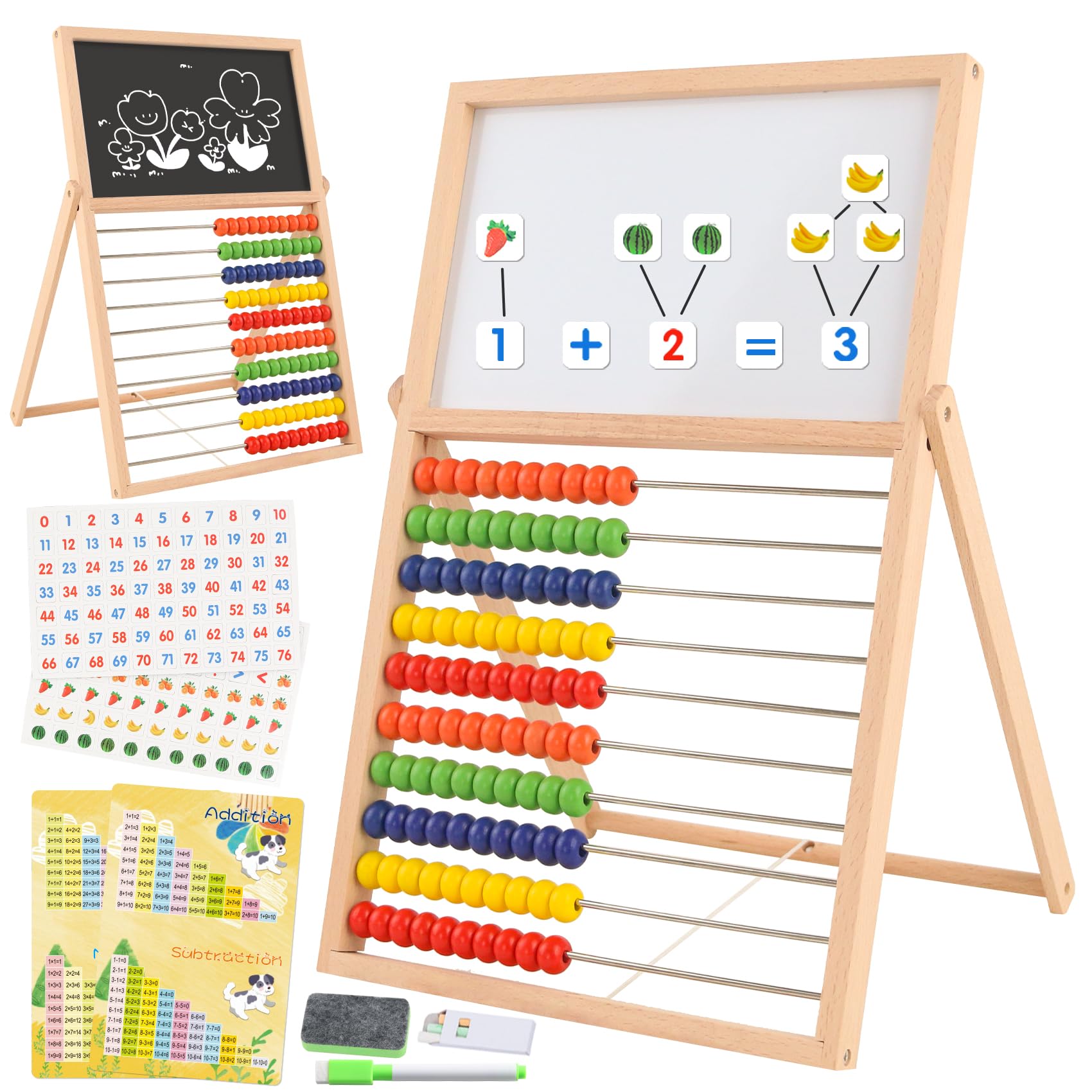
The double-sided magnetic blackboard/whiteboard is the differentiator — a child writes the equation above the frame, then slides the 100 beads to check the answer. That written step pairs with the physical counting motion, matching how preschool-to-first-grade kids learn a problem before solving it. The wooden frame rides on metal rods and stays stable while small hands work the beads, and toddlers return to it during counting time.

The setup suits families who want one tool covering counting, early math, and drawing from preschool through first grade — the magnetic numbers and 40 fruit stickers extend the set beyond the beads. For a child who learns by writing beside the problem, this earns its keep over a plain counting frame. Families who only want a bare 100-bead tool will find the magnetic board an addition they never asked for.

Bottom line: For a child who writes or draws while counting, the double-sided board makes this a genuine two-in-one. A family that only needs a bare 100-bead counter is better off with a plain frame.

#6

Flzoaveus 100-Bead + Cards

Flzoaveus 100-Bead + Cards

Budget counting

Customer rating 4.7/5
Check Price

Worth Noting

  • Compact 8.3 x 9.5-inch footprint runs smaller than photos suggest
  • Pushed hard on a soft surface, the frame can tip backward
Age Range
3-7 years
Card Slot
Yes
Bead Count
100 (10x10)
Accessories
110 math cards
Read the full review

Flzoaveus offers a verified sturdy 100-bead counting frame with a card slot and 110 math cards at a budget price — the leanest value purchase in this set for Montessori-style learners aged 3-6. The wooden frame and steel wires hold up to daily counting practice, and the number cards give structure a bare frame lacks. The compact 8.3 x 9.5-inch footprint runs smaller than photos suggest, and the base has an occasional balance quirk: on a soft surface, hard bead pushing can tip it backward. On a flat tabletop that matters little, which is where it best serves budget-conscious families.

Bottom line: Best on a flat tabletop for budget-conscious Montessori families — the compact footprint and tipping sway matter far less than the price.

#7

B. toys Two-Ty Fruity

B. toys Two-Ty Fruity

Toddler counting

Customer rating 4.6/5
Check Price

Worth Noting

  • Premium price buys theme charm rather than the math cards and boards on comparable guided sets.
  • School-age students who need structured arithmetic practice will outgrow its free-play focus.
Age Range
18 months +
Card Slot
No
Bead Count
100 (fruit-shaped)
Accessories
None
Read the full review

Ten rows of fruit-shaped beads — apples, pears, and bananas — give this frame a playful pull that toddlers reach for during free play. It holds up to the grab-and-shuffle motions of small hands and covers number, color, and fruit recognition pleasantly. The premium price buys that theme charm more than structured math practice, so school-age students working on arithmetic will outgrow it quickly.

Bottom line: Best as a gift for toddlers 18 months to 3 who respond to playful designs; parents wanting guided math drills should consider the card-slot frames instead.

#8

hand2mind 20-Bead Rekenrek 4-Pack

hand2mind 20-Bead Rekenrek 4-Pack

Classroom number sense

Customer rating 4.7/5
Check Price

Worth Noting

  • Units occasionally arrive short a bead
  • Under heavy handheld play the frame joints can separate, so tabletop use suits it best.
Age Range
5-10 years
Card Slot
No
Bead Count
20 (2x10)
Accessories
Set of 4
Read the full review

Four mini 2-row rekenreks that teachers reach for in subitizing and number-bond drills — each row holds five red and five white beads, so kids absorb the five-and-ten structure rather than counting every bead. It is a genuinely different tool from the classic 100-bead frame: effective for early number sense, but it won't replace counting-to-100 practice and sits outside that intent. Frames are compact and backpack-ready; under heavy classroom use the joints can separate, so a flat surface and a quick arrival count keep the set working.

Count each bead when the set arrives and keep the rekenreks on a flat surface during drills.

Bottom line: Best for teachers running small-group number-sense centers and tutoring sessions; families wanting a single 100-bead counting frame are better served by the classic wooden option.

#9

Melissa & Doug Add & Subtract

Melissa & Doug Add & Subtract

Toddler add-subtract

Customer rating 4.8/5
Check Price

Worth Noting

  • The interchangeable boards can slide out mid-use, adding friction during guided play
Age Range
2-6 years
Card Slot
No
Bead Count
55 beads
Accessories
2 double-sided boards
Read the full review

The double-sided boards turn a toddler's first math step into a guided game: slide 55 beads to show a simple addition or subtraction, while the ROYGBIV color-coding pairs color names with quantities. The wood frame and chip-resistant paint absorb daily toddler handling. The tradeoff is structural — the 55-bead format sits outside the 100-bead counting-frame intent, the interchangeable boards can slide out mid-play, and the premium price buys guided activities rather than a broader curriculum.

Bottom line: Fits a toddler (2-4) whose first math step is guided, board-led addition — skip it if you need a full 100-bead counting frame.

#10

Vanplay Pastel Abacus Set

Vanplay Pastel Abacus Set

Pastel design

Customer rating 4.5/5
Check Price

Worth Noting

  • Parent setup guidance is thin
Age Range
3-6 years
Card Slot
No
Bead Count
100 (10 rows)
Accessories
112 cards, sticks, box
Read the full review

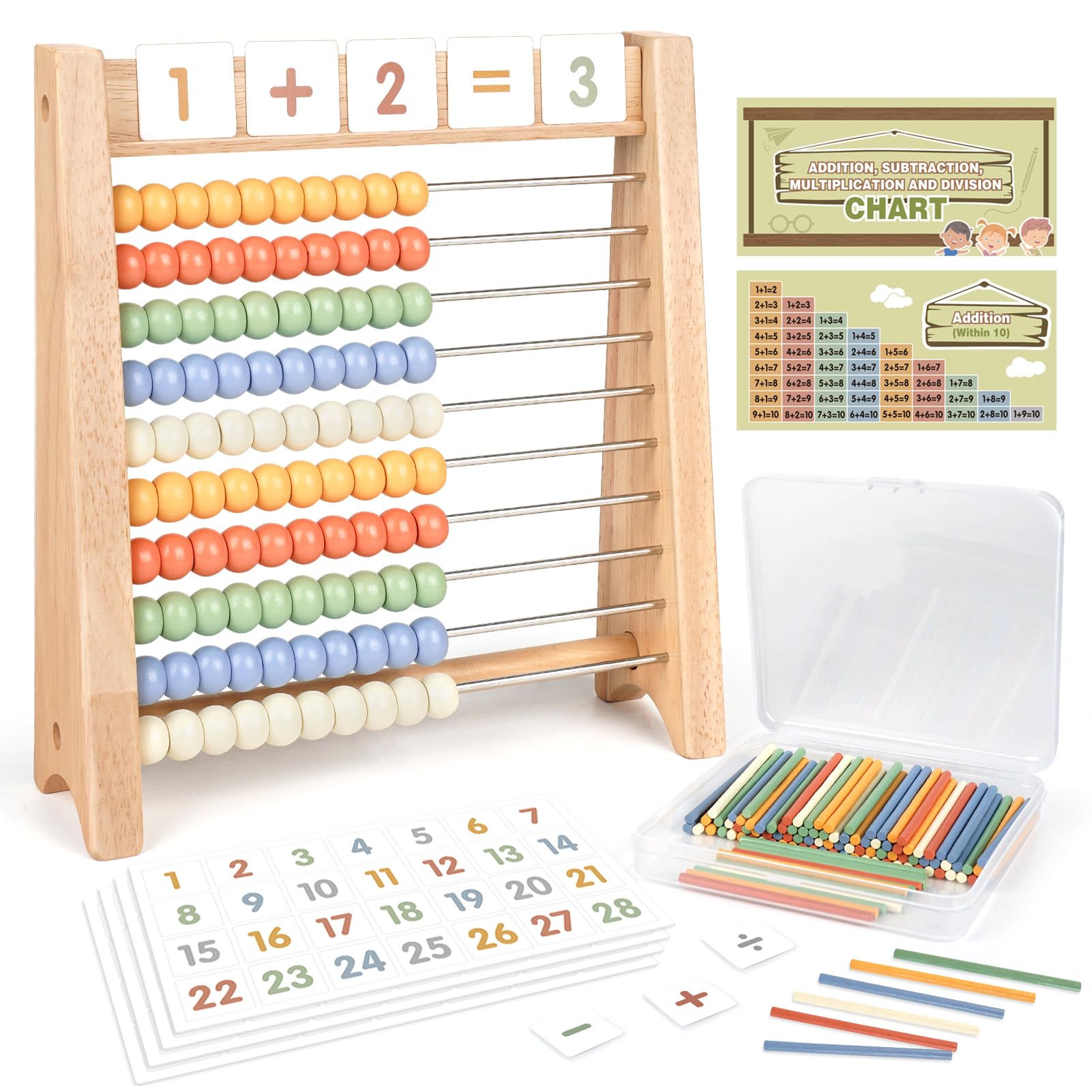
A smooth 100-bead frame with 112 math cards, 100 counting sticks, and a storage box make this a complete homeschool kit in a calm, modern palette that kids gravitate to. Solid wood and non-toxic paint hold up to daily preschool use, and the neutral colors blend into a tidy learning corner. The verified owner-feedback base is thinner than on the top-tier counting frames, so long-term durability has less independent confirmation.

Bottom line: This pastel kit fits the family building a calm, modern homeschool corner from a single tidy set — not a loud, brightly colored playroom centerpiece.

#11

WOODMAM Abacus + Sticks

WOODMAM Abacus + Sticks

On-paper kit

Customer rating 4.5/5
Check Price

Worth Noting

  • Durability is promised by the spec sheet rather than demonstrated through extended use
Age Range
3-10 years
Card Slot
No
Bead Count
100 (spec sheet)
Accessories
100 sticks, 80 cards
Read the full review

The WOODMAM spec sheet is the draw: a solid-wood 100-bead frame on metal rods, 100 counting sticks, 80 number/alphabet/symbol cards, and a math operations table — a complete kit for ages 3-10 at a mid-range price. Durability is stated rather than confirmed by extended use, so longevity is a fair assumption rather than a settled fact. Buyers comfortable evaluating a feature-dense kit on paper will find strong value; those needing long-term build confirmation should lean toward the verified counting frames in this set.

Bottom line: Fits families who compare kits by full spec bundles and can accept an unconfirmed durability record — inspect the frame's joints on arrival before daily use.

How to Choose

Bead Count and Row Structure

Choose a 10-row, 100-bead frame for ages 3-6. The ten-bead rows act as visual decades, so a child sees that one full row equals ten and two full rows equal twenty — the foundation of place value.

Frames with 55 or 20 beads serve earlier or narrower purposes. A 55-bead set suits toddlers making first number-to-quantity connections, while a 20-bead rekenrek drills subitizing and number bonds. Neither can display two-digit regrouping, so neither doubles as a full counting-and-arithmetic tool.

Frame and Rod Materials

The beads slide along rods, and how those rods anchor to the frame decides the product's life. Metal rods set into a solid wood frame hold up to years of hard pushing; plastic connectors or friction-fit dowels loosen as the sliding motion works the joints.

That loose-joint failure is why the frame separates on budget units within days, not months. For any child under six who pushes beads fast, a metal-rod frame on a stable base is the safer buy.

Included Accessories

A bare frame is self-directed — a child slides beads until interest fades. Bundled cards, counting sticks, and math tables add structure: a card shows '2 + 3' as a written prompt, and the sticks let a child compare quantities beyond the frame's beads.

The trade-off is piece management. Kits with 100+ small accessories keep lessons guided but demand adult oversight to avoid scattering and loss.

The Card Slot Upgrade

The card slot is the most useful modern upgrade. It holds a pre-printed equation above the beads, so the written problem stays in view while the child slides counters — dropping the working-memory load of holding the numbers in their head.

The catch is that cards and slots add moving parts. On lower-priced sets the cards can sit loosely or slide out too easily, so check that the slot grips the card before you commit.

Match the Age Range

Matching bead size to hand size matters more than parents expect. An 18-month-old needs large, fruit-shaped beads that are easy to grip and hard to choke on; a 5-year-old needs a standard count frame where beads slide smoothly.

School-age children doing equation work benefit most from frames with card slots and sticks. A toddler on a full arithmetic kit will scatter the small pieces, while a 2nd grader on a bare toddler frame will run out of challenge.

Frequently Asked Questions